
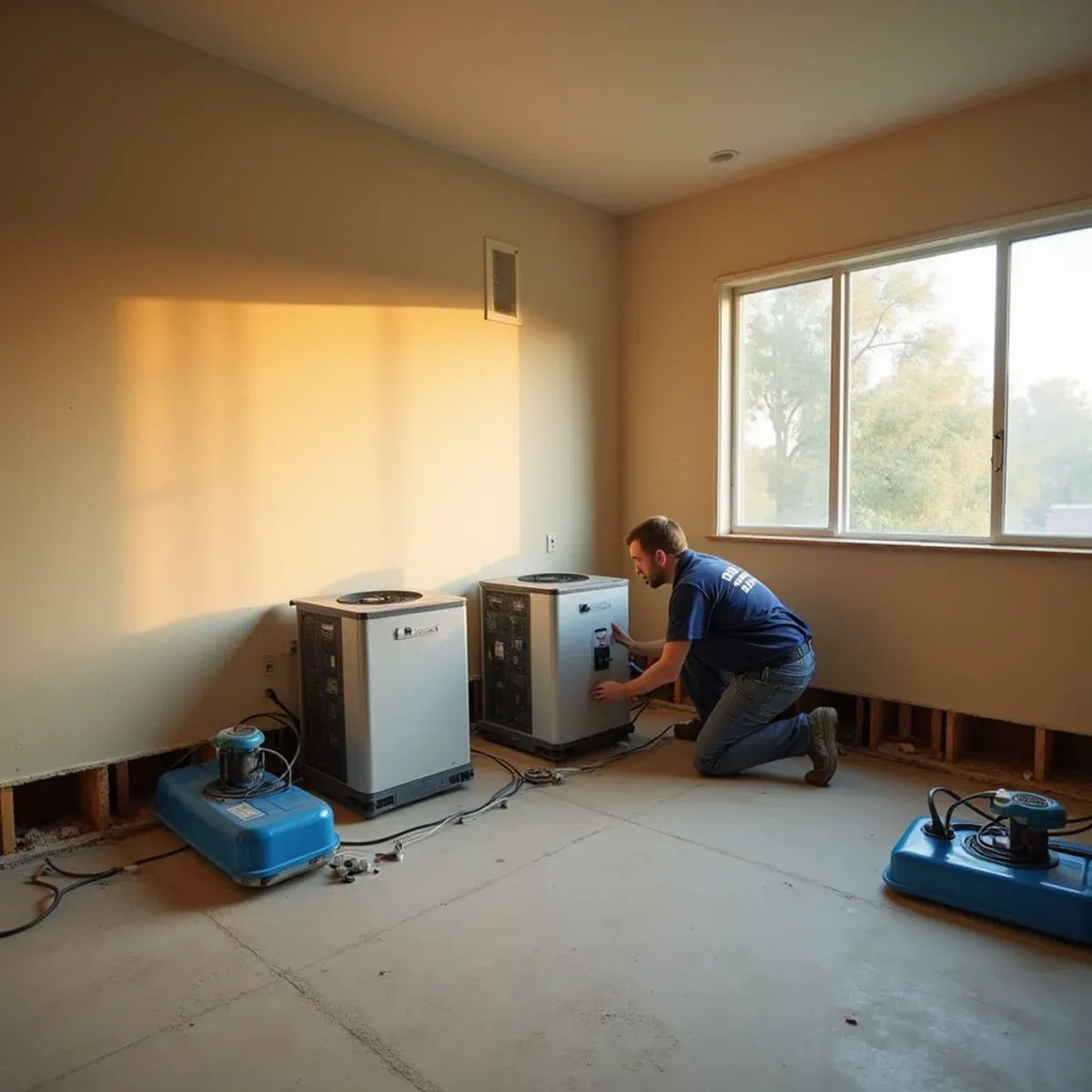
Most of what we dry in Santa Fe Springs has no bedrooms in it. The city's warehouse, manufacturing and distribution base dwarfs its housing, so the typical call comes from a facility manager on Telegraph or Norwalk at four in the morning after a sprinkler head emptied across a distribution floor. The question is never really about drying. It's whether shipping goes out at eight. The problem gets measured here in cubic feet of open volume and pallets of racked product, not in rooms.
You can't seal a hundred-thousand-square-foot building the way you seal a bedroom, so we zone it. Poly containment around the affected bays, ducted desiccant dehumidification sized to the volume, and airflow directed under racking rather than at it. The drying log matters more here than anywhere else we work, because a carrier, a landlord and a tenant will all read the same file. The residential pockets around Los Nietos are ordinary house work, but the equipment yard we pull from is built for the industrial side of town.
What Santa Fe Springs Changes About Structural Drying
1Zoning a warehouse instead of sealing it
You can't seal a hundred-thousand-square-foot building the way you seal a bedroom. We contain the affected bays with poly, bring the chamber down to a volume equipment can actually control, and keep the aisles and dock doors your operation genuinely needs in service. The rest of the building keeps working while a defined zone dries under monitoring.
2Desiccant capacity for open-plan volume
Refrigerant dehumidification runs out of room fast in a high-bay space. Ducted desiccant units handle the volume, pull grain depth low enough to move water out of a thick slab and sheathing, and keep airflow moving under racking rather than blasting product. Sizing that correctly on day one is the difference between a five-day job and a three-week one.
3Access and shutoffs before the after-hours call
Most of our commercial losses here start between midnight and six. When we already hold current gate codes, alarm contacts, sprinkler riser locations and main shutoff information, crews begin extracting instead of waiting on a phone tree. Facilities along the Norwalk and Telegraph corridors can send that to us before anything ever happens, and it costs nothing.
How the Work Runs
The method is the same one we use on every structural drying job, documented to the IICRC S500:2025 standard. Here it is in short — the full structural drying & dehumidification process explains each stage in detail.
- Establish the dry standard
- Calculate the load and build the chamber
- Place air movers for surface evaporation
- Run LGR dehumidification to capture the moisture
- Monitor and adjust daily
- Verify, document, and demobilize
The Santa Fe Springs Background Worth Knowing
The water sitting in a wet-pipe sprinkler system has been there for years. It is stagnant, it has been in contact with black steel and scale that whole time, and some systems carry corrosion inhibitors or antifreeze as well. When a head discharges, that is what lands on your floor and soaks into your product. Under IICRC S500:2025 water gets categorized on the evidence in front of us, and sprinkler discharge that has run across a warehouse floor almost never stays in Category 1. That decision drives what we dry in place, what comes out, and how the crew works.
There is more on the housing stock, drainage and plumbing history of this city on our water damage restoration in Santa Fe Springs page.
Santa Fe Springs at a glance
- Dominant construction era
- 1950–1975
- Foundation type
- slab on grade
- Supply piping found here
- galvanized steel, copper, commercial-grade systems
- Drain line materials
- cast iron, commercial waste lines
- Terrain and water table
- flat, moderate water table
- Most common local failure
- fire-sprinkler discharge and commercial supply failures across large open-plan warehouse and manufacturing floors
- Highest-value local prevention
- keeping current building access and shutoff information on file before an after-hours failure
What It Costs in Santa Fe Springs
We do not quote a number over the phone before seeing the property — anyone who does is guessing. The variables that actually move the price on a structural drying job are size of the drying chamber, class of water intrusion, material types involved, and they are broken down in full on the structural drying & dehumidification page. The assessment and the written estimate are free anywhere in Santa Fe Springs, day or night, with no obligation.
Structural Drying Questions from Santa Fe Springs Homeowners
Usually some of it, and that's exactly the point of zoning rather than sealing the whole building. We contain the wet bays, keep the dock doors and aisles you actually need in service, and schedule the loud work around your shifts where we can. What we won't do is leave equipment out of a zone that still reads wet in order to keep a lane open. We'll show you the daily log and let you decide with real numbers.
Three to five days covers most residential losses. Saturated hardwood, plaster, or a concrete slab can run seven or more. We will give you an estimated window after the first readings and update you daily — and equipment comes out when the numbers say so, not on a fixed schedule.
We would rather you did not. Drying is a continuous process, and every hour off extends the total run — which usually costs more than the sleep is worth. If noise is genuinely unmanageable we can often reconfigure the chamber or reposition units to reduce it. Talk to us instead of unplugging them.
No. Water that has sat in a wet-pipe system for years picks up scale, rust and whatever inhibitors are in the system, and once it runs across a warehouse floor it collects everything on that floor too. We categorize on the evidence per IICRC S500:2025, and sprinkler discharge almost always lands past Category 1. That affects what gets dried in place, what gets removed, and what protective equipment the crew works in.