
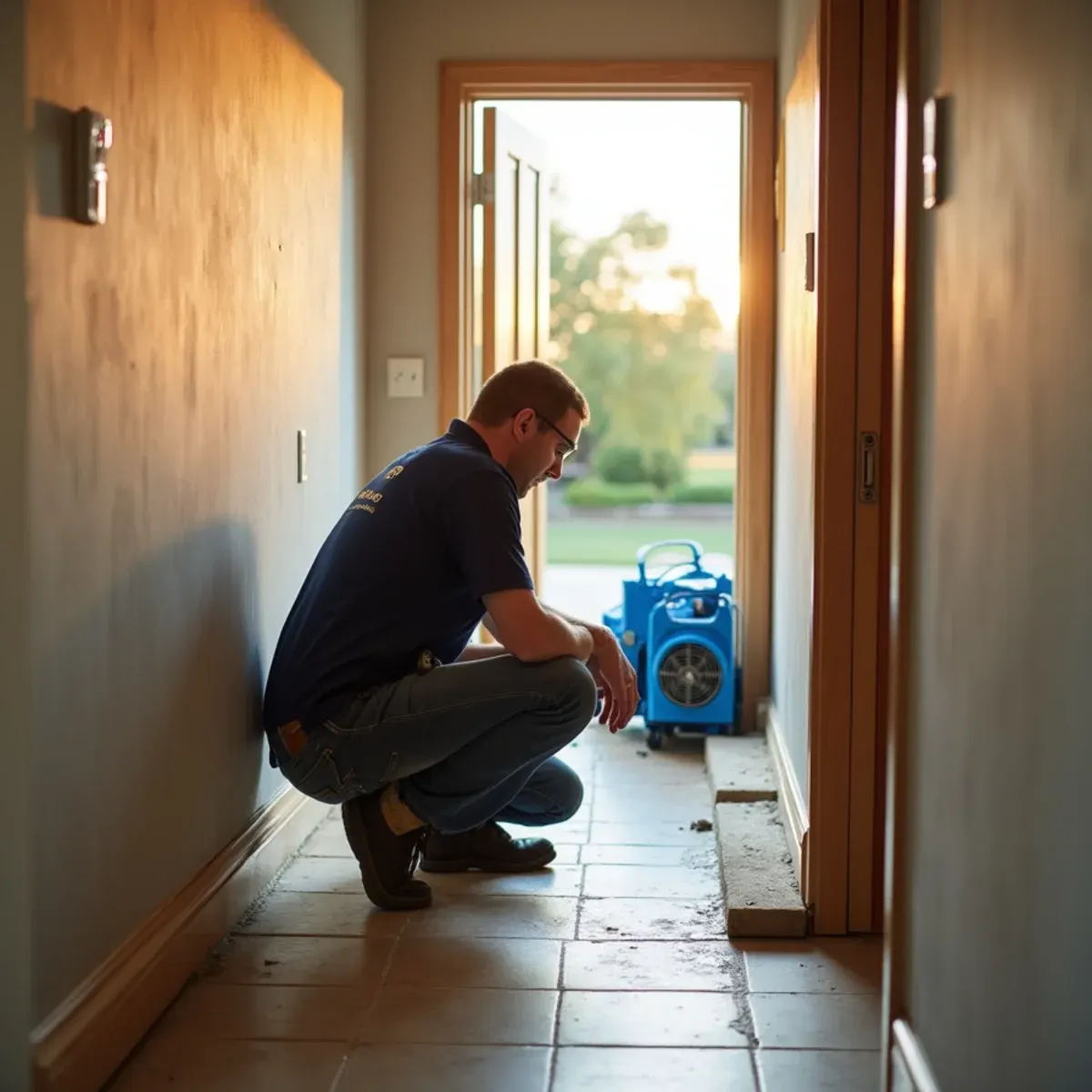
The call usually comes in after hours from a facility manager, not a homeowner. Santa Fe Springs is warehouse, manufacturing and distribution first and residential a distant second, so burst-pipe work here means riser lines inside tilt-up walls, supply drops feeding mezzanine restrooms and break rooms, and fire sprinkler branch lines letting go over stored product. The building is typically empty when it happens. By the time someone notices, water has run for hours across a slab with almost no slope and worked its way under racking and pallet positions.
Cavity drying inside a tilt-up is a different problem from a residential stud bay. Furred-out interior walls, metal studs, insulation blankets, and often a fire-rated assembly we cannot open casually or leave open overnight. We work around racking and forklift traffic and around your production schedule, document under IICRC S500:2025 for your carrier, and bill insurance directly. We're about seventeen minutes north of our Cypress base off the Telegraph and Norwalk corridors, and we'd rather have your shutoff and access information on file before the night you need it.
What Santa Fe Springs Changes About Burst Pipe Damage
1Fire sprinkler lines are supply lines too
A charged wet-pipe system carries the same pressurized water as your domestic supply, and a failed head or a mechanically damaged branch line discharges far more of it, far faster. Forklift contact is the usual culprit. We coordinate with your sprinkler contractor from the first call so the system is isolated properly and restored to service, because an out-of-service system becomes its own problem with your insurer.
2Tilt-up walls dry differently than studs
Concrete panels hold moisture and release it slowly, and the furred-out interior finish traps it against the panel face. We dry the furred cavity separately from the panel itself, monitor both, and set expectations honestly. A tilt-up perimeter takes longer to reach standard than a wood-framed wall does, and pretending otherwise just means somebody closes the wall too early.
3Business interruption drives the schedule
Downtime usually costs more than the water damage. We sequence by zone so operations keep running where they can, extract at the lowest pallet positions first because that's where product loss compounds fastest, and stage equipment clear of forklift aisles. Documentation gets built for both the property claim and the business-interruption side, with hourly detail from the initial response forward.
How the Work Runs
The method is the same one we use on every burst pipe damage job, documented to the IICRC S500:2025 standard. Here it is in short — the full burst pipe water damage repair process explains each stage in detail.
- Stop the source
- Locate the failure precisely
- Coordinate the plumbing repair
- Extract and open only what must be opened
- Cavity and structural drying
- Rebuild and finish
The Santa Fe Springs Background Worth Knowing
The water sitting in a wet-pipe sprinkler system has been there for years. It is stagnant, it has been in contact with black steel and scale that whole time, and some systems carry corrosion inhibitors or antifreeze as well. When a head discharges, that is what lands on your floor and soaks into your product. Under IICRC S500:2025 water gets categorized on the evidence in front of us, and sprinkler discharge that has run across a warehouse floor almost never stays in Category 1. That decision drives what we dry in place, what comes out, and how the crew works.
There is more on the housing stock, drainage and plumbing history of this city on our water damage restoration in Santa Fe Springs page.
Santa Fe Springs at a glance
- Dominant construction era
- 1950–1975
- Foundation type
- slab on grade
- Supply piping found here
- galvanized steel, copper, commercial-grade systems
- Drain line materials
- cast iron, commercial waste lines
- Terrain and water table
- flat, moderate water table
- Most common local failure
- fire-sprinkler discharge and commercial supply failures across large open-plan warehouse and manufacturing floors
- Highest-value local prevention
- keeping current building access and shutoff information on file before an after-hours failure
What It Costs in Santa Fe Springs
We do not quote a number over the phone before seeing the property — anyone who does is guessing. The variables that actually move the price on a burst pipe damage job are how long the line ran before discovery, which floor it happened on, hot line versus cold line, and they are broken down in full on the burst pipe water damage repair page. The assessment and the written estimate are free anywhere in Santa Fe Springs, day or night, with no obligation.
Burst Pipe Damage Questions from Santa Fe Springs Homeowners
Water off, then a power and life-safety check, then we get your sprinkler contractor on the phone while extraction starts. Product in the lowest pallet positions comes first, because that's where the loss compounds fastest. We work the floor in zones so your operation keeps moving where it can, document everything under IICRC S500:2025 for both the property and business-interruption sides, and bill the insurance directly rather than putting it on your operating account.
We restore the water damage and coordinate the plumbing repair, working with your plumber or bringing in a licensed one from our network. Handling both under one schedule is what keeps a burst pipe from turning into two weeks of contractor coordination.
More than people expect. A half-inch supply line at typical residential pressure moves in the range of 8 to 10 gallons a minute. That is roughly 500 gallons in an hour — comparable to filling a small backyard pool inside your walls and floor.
No. Water that has sat in a wet-pipe system for years picks up scale, rust and whatever inhibitors are in the system, and once it runs across a warehouse floor it collects everything on that floor too. We categorize on the evidence per IICRC S500:2025, and sprinkler discharge almost always lands past Category 1. That affects what gets dried in place, what gets removed, and what protective equipment the crew works in.