
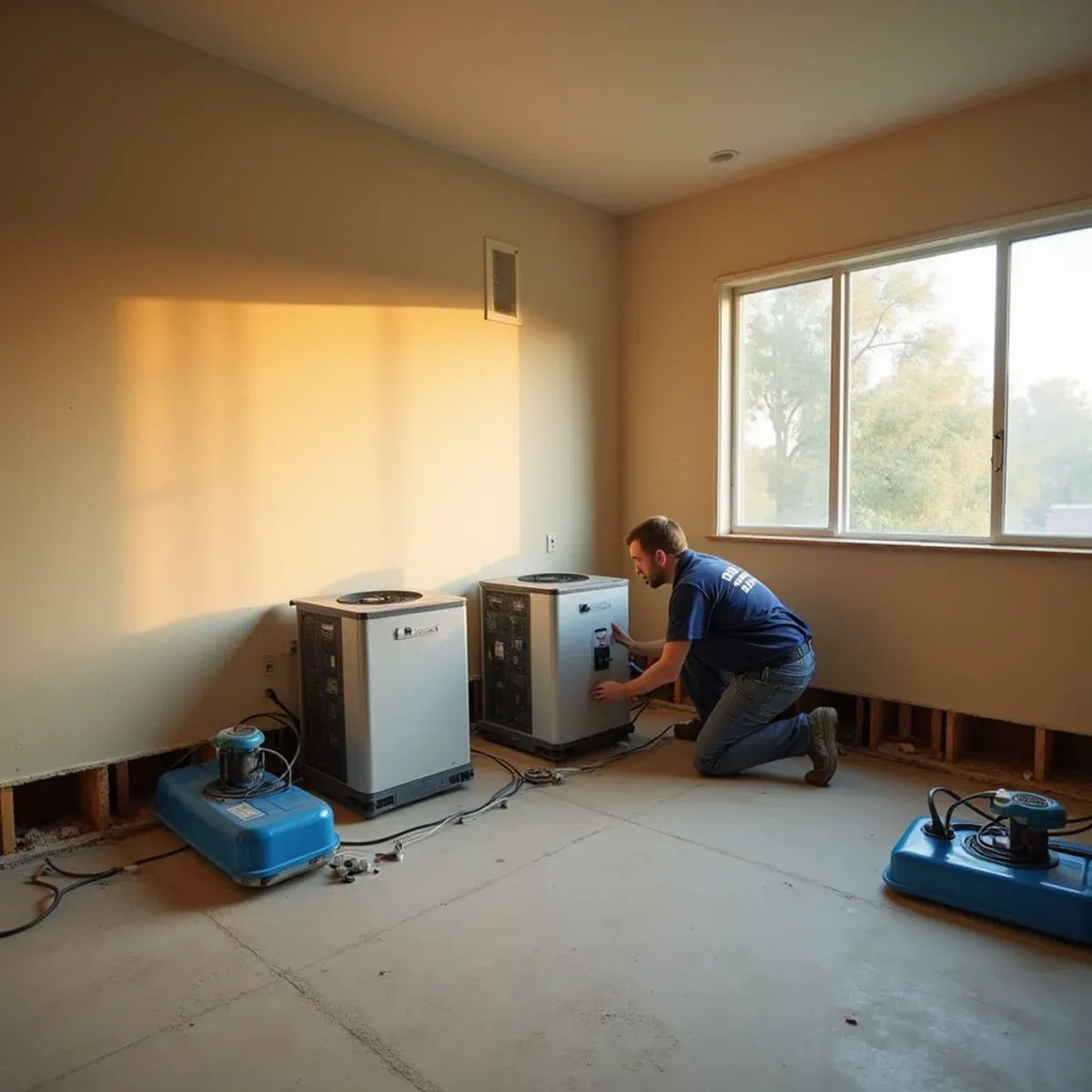
Most people call us from a hallway, standing on a patch of carpet that's warm and wet for no reason they can see. In La Habra's 1950s-to-1980s tract housing that's usually under-slab copper, and because the ground here rolls rather than lying flat, the water doesn't spread in a tidy circle. It follows the fall of the slab. That's why the wet area often turns up two rooms downhill from the failure while the floor directly above the leak reads perfectly dry on a meter.
So we map before we set equipment. Non-invasive readings across the whole floor plane, penetrating readings at the base plates, thermal to find the edge of the wet zone, then a chamber built around what's actually affected rather than the room where you first noticed it. The multi-family stock along the Whittier Boulevard corridor and the older downtown houses add a second question, which is where the water went next door. We'd rather answer that on day one than on day four.
What La Habra Changes About Structural Drying
1The wet zone follows the slab's fall
La Habra's ground rolls gently, so water under a slab doesn't spread evenly. It runs downhill inside the assembly and frequently shows two rooms away from the failure. We map the whole floor plane with non-invasive meters, confirm with penetrating readings at the base plates, and set the chamber around what is genuinely wet rather than around the room where you first felt damp carpet.
2Corridor multi-family dries as one job
Along Whittier Boulevard and around Idaho Street a lot of the housing shares walls. Water in one unit is routinely water in the next, and drying only the reported unit leaves a wet party wall that reappears as a stain. We meter the neighbors before setting equipment and, where access allows, chamber both sides at once so the assembly dries as the single unit it actually is.
3Drying doesn't fix what caused it
Decades of added patios, driveways and hardscape have quietly redirected where water runs on these lots. If your wet corner is an exterior water problem, we'll dry the structure properly and then tell you plainly that the drying didn't address the cause. Grading and drainage is separate work, and skipping it means we're both back here next winter looking at the same corner.
How the Work Runs
The method is the same one we use on every structural drying job, documented to the IICRC S500:2025 standard. Here it is in short — the full structural drying & dehumidification process explains each stage in detail.
- Establish the dry standard
- Calculate the load and build the chamber
- Place air movers for surface evaporation
- Run LGR dehumidification to capture the moisture
- Monitor and adjust daily
- Verify, document, and demobilize
The La Habra Background Worth Knowing
Copper is good pipe. What it is not is immortal, and the way it went in during this era shortened its life. Soft copper tubing was laid in the sand under the slab before the pour, sometimes in direct contact with aggregate, often with tight bends that thinned the wall on the outside of the curve. Add fifty to seventy years of water moving through the inside and soil chemistry working on the outside, and it develops pinholes. The hot line almost always goes first, because heat accelerates every part of that process.
There is more on the housing stock, drainage and plumbing history of this city on our water damage restoration in La Habra page.
La Habra at a glance
- Dominant construction era
- 1950–1980
- Foundation type
- slab on grade
- Supply piping found here
- under-slab copper, galvanized steel
- Drain line materials
- cast iron
- Terrain and water table
- rolling, moderate water table
- Most common local failure
- under-slab copper failures in 1960s tract housing, plus drainage that decades of added hardscape has redirected
- Highest-value local prevention
- watching where water actually runs during the first storm, because the ground here is not flat
What It Costs in La Habra
We do not quote a number over the phone before seeing the property — anyone who does is guessing. The variables that actually move the price on a structural drying job are size of the drying chamber, class of water intrusion, material types involved, and they are broken down in full on the structural drying & dehumidification page. The assessment and the written estimate are free anywhere in La Habra, day or night, with no obligation.
Structural Drying Questions from La Habra Homeowners
No, and anyone who tells you otherwise is selling equipment. Drying returns the structure to a documented dry standard so the materials are safe and stable. It doesn't change where water runs on your lot. On La Habra's rolling ground a corner that repeats is almost always a grading, hardscape or downspout problem that worsened as patios and additions went in. We'll dry it properly, show you where water is entering, and be straight that the fix is drainage work.
Three to five days covers most residential losses. Saturated hardwood, plaster, or a concrete slab can run seven or more. We will give you an estimated window after the first readings and update you daily — and equipment comes out when the numbers say so, not on a fixed schedule.
We would rather you did not. Drying is a continuous process, and every hour off extends the total run — which usually costs more than the sleep is worth. If noise is genuinely unmanageable we can often reconfigure the chamber or reposition units to reduce it. Talk to us instead of unplugging them.
Do a meter test. Shut off every fixture and the irrigation, note the leak indicator, and check it again a few hours later with nobody using water. If it moved, something is losing water. In 1960s La Habra tract homes that is most often the hot line under the slab, and the giveaway is a warm patch of floor or the sound of water running behind a closed system.