
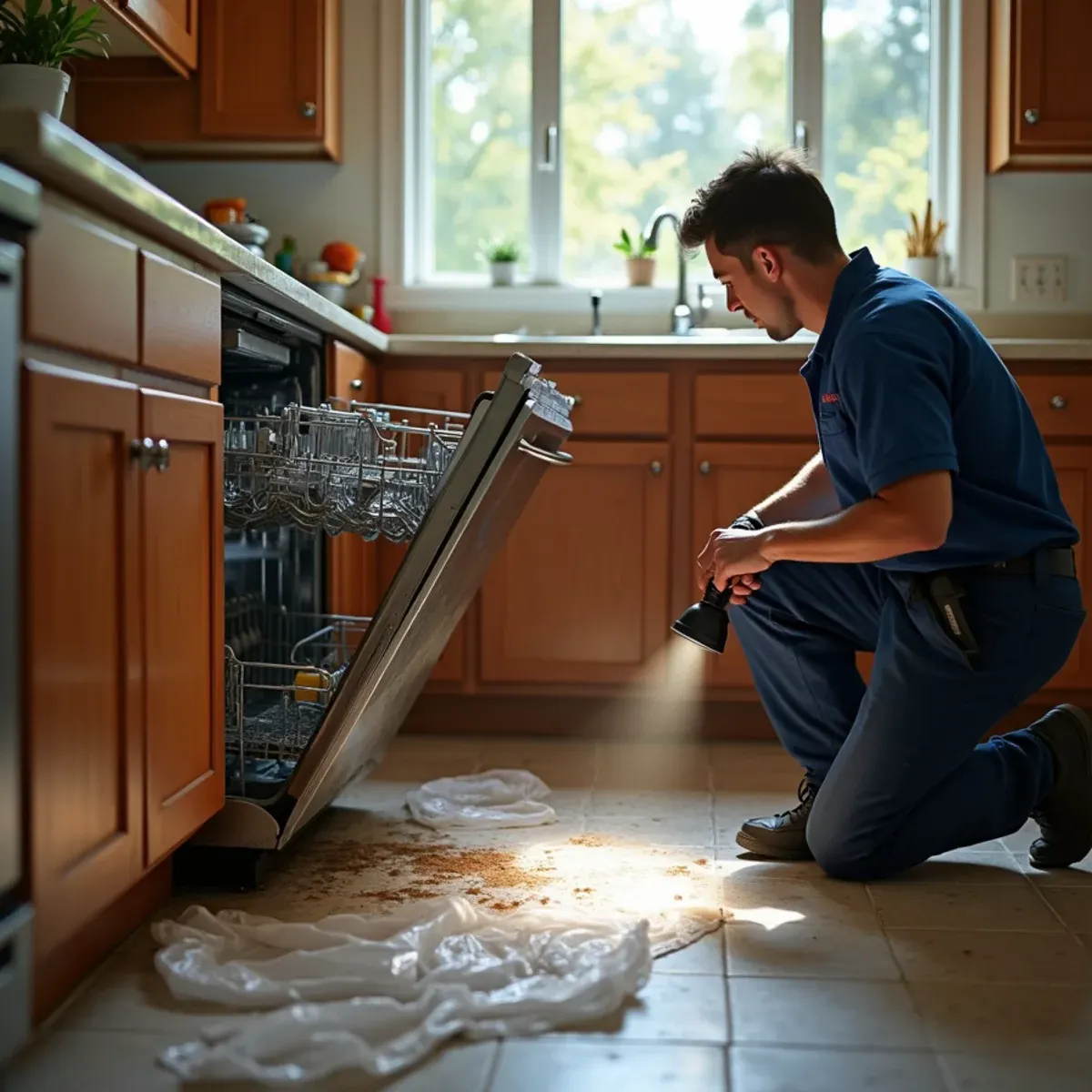
Uptown Whittier, around Greenleaf Avenue and Philadelphia Street, is full of houses that predate the dishwasher by fifty years. Late-Victorian, early Craftsman and 1920s Spanish Revival, nearly all on raised foundations, with kitchens that got their first dishwasher sometime in the 1970s and a supply line run through a hole somebody drilled in the original subfloor. When that line begins to weep, the water goes straight down the hole into the crawl space. Nothing shows on the kitchen floor until the framing underneath has been damp for a month or more.
Climb into College Hills, subdivided in 1923 as the city's first hillside tract, and the houses step down the grade on curving streets. Laundry rooms end up on lower levels or in garages tucked beneath living space, so an overflowing washer drains into whatever is below it rather than spreading across a floor. Friendly Hills works much the same way. East Whittier, out past Whittier Boulevard, is conventional postwar slab and behaves like any tract of its age. Three different drying problems inside one city, about twenty minutes north of our Cypress base.
What Whittier Changes About Appliance Leaks
1Dishwasher lines drilled through original subfloor
Retrofitted kitchens in Uptown almost always have a penetration cut through hundred-year-old subfloor for the supply and drain. That hole is a direct path to the crawl space, which is why these leaks give no surface warning. We inspect the joist bays under the sink run, check the sill and the nearest post for rot, and dry from below so the original flooring above has a chance of staying.
2Lower-level laundry in the hillside tracts
In College Hills and Friendly Hills the laundry frequently sits on a lower level or in a garage built into the slope, with living space directly above or beside it. Water follows the grade and the framing rather than pooling, ending up in a wall cavity two rooms away. We check the downslope side of the house and the garage ceiling before assuming the loss is contained to the laundry room.
3Clay and cast-iron drains under old kitchens
An old Uptown house drains a washer's thirty gallons into a clay lateral with a century of root intrusion. The line cannot take it, so the water comes back up through the standpipe or a floor drain, and that is Category 3 under IICRC S500:2025, not a clean supply leak. That changes what we can save, and it means a plumber should scope the line before you run the washer again.
How the Work Runs
The method is the same one we use on every appliance leaks job, documented to the IICRC S500:2025 standard. Here it is in short — the full appliance leak water damage cleanup process explains each stage in detail.
- Isolate the supply
- Pull the appliance and read behind it
- Open cabinet bases where needed
- Extract and remove unsalvageable material
- Targeted drying of the enclosed spaces
- Rebuild and reinstall
The Whittier Background Worth Knowing
A leak under a raised foundation does not announce itself the way a slab leak does. There is no puddle on the floor and no warm spot underfoot, because the water drips down into the soil and stays there. What you get instead is a smell that is stronger in the morning, a board that feels slightly soft, and eventually a floor that has been quietly feeding fungal growth for months. By the time an Uptown homeowner calls us about a crawl space leak, the question is rarely how to dry it. It is how much of the joist and subfloor is still doing its job.
There is more on the housing stock, drainage and plumbing history of this city on our water damage restoration in Whittier page.
Whittier at a glance
- Dominant construction era
- 1890–1980
- Foundation type
- mixed on grade
- Supply piping found here
- original turn-of-century piping, galvanized steel, under-slab copper
- Drain line materials
- cast iron, clay
- Terrain and water table
- hillside-mixed, moderate water table
- Most common local failure
- raised-foundation crawl-space leaks in Uptown, and slope drainage failures in the hillside tracts
- Highest-value local prevention
- an annual crawl-space or slope-drain check, depending which Whittier you live in
What It Costs in Whittier
We do not quote a number over the phone before seeing the property — anyone who does is guessing. The variables that actually move the price on a appliance leaks job are slow leak versus sudden failure, how much cabinetry is affected, subfloor condition, and they are broken down in full on the appliance leak water damage cleanup page. The assessment and the written estimate are free anywhere in Whittier, day or night, with no obligation.
Appliance Leaks Questions from Whittier Homeowners
Both, and the plumbing has to be solved first. In Uptown and Los Nietos the drain laterals are clay or old cast iron with root intrusion, and a washer discharges faster than a compromised line can carry. Water that comes back up out of a drain is contaminated, which changes the cleanup from drying to removal and disinfection of porous materials. Get the line scoped and cleared, then we handle the affected flooring and wall base properly.
Yes. Dishwasher leaks run backward and sideways under the unit into the cabinet bases and subfloor, which is why the visible floor often looks untouched. A free moisture reading takes twenty minutes and will tell you definitively whether anything behind or beneath is wet.
Often only the affected base or toe-kick, not the whole box. Particleboard bottoms that have swollen and delaminated have to be replaced, but the cabinet frame, doors, and countertop can usually stay. We repair at the smallest reasonable scope.
It cuts both ways. A crawl space leak hides longer, because the water drips into soil instead of pooling on your floor, so it often runs for months and reaches the framing before anyone notices. The upside is real though: the plumbing is accessible, so locating and repairing it does not mean breaking concrete. On balance, detection is your weak point in Uptown, which is why an annual look under the house is worth doing.