
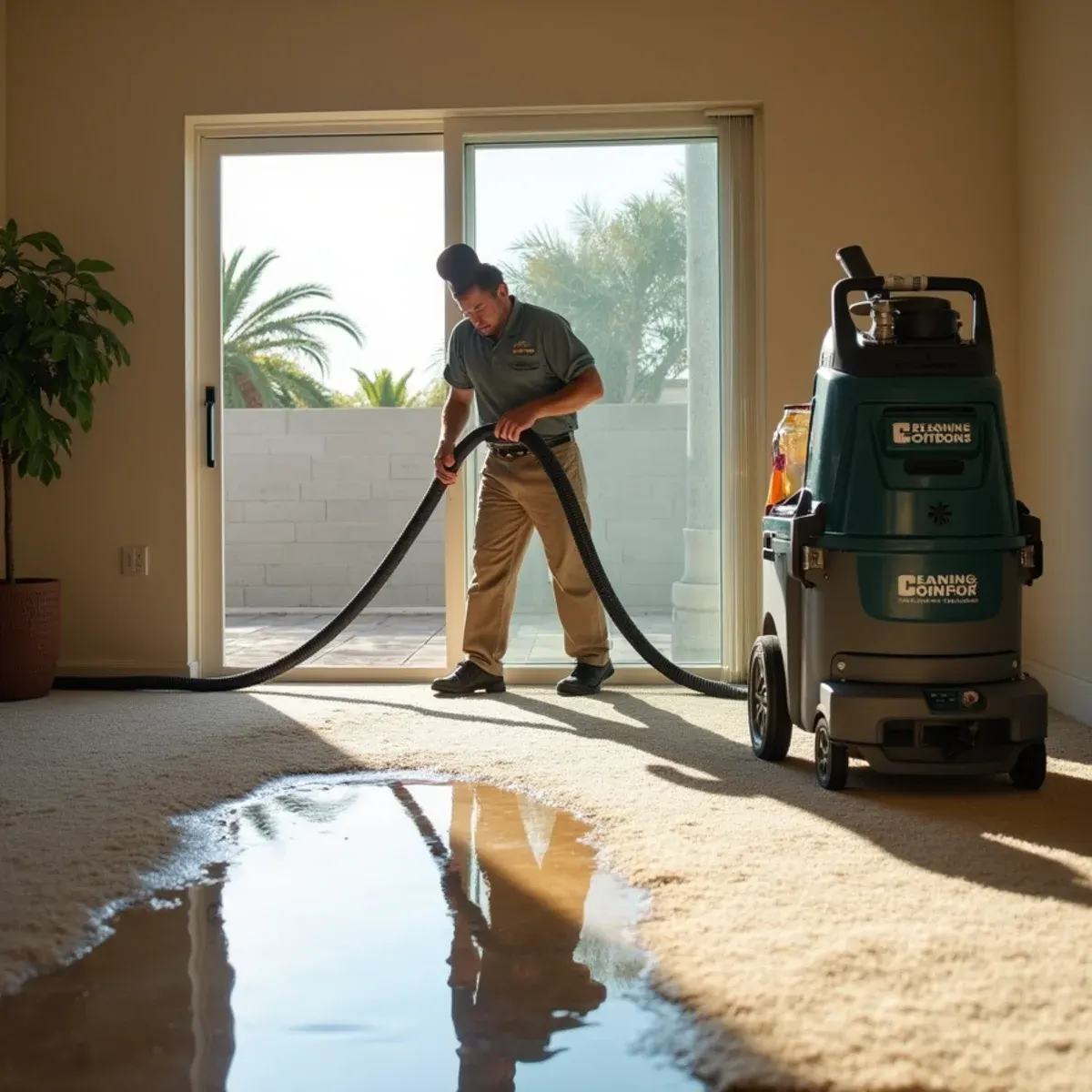
Norwalk went from farmland to a built-out city inside about fifteen years after the war, and a lot of those houses still run their original galvanized supply. When a scaled line finally opens up, what comes out is not the clear water people picture. It carries decades of rust and mineral scale, and it wicks into carpet backing and light-colored fiber within hours. The moisture is the easy part. The staining is what decides whether the carpet is worth drying at all.
The lots are small and the houses were built fast and economically, with not much room between the street and the front door. That matters on a job like this. There is often no garage bay free and no side yard to stage furniture and wet pad, so we plan the removal path before anything gets cut. On the west edge the San Gabriel River channel carries large regional runoff past the city, but the losses we see inside Norwalk homes are overwhelmingly supply-side, not storm.
What Norwalk Changes About Carpet Drying
1Rust staining decides the carpet call
Clear water and rusty water do the same thing to a pad and very different things to fiber. Galvanized discharge leaves an orange tide line that sets as it dries, and on light nylon or older polyester it rarely comes out with hot water extraction alone. We test a hidden section early. If the stain will not release, we say the carpet is a replace and stop billing to dry it.
2Small lots leave nowhere to stage
A Norwalk tract house does not give you a spare room. Pad comes out in strips and gets bagged at the door, and furniture goes on blocks and tabs rather than out to a yard that is mostly driveway. We plan that sequence before the first cut so the family can still use a bathroom and a bedroom while the equipment runs.
3Whole-house wetting from one break
These floor plans are compact, which means a supply break in a hall bathroom can put water into three rooms of continuous carpet before anyone notices. Continuous carpet with no doorway seam has to be treated as one drying zone. Weighted extraction across the whole run, then float from the wet end, so we are not pushing water into dry pad.
How the Work Runs
The method is the same one we use on every carpet drying job, documented to the IICRC S500:2025 standard. Here it is in short — the full carpet water damage & drying process explains each stage in detail.
- Map the real wet perimeter
- Identify the pad and the category
- Weighted extraction, pass after pass
- Float the carpet or pull the pad
- Dry the slab or subfloor
- New pad, re-stretch, reinstall
The Norwalk Background Worth Knowing
The homes built in Norwalk during the postwar surge were built to be affordable and built fast, which was exactly the right priority at the time. Seventy years later, some of those choices have consequences.
There is more on the housing stock, drainage and plumbing history of this city on our water damage restoration in Norwalk page.
Norwalk at a glance
- Dominant construction era
- 1945–1960
- Foundation type
- slab on grade
- Supply piping found here
- original galvanized steel
- Drain line materials
- cast iron
- Terrain and water table
- flat, moderate water table
- Most common local failure
- original galvanized supply lines failing after decades of internal scaling and erosion at fittings
- Highest-value local prevention
- clearing yard and area drains before the season, since small lots leave little ground between the street and the house
What It Costs in Norwalk
We do not quote a number over the phone before seeing the property — anyone who does is guessing. The variables that actually move the price on a carpet drying job are whether the pad is salvageable, square footage and equipment days, what sits under the pad, and they are broken down in full on the carpet water damage & drying page. The assessment and the written estimate are free anywhere in Norwalk, day or night, with no obligation.
Carpet Drying Questions from Norwalk Homeowners
Not every time. A pinhole caught in an hour on a mid-tone carpet often extracts clean. What tends to end a carpet in Norwalk is a line that ran overnight, because the rust has time to set into the backing and the latex. We check for stain release before committing to a drying plan, and if the fiber is going to hold the color we tell you up front instead of running equipment for four days first.
Frequently it can be saved. The deciding factors are water category, how many hours it sat, and whether the backing has delaminated. Clean supply-line water caught within a day, on carpet that was in decent shape beforehand, usually means we replace the pad and keep the carpet. Anything past Category 1, or carpet that has come apart at the backing, is a different answer. We take the readings and check the backing before saying either way.
No, but it does more often than not. On a clean-water loss we reach quickly, we can float the carpet, push dry air into the pad space, and dry it in place. Moisture-barrier pad, dense slab rubber, and anything that sat overnight in gray water comes out. S500:2025 treats pad as non-restorable once contamination is involved, and field experience supports that. It is inexpensive material against a real risk.
If it is original galvanized from the postwar build-out, it has exceeded any reasonable service life. If you have had one failure, a second is a matter of when. The cheapest moment to repipe is while walls are already open for a repair — the demolition and patching are already in the scope.