
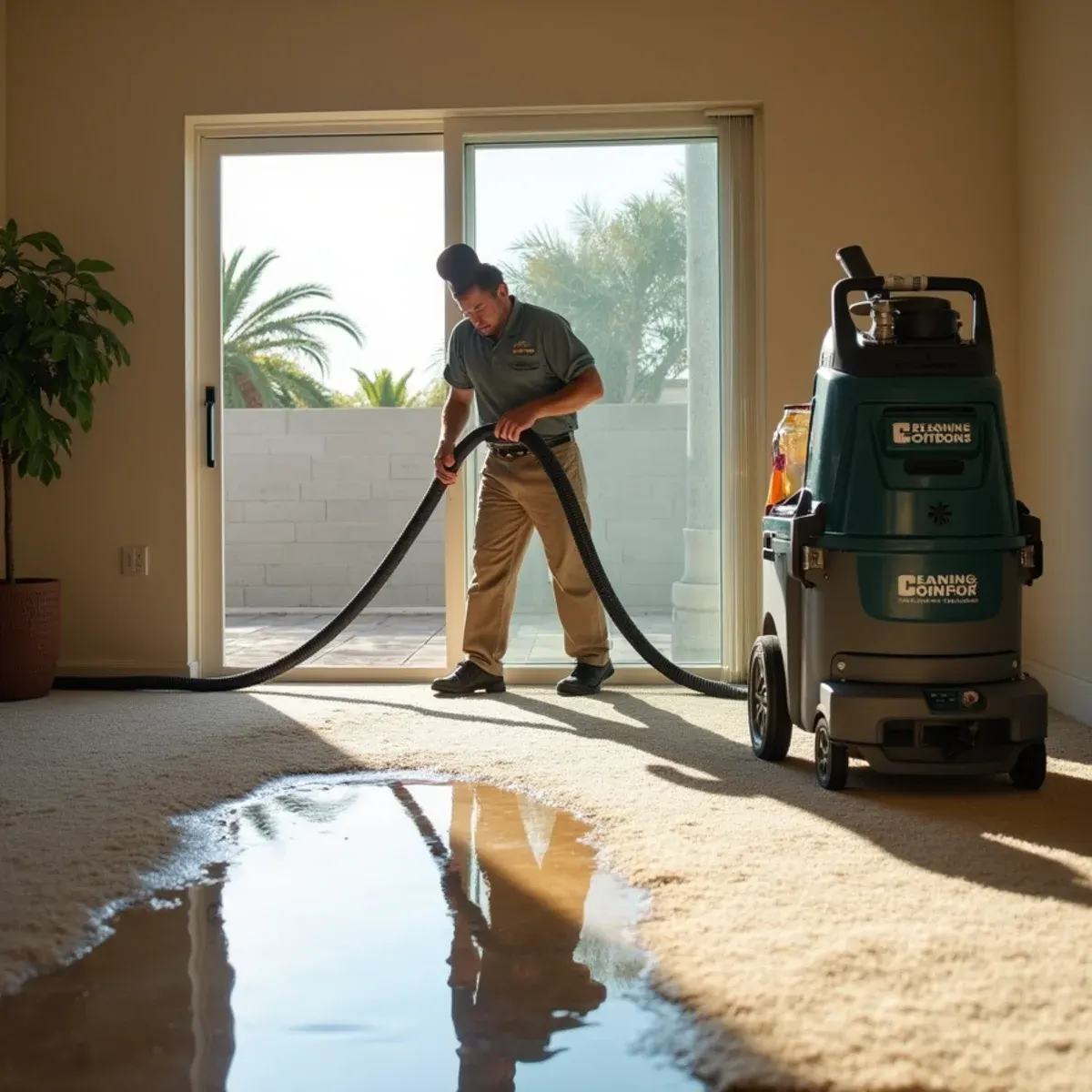
A washer connection lets go in a second-floor Buena Park apartment on a weekday morning while everyone is at work. The water crosses the unit, finds the corridor, and by the time somebody locates a shutoff there is wet pad in three or four units and forty feet of hallway. That escalation is the defining Buena Park pattern, and it comes straight from the housing mix: a large apartment stock built between 1950 and 1975, plus hotels and chain restaurants stacked along the Beach Boulevard corridor near Knott's Berry Farm.
Those two carpet types behave differently and we plan for both on the same job. Inside the units it's ordinary pad over slab, so weighted extraction and floating are genuinely on the table if we catch it early. In the corridors, and in most of the hotel and restaurant spaces, it's direct glue-down commercial carpet with no pad at all, bonded to concrete. Nothing to pull back, nothing to float, and the call comes down to what the water was and how long it sat before anyone opened a door on it.
What Buena Park Changes About Carpet Drying
1Corridor glue-down versus in-unit pad
The hallway carpet in most Buena Park apartment buildings is glued straight down and dries under directed airflow or not at all. Unit carpet has pad, which holds far more water and drives the demolition call. Treating both the same way is how a building ends up with a corridor that smells for a year after the units are perfectly fine.
2Category climbs as water crosses units
Water that starts clean at a supply line doesn't stay clean once it has run under three doors, across corridor carpet and past whatever was on those floors. We category the water where it is, not where it started. Pad in the source unit may be borderline salvageable. Pad two units down the hall almost never is.
3Hotel rooms carry a revenue clock
On the Beach Boulevard properties, every room we're drying is a room that isn't selling. We stage room by room rather than shutting a whole floor, set containment so adjacent rooms stay rentable, and work overnight when the property prefers it. We'll give an honest read on which rooms come back and which need the flooring replaced outright.
How the Work Runs
The method is the same one we use on every carpet drying job, documented to the IICRC S500:2025 standard. Here it is in short — the full carpet water damage & drying process explains each stage in detail.
- Map the real wet perimeter
- Identify the pad and the category
- Weighted extraction, pass after pass
- Float the carpet or pull the pad
- Dry the slab or subfloor
- New pad, re-stretch, reinstall
The Buena Park Background Worth Knowing
Buena Park has a large apartment and condominium stock, and multi-unit water losses are a meaningful share of our work here. A supply line failure in a second-floor unit reaches the unit below within minutes and frequently affects three or four units before anyone finds the shutoff.
There is more on the housing stock, drainage and plumbing history of this city on our water damage restoration in Buena Park page.
Buena Park at a glance
- Dominant construction era
- 1950–1975
- Foundation type
- slab on grade
- Supply piping found here
- galvanized steel, under-slab copper
- Drain line materials
- cast iron
- Terrain and water table
- flat, moderate water table
- Most common local failure
- multi-unit escalation, where one riser or supply failure reaches three or four units before anyone finds the shutoff
- Highest-value local prevention
- posting the main shutoff location and an emergency contact where tenants will actually see it
What It Costs in Buena Park
We do not quote a number over the phone before seeing the property — anyone who does is guessing. The variables that actually move the price on a carpet drying job are whether the pad is salvageable, square footage and equipment days, what sits under the pad, and they are broken down in full on the carpet water damage & drying page. The assessment and the written estimate are free anywhere in Buena Park, day or night, with no obligation.
Carpet Drying Questions from Buena Park Homeowners
The building owner or their carrier owns that decision, because the carpet is part of the unit rather than your property. What we can do is document it properly for you: moisture readings, category, elapsed time and photos before anything moves. Your own belongings sitting on that carpet are a separate claim under renters coverage if you carry it. We work with whoever the owner sends and we won't disappear on you halfway through the job.
Frequently it can be saved. The deciding factors are water category, how many hours it sat, and whether the backing has delaminated. Clean supply-line water caught within a day, on carpet that was in decent shape beforehand, usually means we replace the pad and keep the carpet. Anything past Category 1, or carpet that has come apart at the backing, is a different answer. We take the readings and check the backing before saying either way.
No, but it does more often than not. On a clean-water loss we reach quickly, we can float the carpet, push dry air into the pad space, and dry it in place. Moisture-barrier pad, dense slab rubber, and anything that sat overnight in gray water comes out. S500:2025 treats pad as non-restorable once contamination is involved, and field experience supports that. It is inexpensive material against a real risk.
Regularly. Multi-unit losses get documented unit by unit with separate photographs, moisture maps, and drying logs, which is what lets several owners, an HOA, and multiple carriers each resolve their portion without disputing a single blended invoice.