
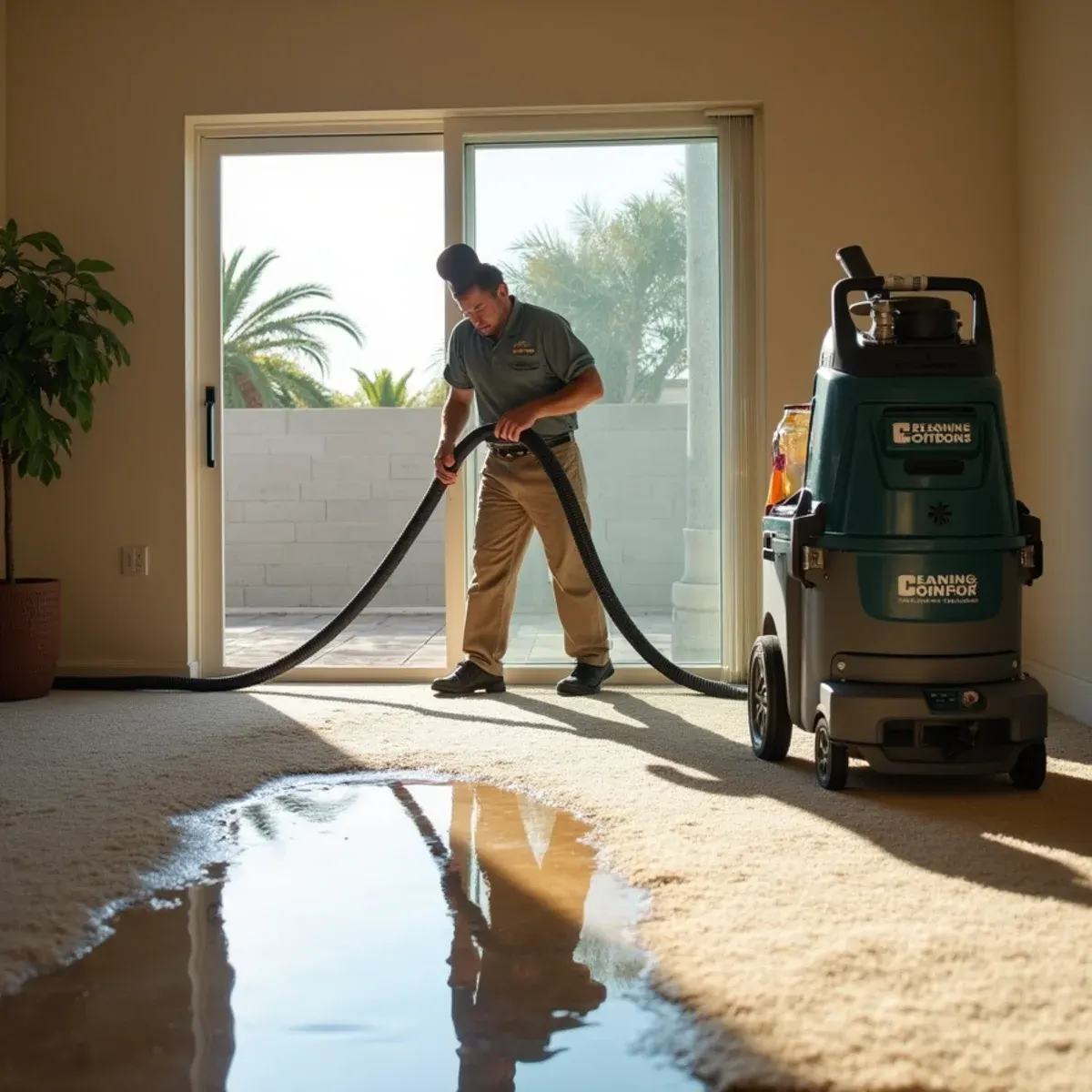
La Palma is the smallest city in Orange County by area and one of the most uniform, built out between 1960 and 1980 on slab with under-slab copper. What sets it apart for carpet work is the two-story share, which runs well above what you see in the surrounding tracts. That means most of the carpet in town is not sitting on concrete at all. It is sitting on pad over plywood over an enclosed floor assembly, and water that gets into that assembly leaves the room without asking.
The pattern we see repeatedly here is an upstairs bathroom or laundry that lets go, saturates the hall pad, then travels sideways through the joist bays and drops through a downstairs ceiling a long way from the source. Long-tenured owners keep these houses beautifully, which is a real advantage, but it also means original under-slab supply lines and original pad. Old rebond and jute delaminate when they're soaked, and once the backing separates the carpet stretches out of shape no matter how well it dries.
What La Palma Changes About Carpet Drying
1Stair carpet wicks the whole flight
In a two-story La Palma house, water reaching the top landing runs the stair nosings and soaks pad on every tread. Stairs are the slowest thing in the building to dry, because airflow can't get under the treads without lifting carpet at the landing. We usually pull stair pad rather than fight it for a week, and we tell you that on day one.
2Two floors, two unrelated failure modes
Upstairs, the enemy is the enclosed floor assembly that hides the true footprint. Downstairs, on slab, it's under-slab copper wetting the pad from below with nothing at all to see overhead. The same house can hand you both problems within a decade, and they need different equipment, different drying targets and different demolition decisions.
3Original pad from a long-tenured owner
Houses that stayed with one family for thirty years often still have their first or second carpet. Old pad has already compressed and lost loft, and when it's soaked it delaminates rather than rebounds. Floating that carpet back over the same pad rarely works out. The face carpet itself is frequently salvageable on clean water, and we'll say so when it is.
How the Work Runs
The method is the same one we use on every carpet drying job, documented to the IICRC S500:2025 standard. Here it is in short — the full carpet water damage & drying process explains each stage in detail.
- Map the real wet perimeter
- Identify the pad and the category
- Weighted extraction, pass after pass
- Float the carpet or pull the pad
- Dry the slab or subfloor
- New pad, re-stretch, reinstall
The La Palma Background Worth Knowing
There is a pattern we see repeatedly in La Palma. A homeowner has taken excellent care of a house for thirty years — new roof, dual-pane windows, updated electrical panel, remodeled kitchen. Then a slab leak runs for eight months under the living room and nobody catches it, because there was never anything to see.
There is more on the housing stock, drainage and plumbing history of this city on our water damage restoration in La Palma page.
La Palma at a glance
- Dominant construction era
- 1960–1980
- Foundation type
- slab on grade
- Supply piping found here
- under-slab copper
- Drain line materials
- cast iron, ABS
- Terrain and water table
- flat, moderate water table
- Most common local failure
- second-floor supply and fixture failures that travel through the floor assembly into the ceiling below
- Highest-value local prevention
- knowing where the main shutoff is and confirming it still turns, because two-story losses double in size in minutes
What It Costs in La Palma
We do not quote a number over the phone before seeing the property — anyone who does is guessing. The variables that actually move the price on a carpet drying job are whether the pad is salvageable, square footage and equipment days, what sits under the pad, and they are broken down in full on the carpet water damage & drying page. The assessment and the written estimate are free anywhere in La Palma, day or night, with no obligation.
Carpet Drying Questions from La Palma Homeowners
Often yes, and the pad usually isn't. On clean supply water caught within a day, the face carpet in a La Palma upper floor can be floated over air movers, dried and re-stretched. The pad is what held the volume and what pushed water into the joist bays, so it comes out. The real work is the assembly between the floors, which is why the ceiling below usually gets opened. We check the backing for delamination before promising anything.
Frequently it can be saved. The deciding factors are water category, how many hours it sat, and whether the backing has delaminated. Clean supply-line water caught within a day, on carpet that was in decent shape beforehand, usually means we replace the pad and keep the carpet. Anything past Category 1, or carpet that has come apart at the backing, is a different answer. We take the readings and check the backing before saying either way.
No, but it does more often than not. On a clean-water loss we reach quickly, we can float the carpet, push dry air into the pad space, and dry it in place. Moisture-barrier pad, dense slab rubber, and anything that sat overnight in gray water comes out. S500:2025 treats pad as non-restorable once contamination is involved, and field experience supports that. It is inexpensive material against a real risk.
Typically fifteen to twenty minutes. La Palma borders Cypress directly to the north, so it is one of the fastest calls we run and the 60-minute commitment applies in full.