
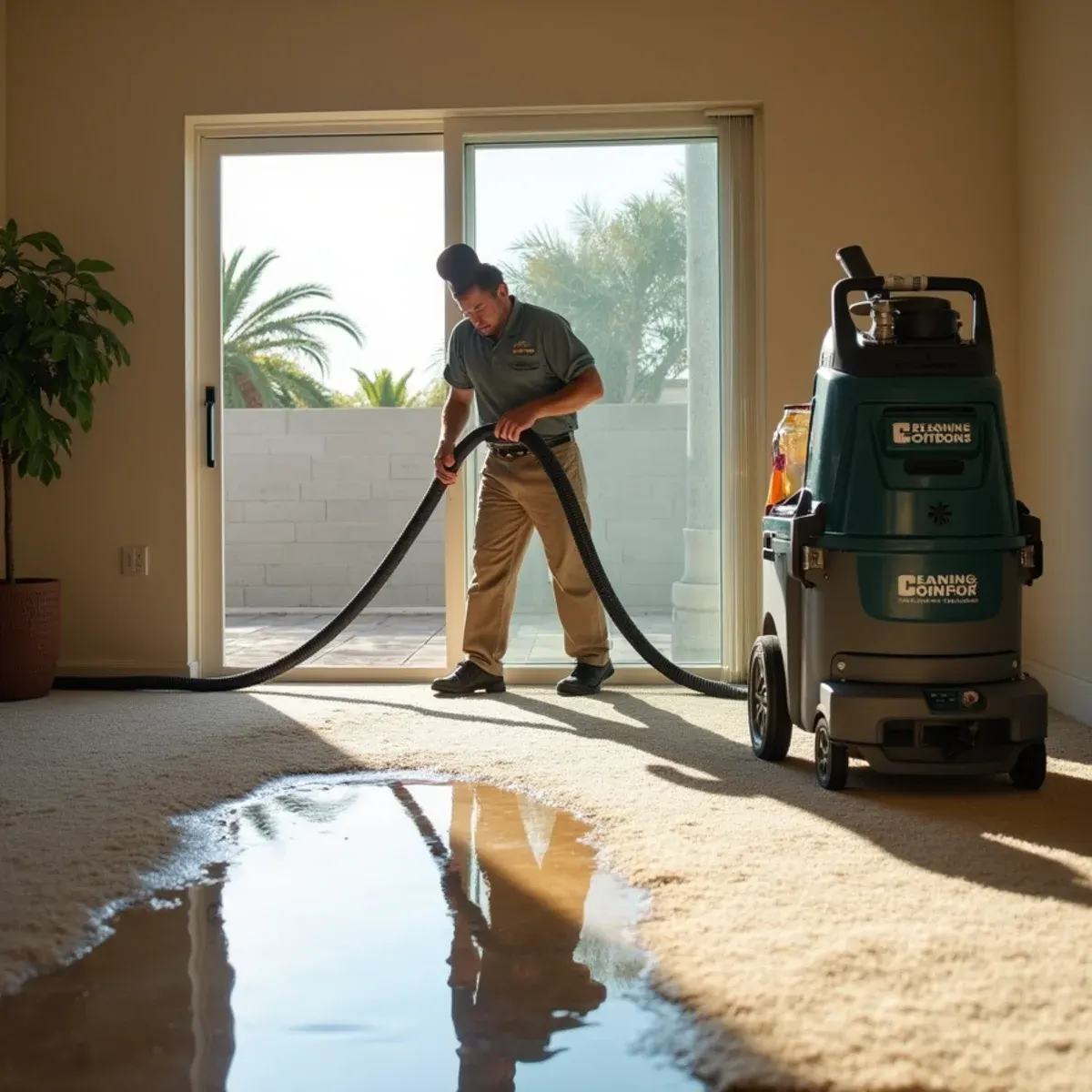
The instinct after a water loss is to open the windows. On the Eastside in June that instinct works against you. Costa Mesa sits close enough to the coast that the marine layer holds outdoor humidity high for long stretches, and pulling that air across wet carpet adds moisture instead of removing it. Drying here is a closed system: doors shut, dehumidification sized to the load, air movers positioned to move water out of the pad and into a machine rather than into the room next door.
The building stock splits sharply. Eastside cottages from the twenties through the forties sit on raised foundations under heavy tree canopy, and that combination of crawl space, shade, shallow water table and marine air means the ground under those houses never really dries on its own. Mesa Verde is 1960s slab tract, where the physics are simpler. The Westside mixes industrial buildings with housing, which puts glue-down commercial carpet with no pad at all in the same neighborhood as stretched residential carpet. One city, three drying problems.
What Costa Mesa Changes About Carpet Drying
1Marine humidity sets the drying plan
Grain depression is what dries carpet, not air speed. When outdoor air sits near saturation, opening the house shrinks the difference between inside and outside and the pad stops giving up water. We seal the affected area, run dehumidification to a target we can document, and judge progress by readings rather than by whether the carpet feels dry underfoot.
2Eastside crawl spaces stay loaded
Shallow water table, dense canopy, marine air and a vented dirt crawl add up to subfloors that hold moisture as a baseline. Carpet in an Eastside cottage that got wet has a wet deck underneath it, and it will not dry through the carpet. We work the crawl space at the same time, or the room reads dry and then rebounds.
3Westside glue-down carpet is a different job
Direct-glue commercial carpet over concrete in the Westside's mixed live-work and industrial spaces has no pad to remove and no float to perform. It dries in place or it delaminates from the adhesive. That is a different call than a stretched residential carpet three blocks away in a Mesa Verde tract, and we bring different equipment for it.
How the Work Runs
The method is the same one we use on every carpet drying job, documented to the IICRC S500:2025 standard. Here it is in short — the full carpet water damage & drying process explains each stage in detail.
- Map the real wet perimeter
- Identify the pad and the category
- Weighted extraction, pass after pass
- Float the carpet or pull the pad
- Dry the slab or subfloor
- New pad, re-stretch, reinstall
The Costa Mesa Background Worth Knowing
Under a raised Eastside cottage there is bare soil, and that soil is supposed to stay dry because the foundation vents exchange air with the outside. That system depends on the outside air being drier than the space under the house. For a good part of the year in Costa Mesa it is not. The marine layer holds humidity high through the night and well into the morning, so the crawl space never gets the dry stretch it needs, and moisture that arrives from a plumbing drip, a downspout, or an irrigation line just accumulates.
There is more on the housing stock, drainage and plumbing history of this city on our water damage restoration in Costa Mesa page.
Costa Mesa at a glance
- Dominant construction era
- 1920–1980
- Foundation type
- mixed on grade
- Supply piping found here
- original 1920s–1940s piping on the Eastside, galvanized steel, under-slab copper
- Drain line materials
- cast iron, clay
- Terrain and water table
- coastal-flat, shallow water table
- Most common local failure
- crawl-space moisture under Eastside cottages, held in by a marine layer that slows every natural drying process
- Highest-value local prevention
- confirming crawl-space vents are actually open and that the ground under the house is dry
What It Costs in Costa Mesa
We do not quote a number over the phone before seeing the property — anyone who does is guessing. The variables that actually move the price on a carpet drying job are whether the pad is salvageable, square footage and equipment days, what sits under the pad, and they are broken down in full on the carpet water damage & drying page. The assessment and the written estimate are free anywhere in Costa Mesa, day or night, with no obligation.
Carpet Drying Questions from Costa Mesa Homeowners
Run the fans, keep the windows closed. On most days here the outdoor air carries more moisture than you want to introduce, especially in the morning marine layer, and airing out a wet room slows the pad's release rather than speeding it. Run your air conditioning if you have it, since it dehumidifies. Get furniture legs off the carpet on foil or blocks, and leave the pad alone until we have determined the category.
Frequently it can be saved. The deciding factors are water category, how many hours it sat, and whether the backing has delaminated. Clean supply-line water caught within a day, on carpet that was in decent shape beforehand, usually means we replace the pad and keep the carpet. Anything past Category 1, or carpet that has come apart at the backing, is a different answer. We take the readings and check the backing before saying either way.
No, but it does more often than not. On a clean-water loss we reach quickly, we can float the carpet, push dry air into the pad space, and dry it in place. Moisture-barrier pad, dense slab rubber, and anything that sat overnight in gray water comes out. S500:2025 treats pad as non-restorable once contamination is involved, and field experience supports that. It is inexpensive material against a real risk.
Almost always the crawl space. On these raised 1920s to 1940s houses the soil under the floor stays damp when the foundation vents are blocked and the marine layer keeps outside air humid overnight. That moisture moves up through the subfloor and into the rooms above it. Before assuming anything, walk your perimeter and see whether a planter, a poured patio or landscaping has covered the vents that are supposed to be breathing.