
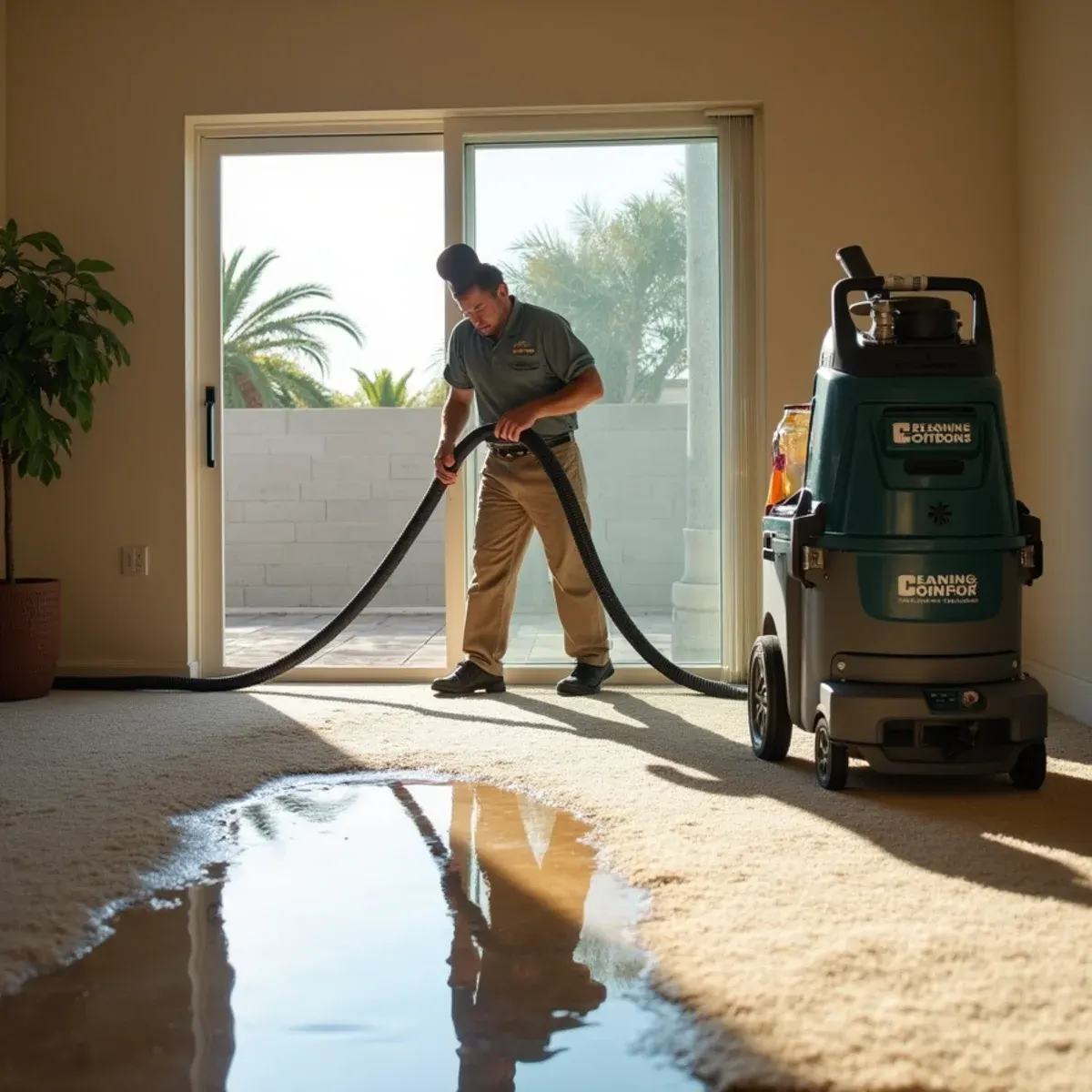
Fountain Valley is dead flat and sits on ground people once called Gospel Swamp, and it carries the shallowest water table in Orange County. That single fact reshapes carpet work here. Slabs in this city emit vapor as a routine background condition, and carpet pad laid on one absorbs it. So the first honest question on a Fountain Valley call isn't how to dry your carpet. It's whether you actually have a leak at all, or whether the ground has been feeding moisture into your pad for years and something finally made you notice.
The stock is uniform 1960s and 1970s slab tract, which works in your favor. Because the pour is consistent room to room, we can take a control reading in a room the water never reached and compare it against the area you're worried about. That comparison settles it. If the numbers match, it's vapor, and we'll tell you so and leave rather than sell you a dry-out you don't need. If the affected room reads well above the control, you have a leak and we go to work. Either way you get the actual number.
What Fountain Valley Changes About Carpet Drying
1Control readings on the same slab
Every Fountain Valley job starts with a baseline taken in a dry room on the same pour. Without that comparison, the slab under your pad reads wet everywhere and the natural response is to tear out far more carpet than the loss justifies. With it, the boundary between your leak and the local groundwater condition becomes obvious in about ten minutes.
2Vapor emission mistaken for a leak
We get called to Fountain Valley homes where nothing failed. Pad has simply been sitting on a slab that gives up moisture continuously, and one humid stretch pushed it past the smell threshold. That isn't a restoration job. It's a flooring and vapor barrier conversation, and pretending otherwise would cost you a deductible for no reason at all.
3New pad over an untested slab fails
Before your replacement carpet goes down, get a relative humidity probe or calcium chloride reading on the slab. In this city that isn't a formality. Pad and carpet backing installed over a slab still releasing vapor will hold odor within a year or two, and the installer who never tested it will point at the water loss instead of the ground.
How the Work Runs
The method is the same one we use on every carpet drying job, documented to the IICRC S500:2025 standard. Here it is in short — the full carpet water damage & drying process explains each stage in detail.
- Map the real wet perimeter
- Identify the pad and the category
- Weighted extraction, pass after pass
- Float the carpet or pull the pad
- Dry the slab or subfloor
- New pad, re-stretch, reinstall
The Fountain Valley Background Worth Knowing
Groundwater beneath Fountain Valley sits close enough to the surface that moisture vapor migration up through concrete slabs is a routine background condition rather than an anomaly. Homeowners here regularly describe a slab that feels cool and damp, or a closet on an exterior wall that never quite feels dry, without any leak at all.
There is more on the housing stock, drainage and plumbing history of this city on our water damage restoration in Fountain Valley page.
Fountain Valley at a glance
- Dominant construction era
- 1960–1980
- Foundation type
- slab on grade
- Supply piping found here
- under-slab copper
- Drain line materials
- cast iron
- Terrain and water table
- flat, shallow water table
- Most common local failure
- slab vapor emission mistaken for a leak, and flooring failures caused by installing over an untested slab
- Highest-value local prevention
- clearing the yard and area drains before the season, because a blocked drain on dead-flat ground ponds water against the house
What It Costs in Fountain Valley
We do not quote a number over the phone before seeing the property — anyone who does is guessing. The variables that actually move the price on a carpet drying job are whether the pad is salvageable, square footage and equipment days, what sits under the pad, and they are broken down in full on the carpet water damage & drying page. The assessment and the written estimate are free anywhere in Fountain Valley, day or night, with no obligation.
Carpet Drying Questions from Fountain Valley Homeowners
In Fountain Valley, often not. With the water table this shallow and lots this flat, slabs release vapor steadily and it concentrates where airflow is poorest, which is usually along a wall behind furniture. A recurring seasonal smell with no rise in your water bill points at vapor rather than a pipe. We can confirm it in one visit with a control reading and a probe. If it is vapor, the fix is a barrier and the right flooring, not a dry-out.
Frequently it can be saved. The deciding factors are water category, how many hours it sat, and whether the backing has delaminated. Clean supply-line water caught within a day, on carpet that was in decent shape beforehand, usually means we replace the pad and keep the carpet. Anything past Category 1, or carpet that has come apart at the backing, is a different answer. We take the readings and check the backing before saying either way.
No, but it does more often than not. On a clean-water loss we reach quickly, we can float the carpet, push dry air into the pad space, and dry it in place. Moisture-barrier pad, dense slab rubber, and anything that sat overnight in gray water comes out. S500:2025 treats pad as non-restorable once contamination is involved, and field experience supports that. It is inexpensive material against a real risk.
The city sits on former wetland with one of the shallowest water tables in Orange County, so moisture vapor migrating up through slabs is a normal background condition here rather than a defect. It matters most when installing flooring over the slab, which is why we test with in-situ RH probes before anything goes back down.