
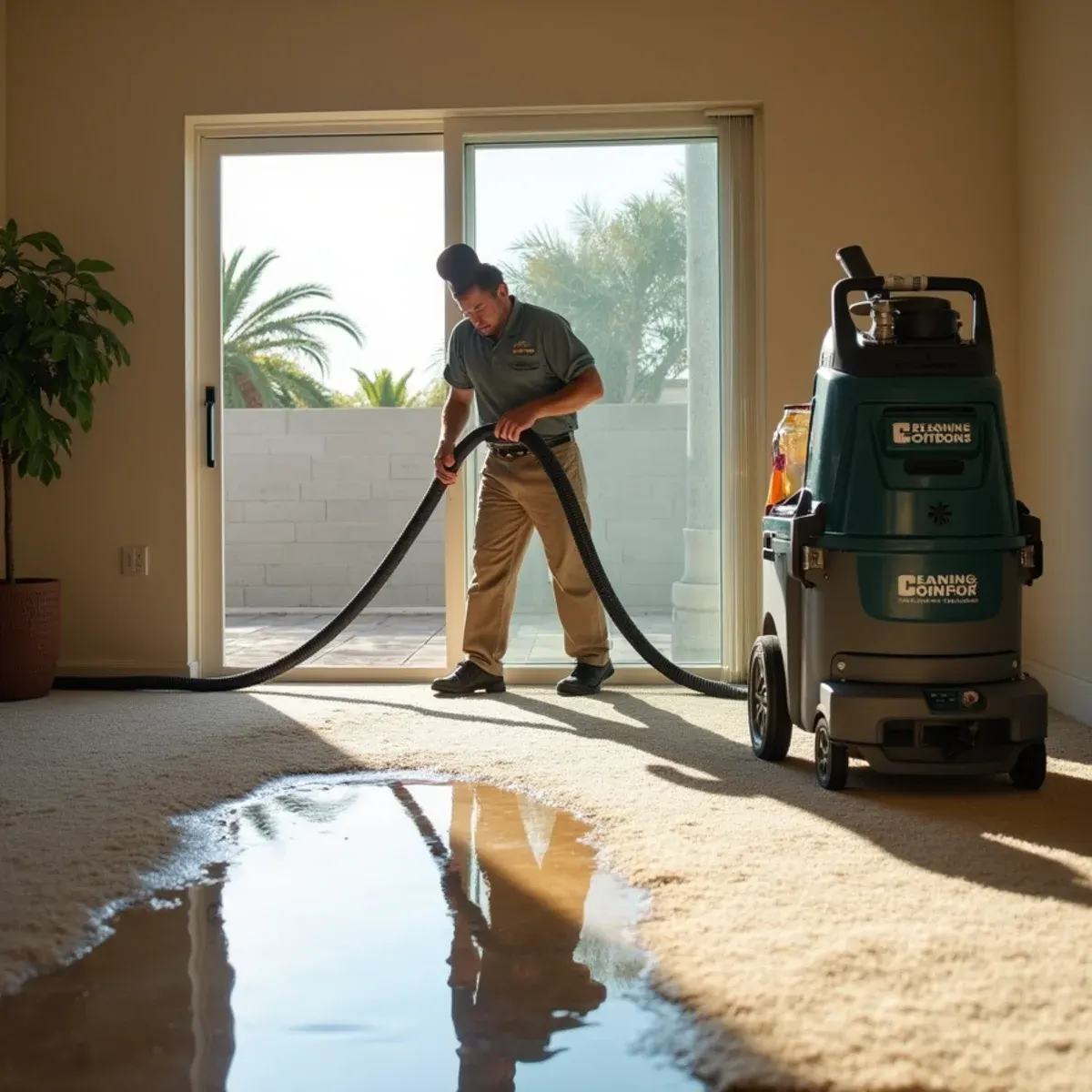
On Pioneer Boulevard the carpet question is a different question. The dining rooms, sari shops and jewelry floors of Little India are mostly direct glue-down commercial carpet, bonded straight to a 1950s slab with no pad in the assembly at all. There is nothing to pull back and float over air movers. It dries in place under directed airflow or it comes up in strips, and what decides that is almost never the volume of water. It's what the water was.
That's where these buildings work against their tenants. This is one of the densest concentrations of independent restaurants and retail in the region, and nearly all of it operates out of structures never designed for commercial kitchens. Cast iron waste lines carrying decades of grease restrict down to a fraction of their diameter and back up into the kitchen and out onto the dining floor. That's Category 3 the moment it crosses the threshold, and glue-down carpet that has taken sewage does not get dried and kept. Residential Artesia, by contrast, is plain postwar slab with ordinary pad-over-slab work.
What Artesia Changes About Carpet Drying
1Glue-down carpet has no pad to save
Direct-glue commercial carpet is bonded to the slab, so weighted extraction and floating over air movers have no role at all. Water sits in the face fibers and at the glue line. Clean water on a well-bonded floor often dries in place. Anything from a waste line means removal, adhesive scraping and slab decontamination before new flooring goes anywhere near it.
2Grease-loaded cast iron backs up first
Kitchens running high-volume frying and heavy spice prep in a building plumbed for a 1955 storefront push grease into cast iron that was never sized for it. The line restricts, then backs up through the lowest floor drain. That's the most common source of wet carpet we see on Pioneer Boulevard, and it dictates a Category 3 response every single time.
3Overnight work keeps the doors open
A closed day on Pioneer Boulevard costs more than the flooring does. We schedule extraction and equipment setup after service where the category allows customers back in, contain the affected area so the rest of the floor keeps trading, and coordinate with neighboring tenants when a shared line is involved. We'll be straight with you when reopening isn't safe.
How the Work Runs
The method is the same one we use on every carpet drying job, documented to the IICRC S500:2025 standard. Here it is in short — the full carpet water damage & drying process explains each stage in detail.
- Map the real wet perimeter
- Identify the pad and the category
- Weighted extraction, pass after pass
- Float the carpet or pull the pad
- Dry the slab or subfloor
- New pad, re-stretch, reinstall
The Artesia Background Worth Knowing
A commercial kitchen is one of the hardest things you can ask a building to accommodate. High water use, continuous drainage, grease loading, floor drains, and equipment connections that get added and modified over the years. When that kitchen is in a building from the 1950s with original cast-iron waste lines, the failure is a matter of time.
There is more on the housing stock, drainage and plumbing history of this city on our water damage restoration in Artesia page.
Artesia at a glance
- Dominant construction era
- 1950–1970
- Foundation type
- slab on grade
- Supply piping found here
- galvanized steel, copper
- Drain line materials
- cast iron
- Terrain and water table
- flat, moderate water table
- Most common local failure
- grease-loaded cast-iron waste lines restricting until a commercial kitchen backs up
- Highest-value local prevention
- hydro-jetting the waste line rather than snaking it, so the pipe wall actually gets cleaned
What It Costs in Artesia
We do not quote a number over the phone before seeing the property — anyone who does is guessing. The variables that actually move the price on a carpet drying job are whether the pad is salvageable, square footage and equipment days, what sits under the pad, and they are broken down in full on the carpet water damage & drying page. The assessment and the written estimate are free anywhere in Artesia, day or night, with no obligation.
Carpet Drying Questions from Artesia Homeowners
Sometimes, and it depends entirely on the source. Clean water from a supply line on glue-down carpet can often be dried overnight behind containment with the rest of the floor trading normally. A grease-line backup cannot. Sewage on a dining room floor is Category 3, the carpet and adhesive come out, and the slab gets cleaned before anything reopens over it. We'll tell you which one you have on the first walkthrough, not after we've set equipment.
Frequently it can be saved. The deciding factors are water category, how many hours it sat, and whether the backing has delaminated. Clean supply-line water caught within a day, on carpet that was in decent shape beforehand, usually means we replace the pad and keep the carpet. Anything past Category 1, or carpet that has come apart at the backing, is a different answer. We take the readings and check the backing before saying either way.
No, but it does more often than not. On a clean-water loss we reach quickly, we can float the carpet, push dry air into the pad space, and dry it in place. Moisture-barrier pad, dense slab rubber, and anything that sat overnight in gray water comes out. S500:2025 treats pad as non-restorable once contamination is involved, and field experience supports that. It is inexpensive material against a real risk.
Yes, and on Pioneer Boulevard that is usually how we schedule it. Overnight crews cost somewhat more in labor and almost always cost dramatically less than lost revenue from closing during operating hours.