
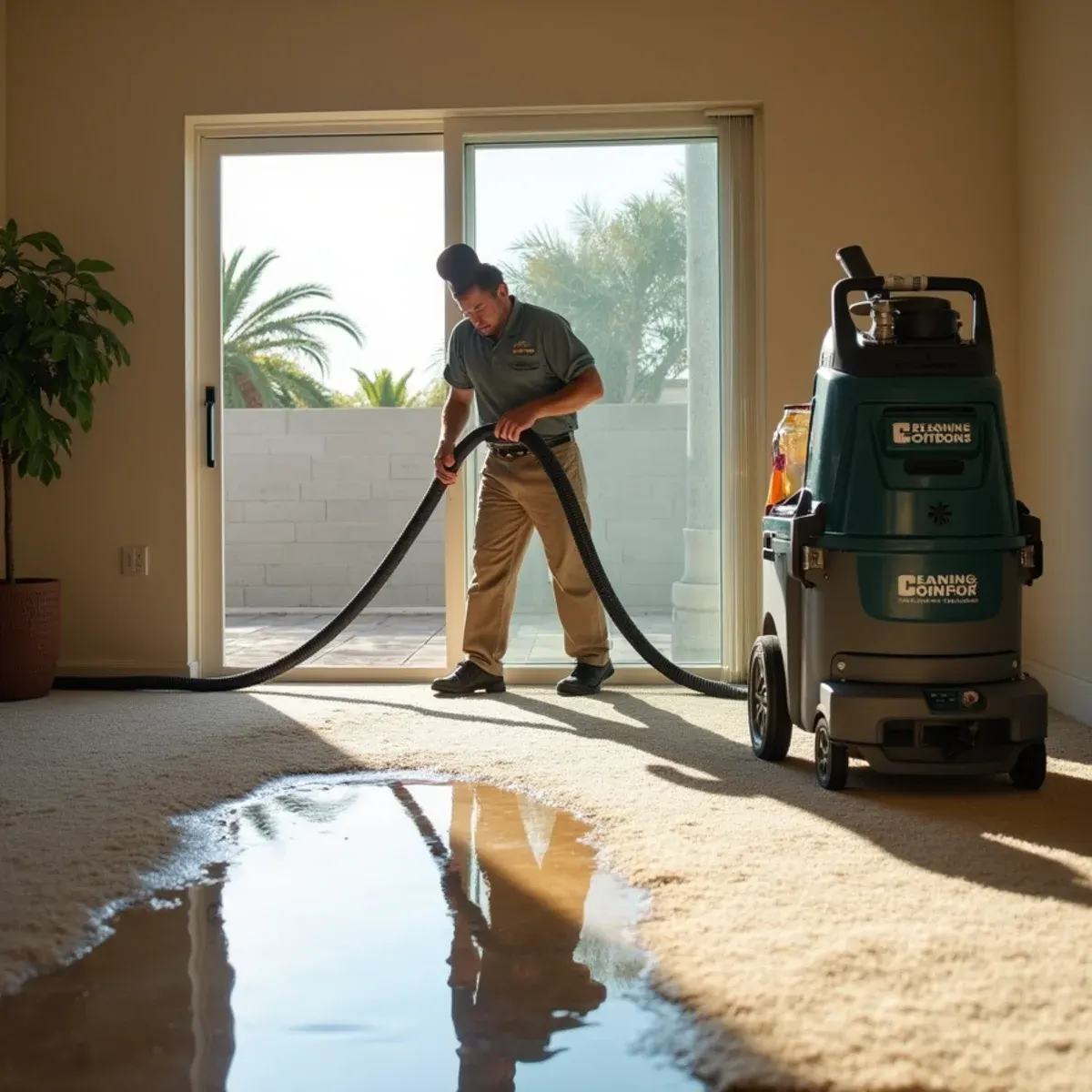
In Floral Park, French Park and Washington Square, wall-to-wall carpet was almost always laid over the original floor rather than in place of it. That floor is old-growth fir or oak with growth rings you cannot buy today at any price, and a saturated pad sitting on it will cup and crown those boards inside a couple of days. So in Santa Ana's historic districts we invert the usual order. Carpet and pad come up first, airflow goes onto the wood, and the save-or-replace question about the carpet gets answered afterward.
This is the county's oldest city and it shows in the wall assemblies too. Lath-and-plaster is everywhere in the pre-war stock, and wet plaster can lose its keys, the fingers of material squeezed through the lath that hold the whole wall up. That failure stays quiet until a section drops. Historic preservation review applies to much of the exterior and structural work in these districts, which shapes the repair phase even where it has no bearing on emergency drying. Outside the districts, the dense postwar apartment stock is conventional pad-over-slab work.
What Santa Ana Changes About Carpet Drying
1Lift the carpet to save the floor
Old-growth fir and oak under historic-district carpet is usually the most valuable material in the room. It cups fast under a wet pad and it is very hard to match if it has to be replaced. We pull carpet and pad early, get air across the boards from both faces where a crawl space allows it, and accept a slower, gentler dry so the wood doesn't check.
2Wet plaster can drop its keys
Plaster holds water far longer than drywall, and once saturated the keys behind the lath soften and let go. A ceiling above wet carpet is worth inspecting from above before anyone works underneath it. We flag that risk immediately in pre-war Santa Ana homes rather than assuming a wall that looked intact on Monday will still be intact by Thursday.
3Preservation review shapes the repair phase
Emergency drying and extraction don't require review, and we start immediately. Anything touching original windows, exterior materials or structure in a designated district does. Knowing that boundary early keeps the reconstruction schedule realistic, and it stops well-meaning contractors from swapping an original wood window for vinyl and creating a much bigger problem than the water did.
How the Work Runs
The method is the same one we use on every carpet drying job, documented to the IICRC S500:2025 standard. Here it is in short — the full carpet water damage & drying process explains each stage in detail.
- Map the real wet perimeter
- Identify the pad and the category
- Weighted extraction, pass after pass
- Float the carpet or pull the pad
- Dry the slab or subfloor
- New pad, re-stretch, reinstall
The Santa Ana Background Worth Knowing
Lath and plaster is wood strips nailed across the studs with several coats of plaster troweled over them. The plaster that squeezes through the gaps between lath forms keys that hook over the wood and hold the whole wall in place. That construction is why plaster walls last a century — and why they behave so differently from drywall when wet.
There is more on the housing stock, drainage and plumbing history of this city on our water damage restoration in Santa Ana page.
Santa Ana at a glance
- Dominant construction era
- 1900–1970
- Foundation type
- mixed on grade
- Supply piping found here
- original early-century piping, galvanized steel, copper
- Drain line materials
- cast iron, clay
- Terrain and water table
- flat, moderate water table
- Most common local failure
- plaster key failure, where wet plaster softens and releases from the wood lath holding it to the wall
- Highest-value local prevention
- starting aggressive drying within hours on any plaster loss — waiting is the one thing that costs you the wall
What It Costs in Santa Ana
We do not quote a number over the phone before seeing the property — anyone who does is guessing. The variables that actually move the price on a carpet drying job are whether the pad is salvageable, square footage and equipment days, what sits under the pad, and they are broken down in full on the carpet water damage & drying page. The assessment and the written estimate are free anywhere in Santa Ana, day or night, with no obligation.
Carpet Drying Questions from Santa Ana Homeowners
Get a second opinion before that floor leaves the house. Old-growth fir and oak in Floral Park or Washington Square is dense, tight-grained material with no modern equivalent, and it tolerates drying far better than modern flooring does. Cupping frequently relaxes as the boards equalize with the room, and sanding is a last step rather than a first one. Give it weeks before judging. The carpet on top is the disposable layer and that call can be made immediately.
Frequently it can be saved. The deciding factors are water category, how many hours it sat, and whether the backing has delaminated. Clean supply-line water caught within a day, on carpet that was in decent shape beforehand, usually means we replace the pad and keep the carpet. Anything past Category 1, or carpet that has come apart at the backing, is a different answer. We take the readings and check the backing before saying either way.
No, but it does more often than not. On a clean-water loss we reach quickly, we can float the carpet, push dry air into the pad space, and dry it in place. Moisture-barrier pad, dense slab rubber, and anything that sat overnight in gray water comes out. S500:2025 treats pad as non-restorable once contamination is involved, and field experience supports that. It is inexpensive material against a real risk.
Usually, if drying starts quickly. Plaster holds much more water than drywall and dries far more slowly, so it needs more equipment and often desiccant dehumidification. The risk is the plaster keys softening and releasing from the lath, which is why waiting is the one thing that genuinely costs you the wall.