
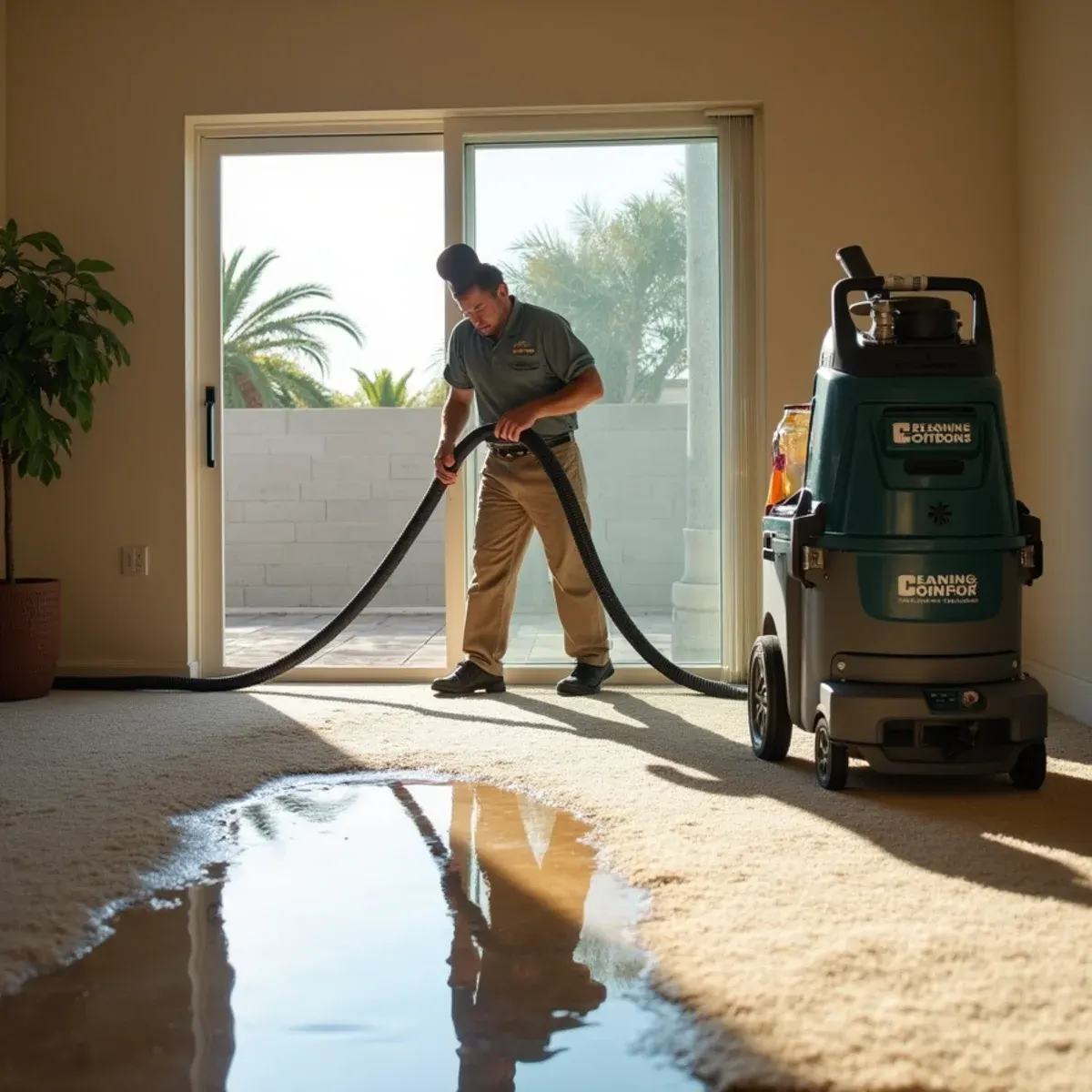
The call usually comes from a house with eight or nine people in it. Carpet in every bedroom, the hall and often the living room, furniture in all of them, and a washer hose or an angle stop that let go behind a wall mid-morning. Garden Grove's multi-generational households are its defining feature, and they put a modern load on plumbing sized for a 1955 family. Angle stops, risers and rubber supply hoses that would last decades under light use rack up cycle counts here that wear them out years early.
The building side is consistent: 1950 through 1970, slab, galvanized supply with under-slab copper repairs threaded through it. Water on slab spreads flat and wide beneath the pad and gets under baseboards two rooms away before anything shows on the surface. What actually slows a Garden Grove job down isn't the drying, it's the contents. Every room is furnished and in use, and pulling pad means lifting, blocking and staging belongings for a family that still needs somewhere to sleep tonight. We plan that with you rather than around you.
What Garden Grove Changes About Carpet Drying
1Fixture cycles wear out the small parts
Angle stops under sinks, toilet risers and rubber washer hoses fail on cycles, not calendar years. A Garden Grove household running twice the laundry and four times the bathroom traffic of the original 1955 family reaches those numbers far sooner. Most of the carpet losses we see in this city trace back to one of those three parts rather than to a slab leak.
2Furnished rooms change the extraction plan
Weighted extraction needs the wand to reach the carpet, so beds, dressers and cabinets get lifted onto blocks or moved out. In a full house there is nowhere obvious to move things to. We block in place where that's safe, stage the rest in the garage or the truck, and photograph everything before it moves so nothing gets argued about later.
3Nothing signed across a language gap
Many Garden Grove households run in Vietnamese or Korean at home, and the person who called us is often not the person who signs. We wait for the family member who wants to read it through. We would rather lose an hour on the front end than have someone agree to work they didn't fully follow, and no one on our crew will push for a signature.
How the Work Runs
The method is the same one we use on every carpet drying job, documented to the IICRC S500:2025 standard. Here it is in short — the full carpet water damage & drying process explains each stage in detail.
- Map the real wet perimeter
- Identify the pad and the category
- Weighted extraction, pass after pass
- Float the carpet or pull the pad
- Dry the slab or subfloor
- New pad, re-stretch, reinstall
The Garden Grove Background Worth Knowing
A 1958 tract home was plumbed for a family of four with one bathroom in regular use, one washing machine, and a single water heater sized to match. Many Garden Grove homes today support considerably more than that, and the plumbing feels it.
There is more on the housing stock, drainage and plumbing history of this city on our water damage restoration in Garden Grove page.
Garden Grove at a glance
- Dominant construction era
- 1950–1970
- Foundation type
- slab on grade
- Supply piping found here
- galvanized steel, under-slab copper
- Drain line materials
- cast iron, clay
- Terrain and water table
- flat, moderate water table
- Most common local failure
- accelerated wear on angle stops, supply risers and washing machine hoses from far higher fixture cycle counts
- Highest-value local prevention
- shorter replacement intervals on every wear item — hoses at five years without exception
What It Costs in Garden Grove
We do not quote a number over the phone before seeing the property — anyone who does is guessing. The variables that actually move the price on a carpet drying job are whether the pad is salvageable, square footage and equipment days, what sits under the pad, and they are broken down in full on the carpet water damage & drying page. The assessment and the written estimate are free anywhere in Garden Grove, day or night, with no obligation.
Carpet Drying Questions from Garden Grove Homeowners
Usually yes, with some rearranging. Air movers and dehumidifiers are loud and warm, and the affected rooms are effectively out of use for three to five days. In a Garden Grove house with several generations sharing bedrooms, that normally means doubling up in the rooms that stayed dry. If the water was Category 3, or the wet area includes the only bathroom, we'll say honestly that staying is a bad idea and document it properly for the carrier.
Frequently it can be saved. The deciding factors are water category, how many hours it sat, and whether the backing has delaminated. Clean supply-line water caught within a day, on carpet that was in decent shape beforehand, usually means we replace the pad and keep the carpet. Anything past Category 1, or carpet that has come apart at the backing, is a different answer. We take the readings and check the backing before saying either way.
No, but it does more often than not. On a clean-water loss we reach quickly, we can float the carpet, push dry air into the pad space, and dry it in place. Moisture-barrier pad, dense slab rubber, and anything that sat overnight in gray water comes out. S500:2025 treats pad as non-restorable once contamination is involved, and field experience supports that. It is inexpensive material against a real risk.
Yes, all five ZIP codes — 92840, 92841, 92843, 92844, and 92845 — for both residential and commercial properties. Response time runs about twenty-five to thirty-five minutes depending on where in the city.