
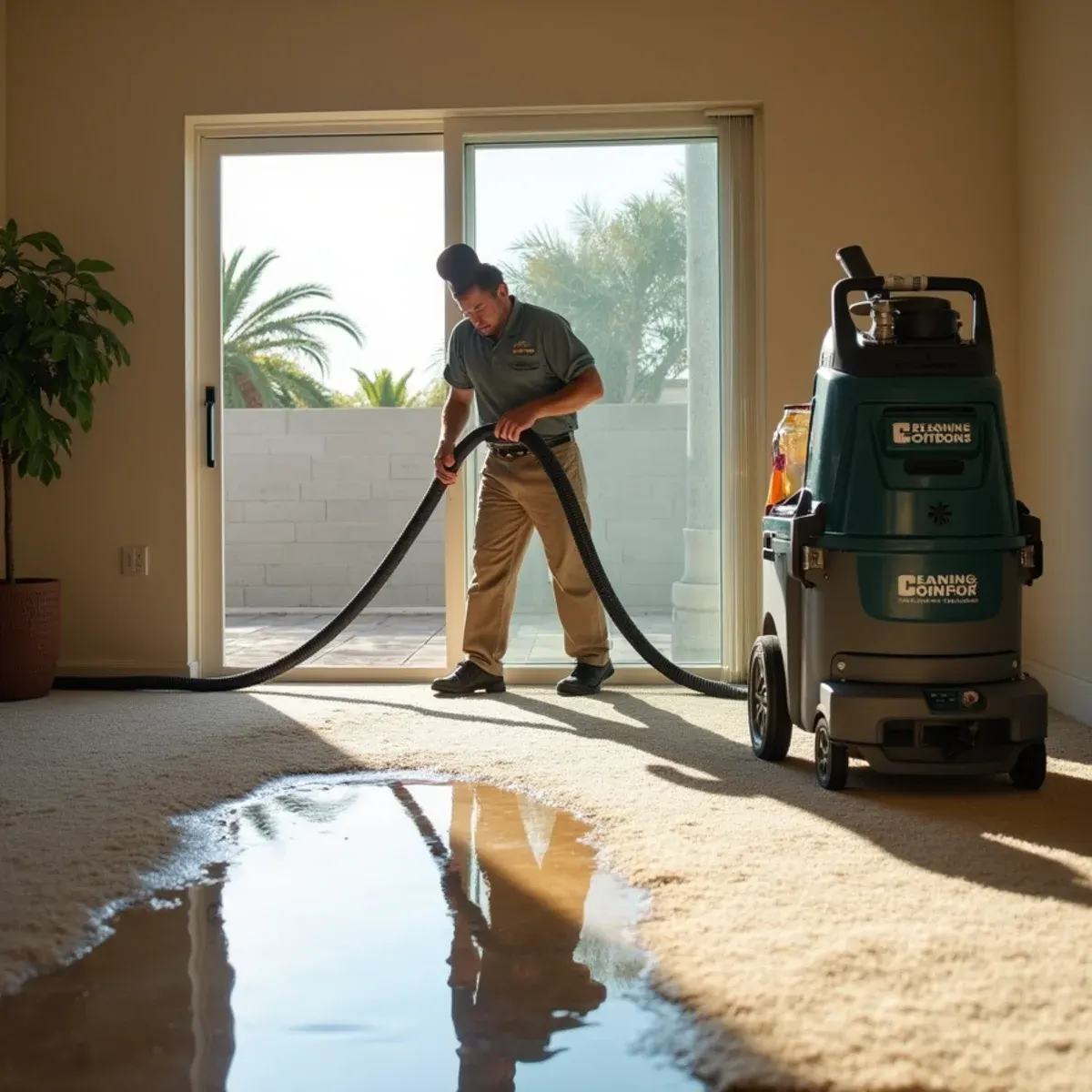
In a lot of Stanton homes, drying the carpet is the easy half of the job, and we would rather say that plainly. The city carries a heavy share of manufactured and mobile homes, and those floors are particleboard decking laid over a belly wrap. When a supply line inside the floor cavity fails, the wrap holds water against the underside of the deck like a bathtub liner. The carpet on top can come back beautifully. The decking swells, loses its fastener hold and goes soft, and no amount of airflow reverses that.
The other half of Stanton is conventional and we treat it that way. Dense older apartments and single-family houses from the 1950s through the 1970s sit on slab or mixed foundations, and there the work is straightforward: weighted extraction to pull water back through the pad, float the carpet over air movers if the water was clean and we caught it early, pull the pad when it wasn't. What matters most on a Stanton call is establishing which kind of building we're standing in before anyone quotes anything.
What Stanton Changes About Carpet Drying
1Belly wrap holds water under the deck
The wrap that keeps insulation and rodents out keeps water in just as effectively. We look for sag, tap for pooling and open the wrap where the readings justify it, because a leak that started three months ago may still be sitting in there. Drying carpet above an unopened belly wrap wastes your time and your equipment days, and we won't set fans on that.
2Particleboard decking rarely comes back
Particleboard is wood chips and glue. Once it swells, the bond is gone and the panel stays weak even at a normal moisture reading. We check screw hold and deflection rather than trusting the meter alone. If the deck is compromised, the honest sequence is deck replacement first and new carpet after, not a week of fans followed by the same soft spot.
3Tight lots make equipment runs long
Stanton mobile home parks and older apartment courts are dense, with narrow drives and limited parking. Truck-mount hose runs get long, which costs vacuum lift right when weighted extraction needs it most. We plan the route before starting and stage portable extractors inside when the distance from the curb would otherwise cost you extraction quality on the pad.
How the Work Runs
The method is the same one we use on every carpet drying job, documented to the IICRC S500:2025 standard. Here it is in short — the full carpet water damage & drying process explains each stage in detail.
- Map the real wet perimeter
- Identify the pad and the category
- Weighted extraction, pass after pass
- Float the carpet or pull the pad
- Dry the slab or subfloor
- New pad, re-stretch, reinstall
The Stanton Background Worth Knowing
Mobile and manufactured homes need a genuinely different restoration approach, and the reason is what they are built from. The floor system is typically particleboard or OSB over a wood frame with insulation and a vapor barrier belly wrap underneath — and particleboard exposed to water swells, loses structural integrity, and does not recover. It cannot be dried back to serviceable the way plywood often can.
There is more on the housing stock, drainage and plumbing history of this city on our water damage restoration in Stanton page.
Stanton at a glance
- Dominant construction era
- 1950–1975
- Foundation type
- mixed on grade
- Supply piping found here
- galvanized steel, copper, manufactured-home PEX and poly
- Drain line materials
- cast iron
- Terrain and water table
- flat, moderate water table
- Most common local failure
- underfloor leaks in manufactured homes, sealed inside the belly wrap where they cannot evaporate
- Highest-value local prevention
- checking for soft spots underfoot, because a manufactured-home floor gives no other warning
What It Costs in Stanton
We do not quote a number over the phone before seeing the property — anyone who does is guessing. The variables that actually move the price on a carpet drying job are whether the pad is salvageable, square footage and equipment days, what sits under the pad, and they are broken down in full on the carpet water damage & drying page. The assessment and the written estimate are free anywhere in Stanton, day or night, with no obligation.
Carpet Drying Questions from Stanton Homeowners
Because the carpet and the floor are two separate problems here. Carpet and pad sit on top and dry from above with airflow. The particleboard decking underneath is wet from below, held there by the belly wrap, and it swells rather than dries. That soft feel is the panel losing structure around its fasteners. We open the wrap, check deflection and screw hold, and tell you straight whether this is a drying job or a decking replacement.
Frequently it can be saved. The deciding factors are water category, how many hours it sat, and whether the backing has delaminated. Clean supply-line water caught within a day, on carpet that was in decent shape beforehand, usually means we replace the pad and keep the carpet. Anything past Category 1, or carpet that has come apart at the backing, is a different answer. We take the readings and check the backing before saying either way.
No, but it does more often than not. On a clean-water loss we reach quickly, we can float the carpet, push dry air into the pad space, and dry it in place. Moisture-barrier pad, dense slab rubber, and anything that sat overnight in gray water comes out. S500:2025 treats pad as non-restorable once contamination is involved, and field experience supports that. It is inexpensive material against a real risk.
Yes, and we say so explicitly because a lot of companies will not. Manufactured homes need a different approach — opening the belly wrap to dry the floor cavity, removing saturated insulation, and honestly assessing particleboard decking, which usually cannot be dried back to serviceable.