
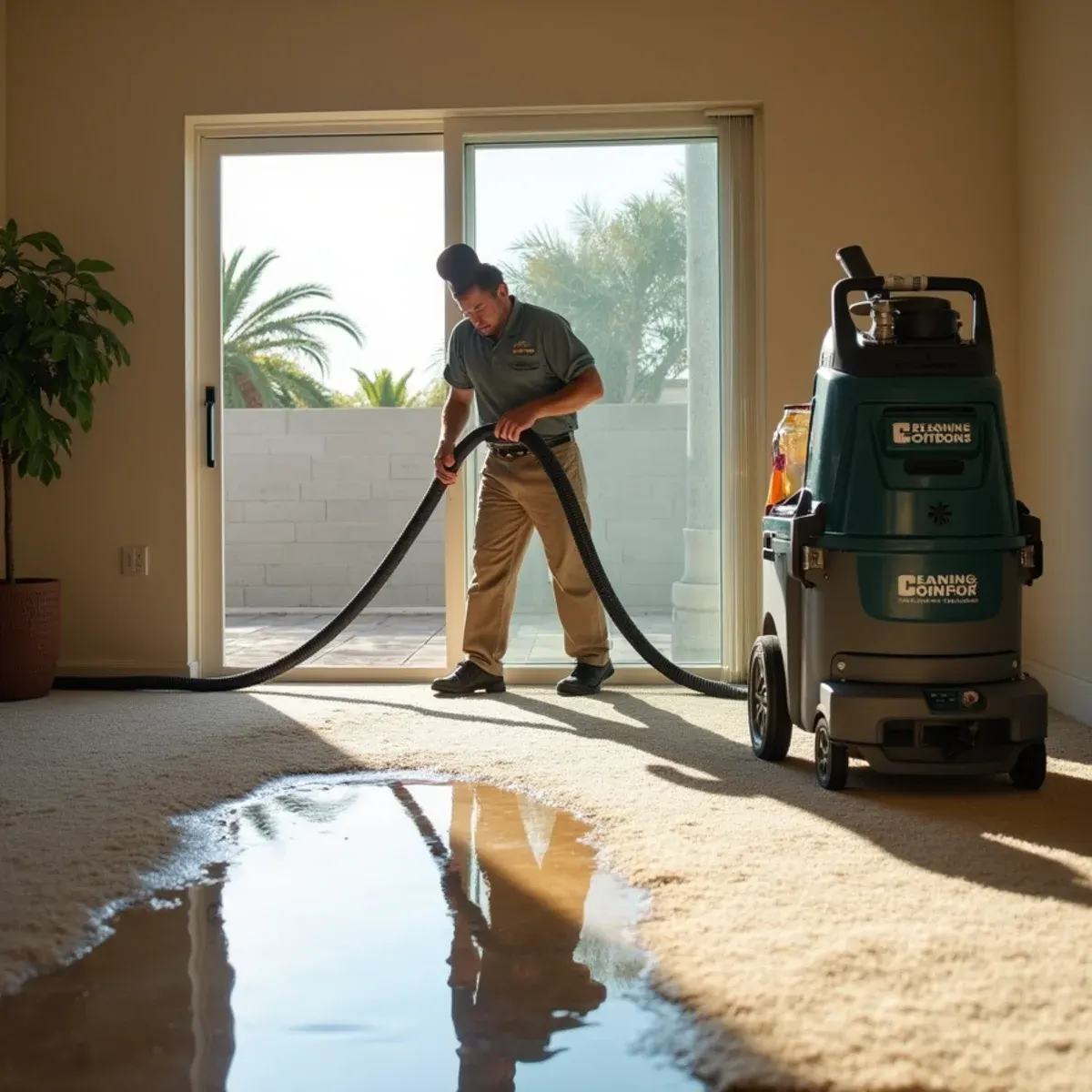
A dry reading on a Westminster slab does not mean the slab is dry, and that one piece of advice saves more carpet here than any equipment we own. The water table sits shallow across this city, especially in the neighborhoods near the Bolsa Chica channel, and those slabs carry a high baseline moisture load as a permanent condition. Pad laid on one of them picks up vapor from below whether or not a pipe ever failed. So the first job on a Westminster carpet call is separating your leak from the ground underneath it.
The housing is 1950s through 1970s slab tract, consistent enough that we can take a control reading in an unaffected room on the same pour and compare. That comparison is the whole ballgame. Commercially, Westminster is different again: the dense independent restaurants and retail along Bolsa Avenue in Little Saigon occupy older buildings where the flooring is usually glue-down carpet in dining and office areas and hard surface in the kitchens. No pad to extract, and the drying decision turns almost entirely on what the water was.
What Westminster Changes About Carpet Drying
1Baseline slab moisture skews the readings
We take a control reading on the same slab in a room the water never reached. Without that number, a Westminster slab looks alarming everywhere and you end up drying concrete that was never part of the loss. With it, we can draw a real boundary and pull pad only where the leak actually went, which usually means less demolition rather than more.
2Test the slab before new pad goes down
Relative humidity probes or a calcium chloride test tell you whether the slab is releasing enough vapor to ruin what gets installed on it. On a shallow-water-table lot near the channel, that answer is often yes. Spending a little on the test before the reinstall beats replacing the same carpet again in eighteen months because it smells.
3Bolsa Avenue carpet is glued, not padded
In the Little Saigon storefronts and upstairs offices, commercial carpet is bonded straight to a 1950s or 1960s slab. There's no pad holding volume, so it either dries in place under directed airflow or comes up in strips. We schedule around service hours where the category allows, because closing a Bolsa Avenue dining room for a week costs far more than the flooring does.
How the Work Runs
The method is the same one we use on every carpet drying job, documented to the IICRC S500:2025 standard. Here it is in short — the full carpet water damage & drying process explains each stage in detail.
- Map the real wet perimeter
- Identify the pad and the category
- Weighted extraction, pass after pass
- Float the carpet or pull the pad
- Dry the slab or subfloor
- New pad, re-stretch, reinstall
The Westminster Background Worth Knowing
Westminster's shallow groundwater means many slabs here carry a higher baseline moisture load than slabs a few miles inland. In an undamaged home with breathable flooring that is usually a non-issue. It becomes an issue in two situations.
There is more on the housing stock, drainage and plumbing history of this city on our water damage restoration in Westminster page.
Westminster at a glance
- Dominant construction era
- 1950–1970
- Foundation type
- slab on grade
- Supply piping found here
- under-slab copper, galvanized steel
- Drain line materials
- cast iron
- Terrain and water table
- coastal-flat, shallow water table
- Most common local failure
- flooring installed over a slab that was never tested and is still releasing vapor
- Highest-value local prevention
- in-situ slab relative humidity testing before any new floor goes down
What It Costs in Westminster
We do not quote a number over the phone before seeing the property — anyone who does is guessing. The variables that actually move the price on a carpet drying job are whether the pad is salvageable, square footage and equipment days, what sits under the pad, and they are broken down in full on the carpet water damage & drying page. The assessment and the written estimate are free anywhere in Westminster, day or night, with no obligation.
Carpet Drying Questions from Westminster Homeowners
That's a common Westminster story and it usually isn't a leak at all. With the water table this shallow, slabs here release vapor continuously, and pad installed over an untested slab absorbs it, stays slightly damp and grows odor-causing bacteria at the backing. Nothing about the installation looked wrong. Before your next carpet goes in, get a relative humidity probe reading on the slab. If it's high, a vapor barrier or a different flooring choice solves it permanently.
Frequently it can be saved. The deciding factors are water category, how many hours it sat, and whether the backing has delaminated. Clean supply-line water caught within a day, on carpet that was in decent shape beforehand, usually means we replace the pad and keep the carpet. Anything past Category 1, or carpet that has come apart at the backing, is a different answer. We take the readings and check the backing before saying either way.
No, but it does more often than not. On a clean-water loss we reach quickly, we can float the carpet, push dry air into the pad space, and dry it in place. Moisture-barrier pad, dense slab rubber, and anything that sat overnight in gray water comes out. S500:2025 treats pad as non-restorable once contamination is involved, and field experience supports that. It is inexpensive material against a real risk.
Westminster has a shallow water table, so slabs here carry more baseline moisture than slabs further inland. Normally that is harmless, but it matters when installing flooring over the slab and it means drying after a loss takes longer. We test with in-situ relative humidity probes before any new floor goes down.