
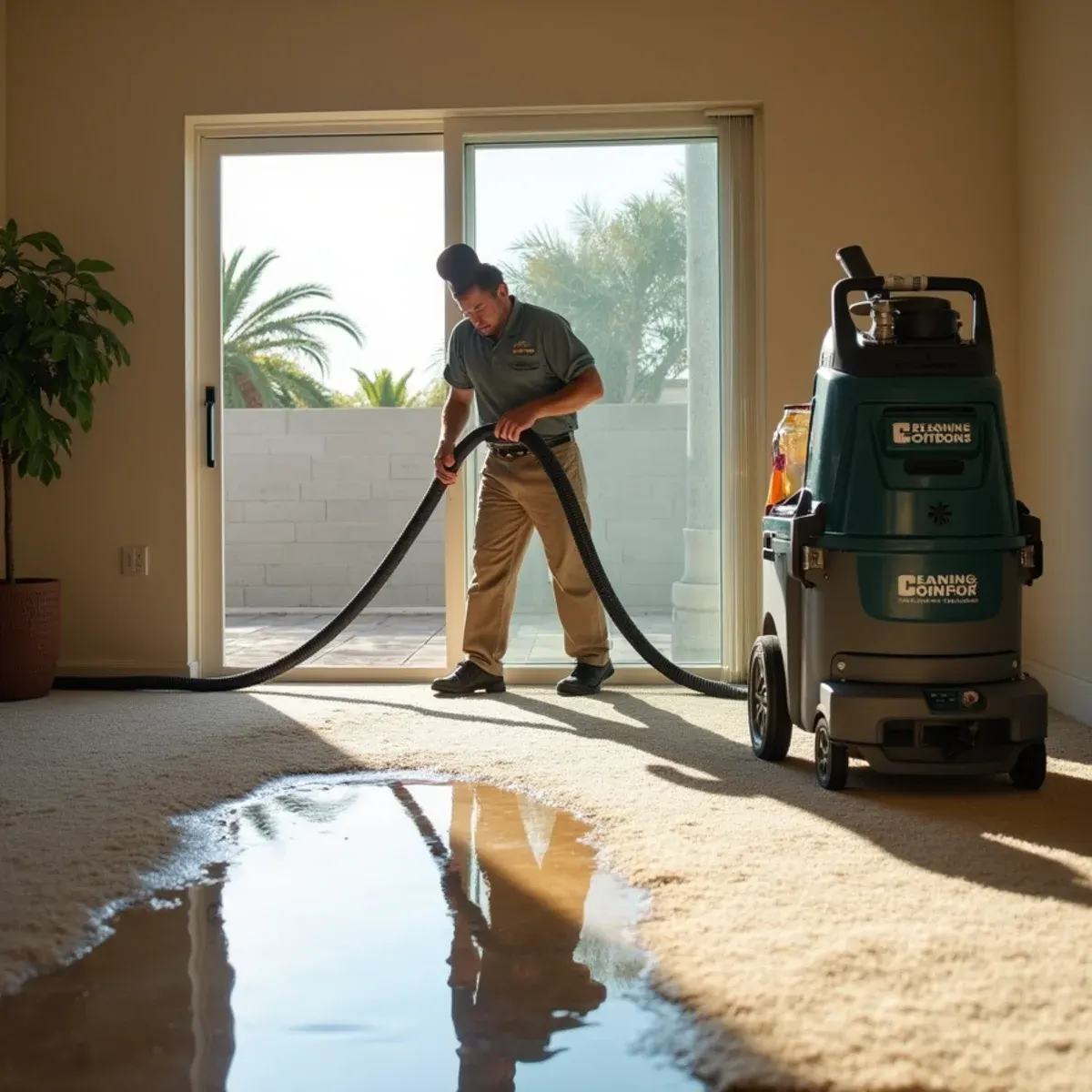
If you've already called a few companies, you've probably heard some version of we don't cover that. Midway City is unincorporated county, one square mile of roughly 8,500 people wedged between Westminster and Huntington Beach with no city hall of its own, so it falls off service maps built from city names. Your mailing address may even read Westminster. We dispatch here as fast as conditions allow, and if you give us the nearest cross street we'll find you faster than an address search will.
The housing runs 1940 to 1960 with mixed foundations, and a substantial share of it is manufactured homes. That share drives the work. Manufactured floors are particleboard decking over a belly wrap, and when a line inside the cavity fails, the wrap holds water against the deck for months. Carpet on top often dries fine and the decking underneath does not. In the older stick-built houses, some with raised sections and sub-floor voids, it's more conventional: extract, assess the pad, then check what the water did below the finished floor.
What Midway City Changes About Carpet Drying
1Belly wrap traps water under the floor
The wrap under a manufactured home floor is designed to keep things out, and it keeps water in just as well. Leaks in that cavity can sit for months without a stain appearing in the room. We look for sag and pooling, open the wrap where the readings justify it, and get the water out before anyone talks about carpet. Fans above a full wrap accomplish nothing.
2County permitting, no city counter
Being unincorporated means anything past emergency drying and reinstall goes through Orange County rather than a city building department. It doesn't slow the extraction or the dry-out, which need no permit at all. It does affect the repair schedule, and knowing that on day one keeps expectations honest about when your flooring actually goes back down.
3Address confusion delays first response
Plenty of Midway City addresses show up as Westminster or Huntington Beach in mapping software, and that costs minutes while a pad is filling. Tell us the cross street when you call. We would rather navigate to an intersection we know than to a pin dropped two neighborhoods away while your carpet keeps drinking.
How the Work Runs
The method is the same one we use on every carpet drying job, documented to the IICRC S500:2025 standard. Here it is in short — the full carpet water damage & drying process explains each stage in detail.
- Map the real wet perimeter
- Identify the pad and the category
- Weighted extraction, pass after pass
- Float the carpet or pull the pad
- Dry the slab or subfloor
- New pad, re-stretch, reinstall
The Midway City Background Worth Knowing
Midway City's housing stock is older than its neighbors on average, with a good deal of it predating 1960, and it includes a substantial mobile home population. That combination produces a specific mix of problems.
There is more on the housing stock, drainage and plumbing history of this city on our water damage restoration in Midway City page.
Midway City at a glance
- Dominant construction era
- 1940–1960
- Foundation type
- mixed on grade
- Supply piping found here
- galvanized steel, copper, manufactured-home supply lines
- Drain line materials
- cast iron, clay
- Terrain and water table
- coastal-flat, shallow water table
- Most common local failure
- manufactured-home underfloor leaks trapped in the belly wrap, which can sit for months
- Highest-value local prevention
- treating any spongy floor area as a moisture problem until a meter says otherwise
What It Costs in Midway City
We do not quote a number over the phone before seeing the property — anyone who does is guessing. The variables that actually move the price on a carpet drying job are whether the pad is salvageable, square footage and equipment days, what sits under the pad, and they are broken down in full on the carpet water damage & drying page. The assessment and the written estimate are free anywhere in Midway City, day or night, with no obligation.
Carpet Drying Questions from Midway City Homeowners
Yes. Midway City being unincorporated is a mapping problem, not a coverage problem, and we work the whole square mile between Westminster and Huntington Beach. It's roughly fourteen minutes from our Katella Avenue shop and we dispatch as fast as conditions allow. Give the dispatcher your cross street along with the address. If your home is manufactured rather than stick-built, mention that too, because the first thing we'll want to look at is the belly wrap under the floor.
Frequently it can be saved. The deciding factors are water category, how many hours it sat, and whether the backing has delaminated. Clean supply-line water caught within a day, on carpet that was in decent shape beforehand, usually means we replace the pad and keep the carpet. Anything past Category 1, or carpet that has come apart at the backing, is a different answer. We take the readings and check the backing before saying either way.
No, but it does more often than not. On a clean-water loss we reach quickly, we can float the carpet, push dry air into the pad space, and dry it in place. Moisture-barrier pad, dense slab rubber, and anything that sat overnight in gray water comes out. S500:2025 treats pad as non-restorable once contamination is involved, and field experience supports that. It is inexpensive material against a real risk.
Yes, fully. It is about a fourteen-minute run from our Cypress base — closer than several cities we serve routinely — and the 60-minute response commitment applies here the same as anywhere else in our area.