
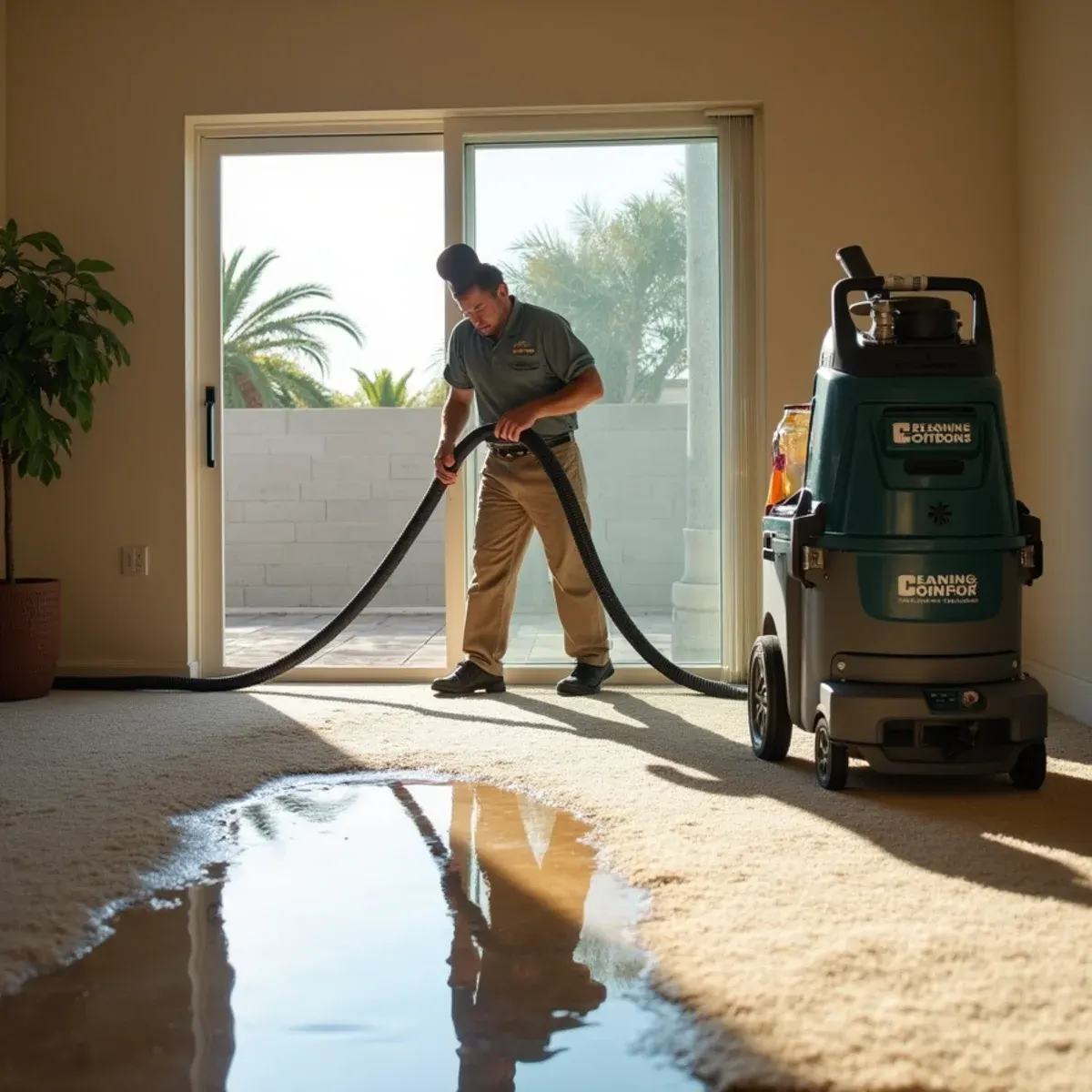
Much of pre-war Fullerton sits on a raised foundation, and that changes carpet work completely. The Craftsman and Spanish Revival homes in the older neighborhoods have old-growth Douglas fir joists and a crawl space under a board or plank sub-floor. Carpet over that assembly does not behave like carpet over slab. Water passes through the seams and drips away rather than pooling, so the carpet reads only mildly damp while the sub-floor and framing underneath quietly take the whole volume. Leaks here run for weeks before anyone has a reason to call.
The rest of the city adds its own wrinkles. Raymond Hills and Sunny Hills are hillside, where gravity gives water a head start between levels. And the dense student rental stock around Cal State Fullerton and Fullerton College comes with chronic delayed reporting, because a tenant who isn't paying for the flooring rarely calls the same day. By the time a landlord hears about it, clean water has become Category 3, and the pad is no longer a decision anyone gets to make.
What Fullerton Changes About Carpet Drying
1Crawl space inspection is part of the job
On a raised Fullerton foundation, we don't quote carpet drying until somebody has been under the house. Water that passed through the sub-floor sits on soil, wets joists and feeds the underside of the boards your pad is lying on. Drying only from above sets up a slow re-wet, and the mold that follows shows up in the crawl space long before it shows in the room.
2Old-growth fir sub-floor dries slowly
Douglas fir plank sub-flooring from the 1910s and 1920s is dense, tight-grained material that holds water longer than modern plywood and gives it back grudgingly. That means more equipment days on a pre-war Fullerton house than on a comparable slab loss. It also means the wood usually survives if you're patient with it, which is worth the extra time.
3Student rentals report late, category climbs
Around the two campuses we regularly arrive at a carpet loss that has been sitting since the weekend. Category is a function of time as much as source. Clean supply water becomes Category 2 in roughly two days and Category 3 after that, at which point pad and often carpet come out regardless of how good they look. Calling the same day genuinely changes the outcome.
How the Work Runs
The method is the same one we use on every carpet drying job, documented to the IICRC S500:2025 standard. Here it is in short — the full carpet water damage & drying process explains each stage in detail.
- Map the real wet perimeter
- Identify the pad and the category
- Weighted extraction, pass after pass
- Float the carpet or pull the pad
- Dry the slab or subfloor
- New pad, re-stretch, reinstall
The Fullerton Background Worth Knowing
The pre-war homes around downtown Fullerton were built with materials that behave completely differently from modern construction. Lath and plaster walls hold several times the water drywall does. Old-growth Douglas fir framing is dense and dries slowly. Original oak and fir flooring is thick, high-quality material that is well worth saving.
There is more on the housing stock, drainage and plumbing history of this city on our water damage restoration in Fullerton page.
Fullerton at a glance
- Dominant construction era
- 1910–1980
- Foundation type
- mixed on grade
- Supply piping found here
- galvanized steel, copper, original pre-war piping
- Drain line materials
- cast iron, clay
- Terrain and water table
- rolling, moderate water table
- Most common local failure
- crawl-space leaks that run undetected for weeks because the water drips away instead of pooling on a floor
- Highest-value local prevention
- posting a shutoff location and emergency contact in every rental, since delayed reporting is the local failure mode
What It Costs in Fullerton
We do not quote a number over the phone before seeing the property — anyone who does is guessing. The variables that actually move the price on a carpet drying job are whether the pad is salvageable, square footage and equipment days, what sits under the pad, and they are broken down in full on the carpet water damage & drying page. The assessment and the written estimate are free anywhere in Fullerton, day or night, with no obligation.
Carpet Drying Questions from Fullerton Homeowners
On a raised Fullerton foundation, almost certainly under the floor. Water runs through the sub-floor seams and lands in the crawl space, where it sits on soil and wets joists from below. The carpet meters low because it never held much, but the assembly beneath it is soaked and that's what you're smelling coming up through the seams. We open an access point and inspect underneath before setting a single air mover in the room.
Frequently it can be saved. The deciding factors are water category, how many hours it sat, and whether the backing has delaminated. Clean supply-line water caught within a day, on carpet that was in decent shape beforehand, usually means we replace the pad and keep the carpet. Anything past Category 1, or carpet that has come apart at the backing, is a different answer. We take the readings and check the backing before saying either way.
No, but it does more often than not. On a clean-water loss we reach quickly, we can float the carpet, push dry air into the pad space, and dry it in place. Moisture-barrier pad, dense slab rubber, and anything that sat overnight in gray water comes out. S500:2025 treats pad as non-restorable once contamination is involved, and field experience supports that. It is inexpensive material against a real risk.
Yes, and they need a different approach. Lath and plaster and old-growth framing hold far more water than modern materials and dry much more slowly, so we plan for seven to fourteen days with higher-capacity equipment. The original material is worth that effort — nothing sold today replaces it.