
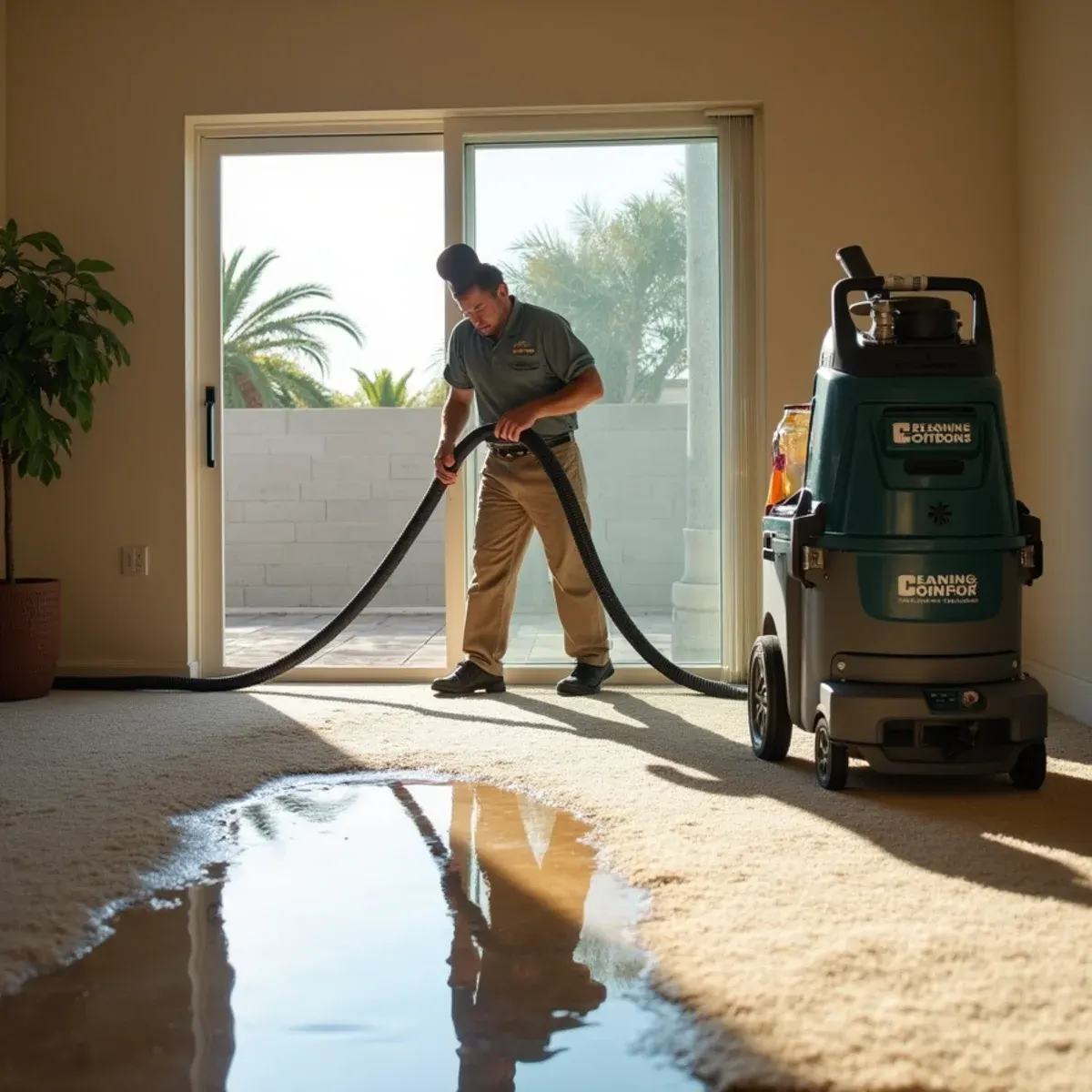
The call usually starts the same way: wet carpet in a back bedroom, and nothing in that room leaks. La Mirada was laid out on rolling ground, not the flat tract land west of here, and that grade keeps working after water gets inside. It runs along the slab under the pad, follows the fall of the lot, and pools against the tack strip on the low wall. By the time somebody steps on it, the entry point is often a patio door or a planter bed twenty or thirty feet uphill.
Almost the whole city went up between the early fifties and the mid sixties, so the slabs are consistent and so is what sits on them: original perimeter grade that has since been buried under added patios, raised planters and low retaining walls. That added hardscape is what sends storm water back toward the house here. Water that crossed soil and hardscape is not clean water, whatever it looked like coming in, so the pad comes out. The carpet itself is frequently fine. Around Biola, student rentals bring their own version, with thin pad under carpet that has already been cleaned hard.
What La Mirada Changes About Carpet Drying
1Water travels downhill under the pad
Finding the wet edge is not finding the source. On a graded La Mirada lot we meter across the slab, not just where the carpet feels damp, and work uphill toward the entry. Pulling and drying only the visible wet area leaves saturated pad on the run between, and that strip is what smells three weeks later.
2Fifty years of added hardscape
Patios poured up against the stem wall, planters holding wet soil at slab level, retaining walls that turned a sheet flow into a channel. None of it was there when the tract was graded. When carpet in a La Mirada family room wets during a storm and not during a shower, that outside grade is the first thing we look at, and we say so in the report your adjuster reads.
3Biola-area rentals and turnover carpet
Rental units near Biola tend to run thin pad and carpet that has been through several tenants. That changes the math. Weighted extraction and floating still work, but if the backing is already delaminating from prior cleanings, saving it buys a few months. We tell the owner that plainly rather than bill for drying something that gets replaced anyway.
How the Work Runs
The method is the same one we use on every carpet drying job, documented to the IICRC S500:2025 standard. Here it is in short — the full carpet water damage & drying process explains each stage in detail.
- Map the real wet perimeter
- Identify the pad and the category
- Weighted extraction, pass after pass
- Float the carpet or pull the pad
- Dry the slab or subfloor
- New pad, re-stretch, reinstall
The La Mirada Background Worth Knowing
La Mirada's gentle slopes mean storm water moves across properties instead of sitting on them, which is generally an advantage — except where fifty years of added patios, raised planters, retaining walls, and settled hardscape have redirected it.
There is more on the housing stock, drainage and plumbing history of this city on our water damage restoration in La Mirada page.
La Mirada at a glance
- Dominant construction era
- 1953–1965
- Foundation type
- slab on grade
- Supply piping found here
- under-slab copper, galvanized steel
- Drain line materials
- cast iron
- Terrain and water table
- rolling, moderate water table
- Most common local failure
- exterior water entering where fifty years of added patios, planters and retaining walls redirected the original drainage back toward the house
- Highest-value local prevention
- walking the property during the first real rain and watching where water actually goes
What It Costs in La Mirada
We do not quote a number over the phone before seeing the property — anyone who does is guessing. The variables that actually move the price on a carpet drying job are whether the pad is salvageable, square footage and equipment days, what sits under the pad, and they are broken down in full on the carpet water damage & drying page. The assessment and the written estimate are free anywhere in La Mirada, day or night, with no obligation.
Carpet Drying Questions from La Mirada Homeowners
Usually yes, the pad usually not. Water that crossed a La Mirada patio, planter bed or lawn picks up soil bacteria and fertilizer on the way in, which puts it past clean-water category no matter how clear it looked. Pad is porous and cheap to replace. Carpet with sound backing gets extracted, treated and floated over air movers, then re-stretched and re-tacked once the slab reads dry.
Frequently it can be saved. The deciding factors are water category, how many hours it sat, and whether the backing has delaminated. Clean supply-line water caught within a day, on carpet that was in decent shape beforehand, usually means we replace the pad and keep the carpet. Anything past Category 1, or carpet that has come apart at the backing, is a different answer. We take the readings and check the backing before saying either way.
No, but it does more often than not. On a clean-water loss we reach quickly, we can float the carpet, push dry air into the pad space, and dry it in place. Moisture-barrier pad, dense slab rubber, and anything that sat overnight in gray water comes out. S500:2025 treats pad as non-restorable once contamination is involved, and field experience supports that. It is inexpensive material against a real risk.
Almost always exterior drainage rather than a plumbing leak — a plugged area drain, a patio that has settled toward the house, or a planter holding moisture against the wall. We identify the actual path rather than just drying the wall, because drying without fixing the cause means doing it again next storm.