
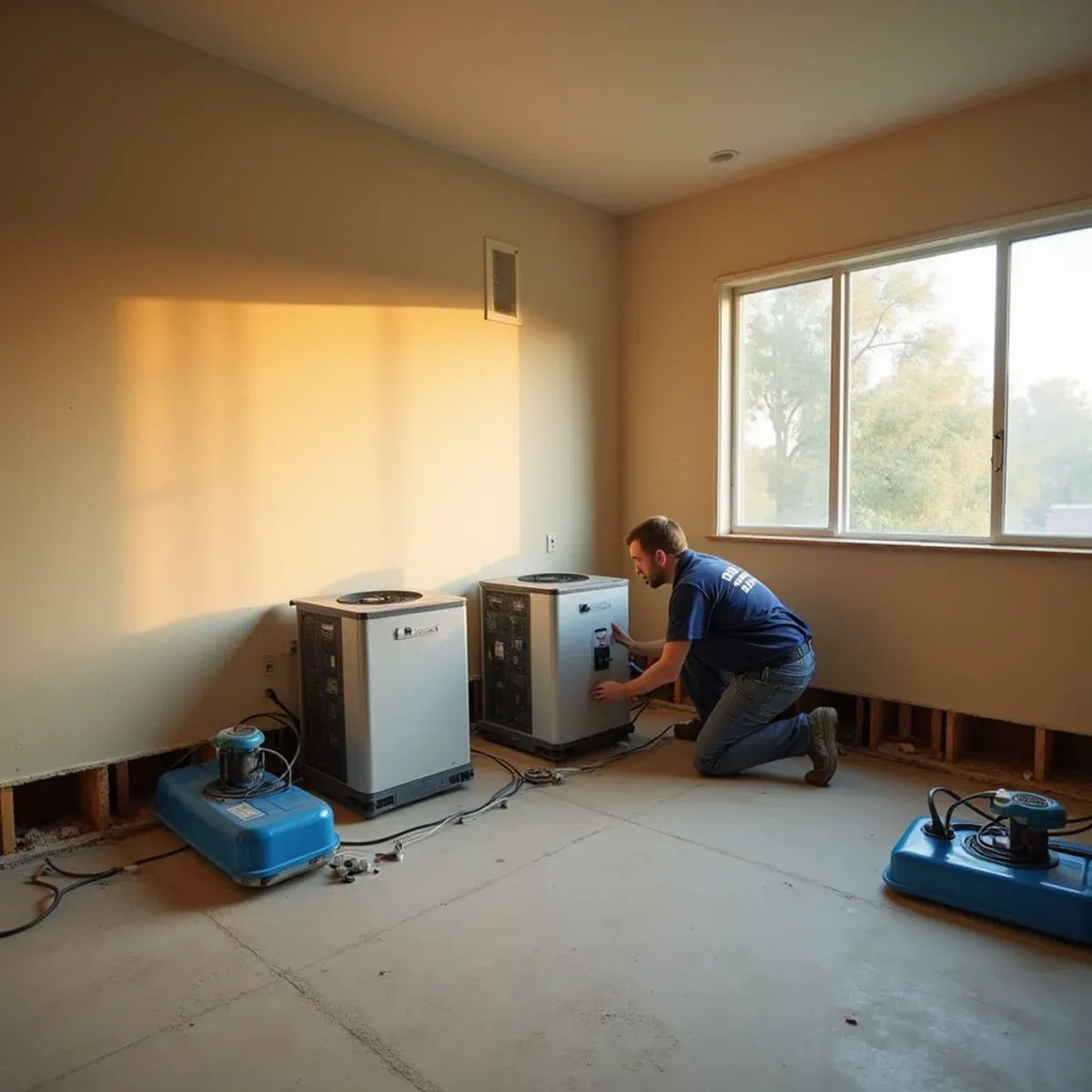
Placentia's tract housing came up off the Valencia groves in one long push from the mid-fifties through the seventies, which means the houses share a vintage, a slab detail and a copper supply system now well past its service life. When that copper lets go near the Morse Avenue area or out toward Alta Vista, hot water spreads sideways under the flooring long before it shows at a baseboard. The floor covering usually looks fine on day one. The meter says otherwise, and the wall cavities are already picking up the difference.
That's where drying in place earns its keep. Instead of pulling laminate or engineered wood, we can often seal the affected area and pull air through the flooring assembly with mat systems while an LGR takes moisture out of the room. It doesn't work everywhere. Some glued-down and click-lock products won't release water fast enough, and we'll say so on the first visit. Around Old Town Placentia the stock is older and less predictable, and the student rentals near Cal State Fullerton usually need documentation for a landlord and a carrier at once.
What Placentia Changes About Structural Drying
1Mat drying instead of pulling the floor
When a slab leak wets a floor covering that can release moisture, we can often dry the assembly in place, with negative-pressure mats drawing air through the floor while an LGR handles the room. It saves the flooring and most of the reinstallation cost. It isn't right for every product, and we'd rather tell you on day one that yours isn't a candidate than waste four days finding out.
2Hot-water leaks load the room fast
Most Placentia slab failures are on the hot side, and hot water evaporates into the room quickly. Humidity climbs, condensation shows on windows, and wall cavities pick up moisture well beyond the wet flooring. That's why dehumidification goes in immediately, before the flooring question is settled. Controlling the air is what stops the damage from spreading sideways into rooms that are still dry.
3Rentals need a documented drying log
Plenty of these tract houses near Cal State Fullerton are rentals, and a landlord, a tenant and a carrier all end up reading the same file. Daily readings, equipment placement, temperature, relative humidity and the dry standard we set get logged each visit as S500:2025 expects. That record settles arguments about whether a unit was returned dry far better than anyone's memory does.
How the Work Runs
The method is the same one we use on every structural drying job, documented to the IICRC S500:2025 standard. Here it is in short — the full structural drying & dehumidification process explains each stage in detail.
- Establish the dry standard
- Calculate the load and build the chamber
- Place air movers for surface evaporation
- Run LGR dehumidification to capture the moisture
- Monitor and adjust daily
- Verify, document, and demobilize
The Placentia Background Worth Knowing
Copper under a slab fails in two directions at once. From the inside, decades of water flow erode thin spots at bends and fittings, especially on the hot side where the metal runs warmer and the water moves faster. From the outside, soil chemistry and stray current attack the pipe wall. Either way the result is a pinhole rather than a burst, which is precisely why these losses are so expensive by the time we see them. A pinhole under concrete can run for months, soaking the sub-base, wicking up into the slab, and surfacing at the edge of the carpet as a stain nobody can explain.
There is more on the housing stock, drainage and plumbing history of this city on our water damage restoration in Placentia page.
Placentia at a glance
- Dominant construction era
- 1955–1980
- Foundation type
- slab on grade
- Supply piping found here
- under-slab copper, galvanized steel
- Drain line materials
- cast iron
- Terrain and water table
- flat, moderate water table
- Most common local failure
- under-slab copper reaching the end of its service life across whole tracts at once
- Highest-value local prevention
- the annual water-meter test, and treating a neighbor's slab leak as information
What It Costs in Placentia
We do not quote a number over the phone before seeing the property — anyone who does is guessing. The variables that actually move the price on a structural drying job are size of the drying chamber, class of water intrusion, material types involved, and they are broken down in full on the structural drying & dehumidification page. The assessment and the written estimate are free anywhere in Placentia, day or night, with no obligation.
Structural Drying Questions from Placentia Homeowners
Concrete dries, just slowly, and the flooring is usually the real question. If your floor covering will pass moisture, we can often dry the assembly in place with mat systems pulling air through it. Glued-down vinyl, some engineered products and tile set in a thick mortar bed won't release water fast enough, and forcing it wastes days. We test on the first visit and tell you which situation you're in before anything is removed.
Three to five days covers most residential losses. Saturated hardwood, plaster, or a concrete slab can run seven or more. We will give you an estimated window after the first readings and update you daily — and equipment comes out when the numbers say so, not on a fixed schedule.
We would rather you did not. Drying is a continuous process, and every hour off extends the total run — which usually costs more than the sleep is worth. If noise is genuinely unmanageable we can often reconfigure the chamber or reposition units to reduce it. Talk to us instead of unplugging them.
Worried is the wrong word, but you should start paying attention. These tracts were built in tight windows with the same copper at the same depth in the same soil, so failures cluster on a street rather than scattering randomly. Treat a neighbor's slab leak as a service bulletin for your own house. Run the meter test, listen for the water heater cycling at odd hours, and check the hallway and bedroom floors for warm or damp patches every so often.