
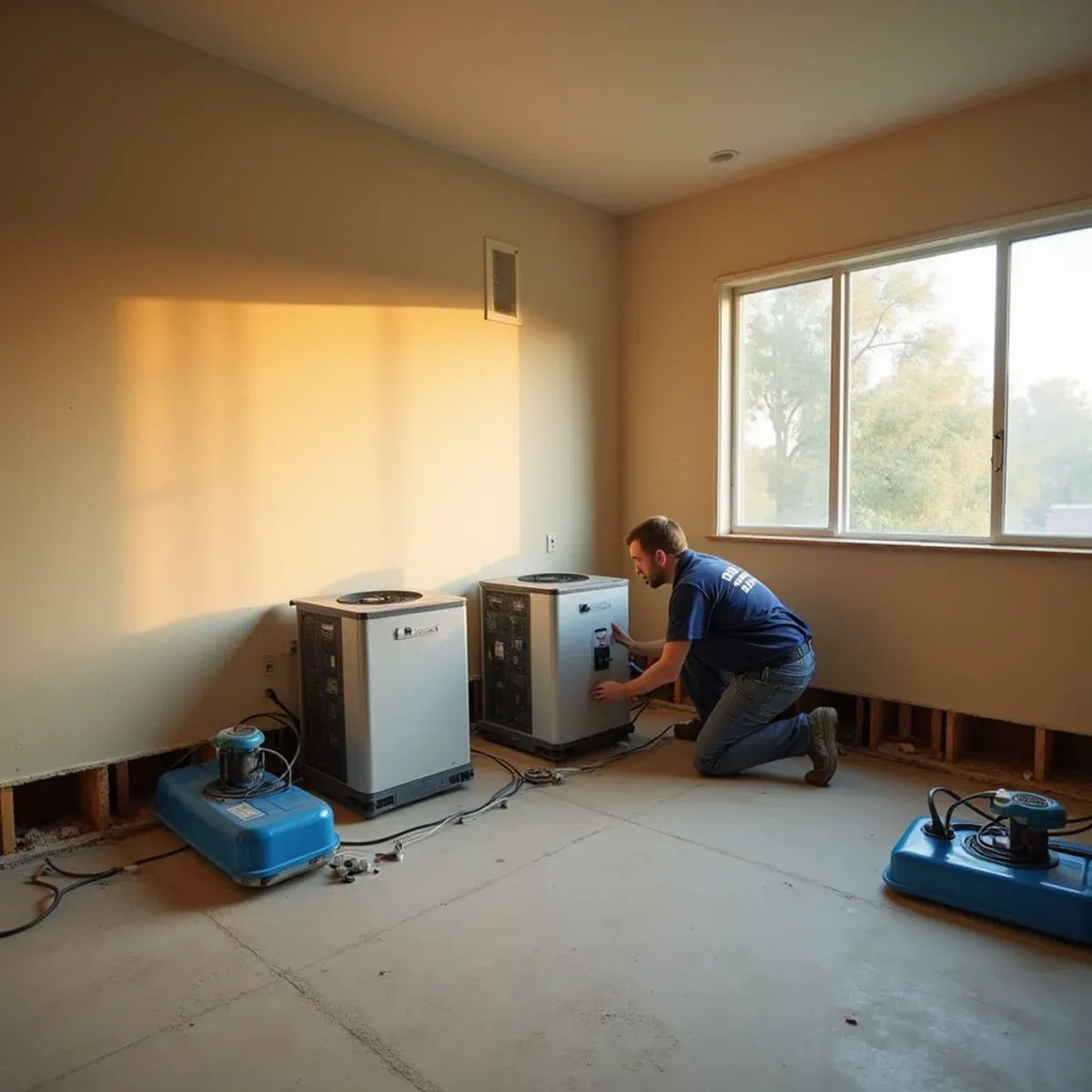
The first thing we look at on a Yorba Linda call usually isn't the wet drywall. It's where the water came from, because on these hillside lots it's often not a pipe at all. Terrace drains, v-ditches, retaining-wall weeps and slope drainage above the pads in Bryant Ranch, Travis Ranch and Vista del Verde are what keep an engineered hillside from turning into a funnel. When one is blocked, a concentrated storm delivers water to the low side of the house: bottom plates, the first foot of drywall, behind the built-ins.
That origin decides the whole plan. S500:2025 puts storm and ground water in Category 3, and the honest consequence is that saturated carpet, pad and the lower band of drywall come out rather than getting dried in place. What we do dry is the structure behind them, framing, sheathing, slab edge and cavities, under containment with an LGR holding the chamber. The larger floor plans out here matter too, because a 3,500-square-foot house on one panel won't carry the equipment a full chamber needs.
What Yorba Linda Changes About Structural Drying
1Category 3 water limits drying in place
Storm water that has crossed graded soil, landscaping and a slope drain is not clean. S500:2025 classifies it as Category 3, and the practical result is that soaked carpet, pad and the lower band of drywall and insulation get removed instead of dried. What we dry is what's behind them, framing, sheathing, slab edge and wall cavities, cleaned first and then held under containment.
2Drying waits on the source stopping
You can't dry a wall that's still being fed. If the slope above the pad is still delivering water, the first job is extraction and temporary control, not equipment placement. During a wet stretch that can mean a day or two of holding the line before the real drying schedule starts. We'd rather tell you that than bill you for air movers running against an open tap.
3One panel won't carry a full chamber
The larger plans in East Lake Village and Yorba Linda Estates need enough air movers and dehumidification that a normal residential panel can't carry it alongside the air conditioning. We calculate the load before anything gets plugged in, distribute across circuits, and bring our own power when the math says so. A breaker tripping quietly at two in the morning is a whole lost drying day.
How the Work Runs
The method is the same one we use on every structural drying job, documented to the IICRC S500:2025 standard. Here it is in short — the full structural drying & dehumidification process explains each stage in detail.
- Establish the dry standard
- Calculate the load and build the chamber
- Place air movers for surface evaporation
- Run LGR dehumidification to capture the moisture
- Monitor and adjust daily
- Verify, document, and demobilize
The Yorba Linda Background Worth Knowing
A hillside lot in Yorba Linda is a drainage system with a house attached. Terrace drains cut across the face of the slope to intercept water before it gains speed. Brow ditches run along the top to keep runoff from ever reaching the slope face. Down-drains carry the collected water to the street or a storm connection. Retaining walls have weep holes and, behind them, a gravel subdrain that relieves pressure on the wall. Every one of those was engineered as part of the pad. Every one of them silts up, roots over, or gets buried by landscaping.
There is more on the housing stock, drainage and plumbing history of this city on our water damage restoration in Yorba Linda page.
Yorba Linda at a glance
- Dominant construction era
- 1970–2005
- Foundation type
- slab on grade
- Supply piping found here
- under-slab copper, later PEX and CPVC
- Drain line materials
- ABS, cast iron
- Terrain and water table
- hillside-mixed, deep water table
- Most common local failure
- exterior water from failed slope drainage, terrace drains and retaining-wall systems rather than from plumbing
- Highest-value local prevention
- clearing terrace and slope drains before the season, since a blocked one turns an engineered hillside into a funnel
What It Costs in Yorba Linda
We do not quote a number over the phone before seeing the property — anyone who does is guessing. The variables that actually move the price on a structural drying job are size of the drying chamber, class of water intrusion, material types involved, and they are broken down in full on the structural drying & dehumidification page. The assessment and the written estimate are free anywhere in Yorba Linda, day or night, with no obligation.
Structural Drying Questions from Yorba Linda Homeowners
The structure can be dried. The porous materials usually can't be kept. Water that crossed a graded slope and landscaping counts as Category 3 under S500:2025, so saturated carpet, pad and the lower band of drywall and insulation are removed rather than dried in place. Once that's out we clean, set containment and dry the framing, sheathing and slab edge back to standard. The slope drainage that let it in needs attention before the next storm.
Three to five days covers most residential losses. Saturated hardwood, plaster, or a concrete slab can run seven or more. We will give you an estimated window after the first readings and update you daily — and equipment comes out when the numbers say so, not on a fixed schedule.
We would rather you did not. Drying is a continuous process, and every hour off extends the total run — which usually costs more than the sleep is worth. If noise is genuinely unmanageable we can often reconfigure the chamber or reposition units to reduce it. Talk to us instead of unplugging them.
Seeping from the weep holes is usually the wall doing its job, relieving water pressure from the soil behind it. The concerning version is the opposite: weep holes that stay dry through a storm while the ground above stays soggy, which suggests the subdrain behind the wall is plugged and pressure is building. Also watch for new cracking, bulging, or a wall that has tipped slightly. Those are engineering questions rather than restoration ones, and we will say so.