
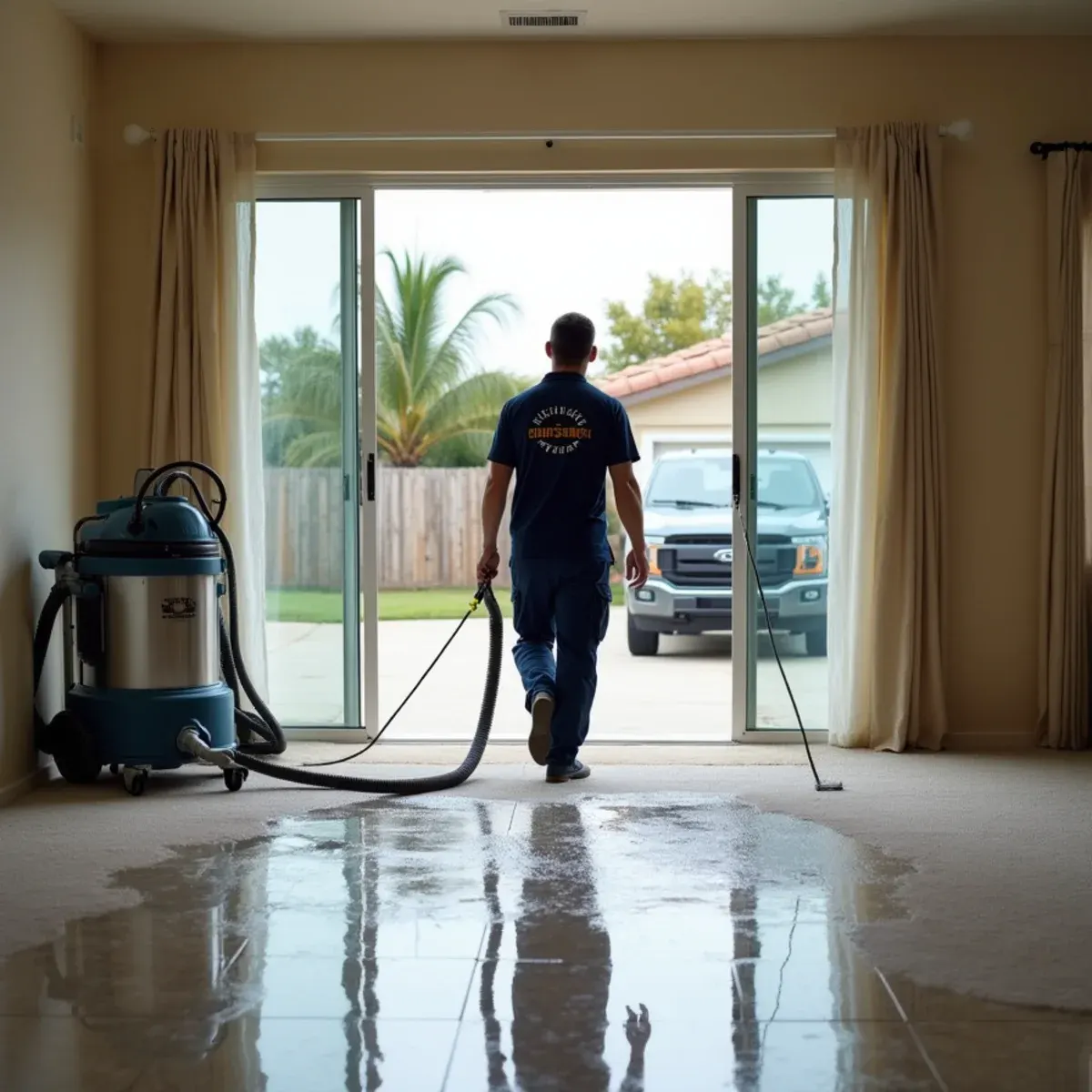
The water we pump out of Yorba Linda homes frequently didn't come from a pipe. It came off the hill. Terrace drains, v-ditches and retaining-wall systems on these engineered slopes are built to move a lot of water fast, and when one plugs with leaf litter or decomposed granite, the flow doesn't stop — it just picks a new route, which is often a side yard, then a slider track, then your family room. In parts of Bryant Ranch and Travis Ranch inside the old Freeway Complex Fire footprint, that runoff carried noticeably more sediment for years afterward.
Silty water changes the extraction. Clean water lifts out of carpet readily; muddy runoff loads the pad with fines that plug an extraction head and stay behind even after the water is gone. So on exterior-origin losses we generally remove pad rather than try to save it, and we treat the water as at minimum Category 2 under IICRC S500:2025 because it crossed soil and hardscape on the way in. Multi-level homes here add gravity — water that enters at the upper pad finds the stairwell.
What Yorba Linda Changes About Water Extraction
1Sediment-loaded water fouls extraction equipment
Runoff off a decomposed-granite slope is not clean water with dirt in it — it's a slurry. It clogs wand jets and vacuum lines, and fines settle into carpet backing where no amount of extraction removes them. We bring debris-tolerant pumps for the bulk removal, pull and bag pad instead of trying to rinse it, and clean equipment between rooms so we aren't spreading sediment.
2Split-level plans send water downstairs
Hillside floor plans in Vista del Verde and East Lake Village often step down with the lot. Water entering at a sliding door on the upper level runs to the stairs and gets a head start. We extract at the bottom first to stop it pooling against the lower slab, then work up, because reversing that order just pushes everything down again.
3Category changes once water crosses soil
Homeowners often assume storm water is clean. Once it has run across a slope, a driveway and a planter, it isn't. We classify it accordingly, which affects what gets saved. Carpet pad, particleboard cabinet bases and drywall wicking above the wet line usually come out. Being direct about that early avoids a second demolition trip a week later.
How the Work Runs
The method is the same one we use on every water extraction job, documented to the IICRC S500:2025 standard. Here it is in short — the full water extraction & removal process explains each stage in detail.
- Bulk removal with submersible pumps
- Truck-mounted extraction on carpet and pad
- Hard-surface and specialty extraction
- Cavity and void extraction
- Removing what cannot be saved
- Post-extraction moisture reading
The Yorba Linda Background Worth Knowing
A hillside lot in Yorba Linda is a drainage system with a house attached. Terrace drains cut across the face of the slope to intercept water before it gains speed. Brow ditches run along the top to keep runoff from ever reaching the slope face. Down-drains carry the collected water to the street or a storm connection. Retaining walls have weep holes and, behind them, a gravel subdrain that relieves pressure on the wall. Every one of those was engineered as part of the pad. Every one of them silts up, roots over, or gets buried by landscaping.
There is more on the housing stock, drainage and plumbing history of this city on our water damage restoration in Yorba Linda page.
Yorba Linda at a glance
- Dominant construction era
- 1970–2005
- Foundation type
- slab on grade
- Supply piping found here
- under-slab copper, later PEX and CPVC
- Drain line materials
- ABS, cast iron
- Terrain and water table
- hillside-mixed, deep water table
- Most common local failure
- exterior water from failed slope drainage, terrace drains and retaining-wall systems rather than from plumbing
- Highest-value local prevention
- clearing terrace and slope drains before the season, since a blocked one turns an engineered hillside into a funnel
What It Costs in Yorba Linda
We do not quote a number over the phone before seeing the property — anyone who does is guessing. The variables that actually move the price on a water extraction job are volume and depth of water, flooring type, contamination level, and they are broken down in full on the water extraction & removal page. The assessment and the written estimate are free anywhere in Yorba Linda, day or night, with no obligation.
Water Extraction Questions from Yorba Linda Homeowners
It matters more, not less. Runoff soaks into pad and wicks up drywall exactly like a plumbing loss, but it also leaves silt and organic material behind, so simply air-drying it leaves contamination in the flooring. We extract the bulk water, remove pad and any wet drywall base, and clean the affected substrate before drying. We'll also walk your terrace drains and v-ditches to find where the water got redirected.
For a typical single-room residential loss, extraction runs one to three hours. Multi-room losses or Category 3 water can take most of a day because of containment setup and material removal. We will give you a realistic timeframe after the walkthrough, before we start.
Often we can save the carpet and only replace the pad, which is the cheaper and less disruptive path. The deciding factors are water category, how long it sat, and whether the pad is a moisture barrier type. Clean water caught quickly usually means the carpet stays.
Seeping from the weep holes is usually the wall doing its job, relieving water pressure from the soil behind it. The concerning version is the opposite: weep holes that stay dry through a storm while the ground above stays soggy, which suggests the subdrain behind the wall is plugged and pressure is building. Also watch for new cracking, bulging, or a wall that has tipped slightly. Those are engineering questions rather than restoration ones, and we will say so.