
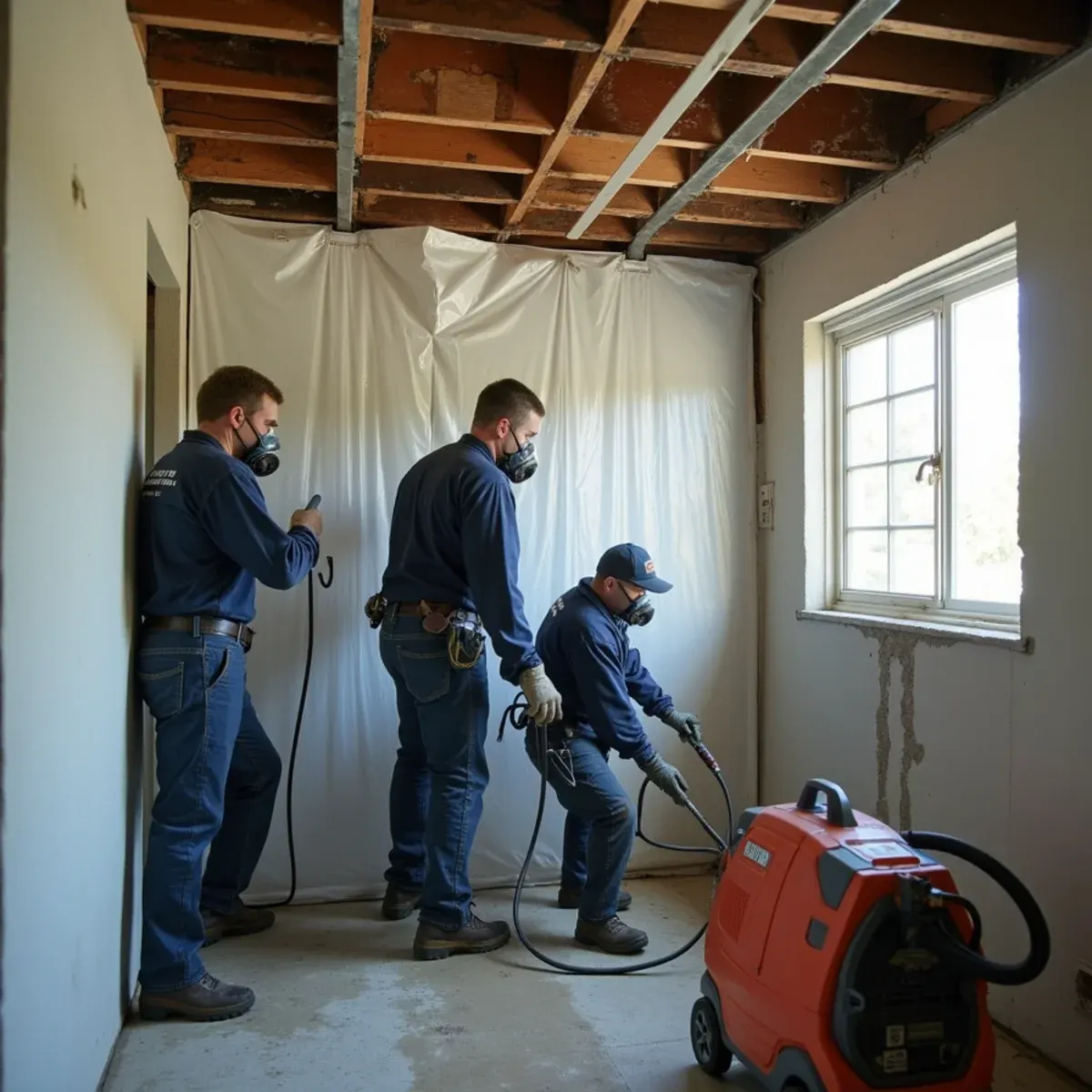
When Lakewood floods, it does not flood one house. Roughly 17,500 homes went up between 1950 and 1953 at up to a hundred a day, to the same pad heights, on the same grading, with the same slab detail — so when a storm gets past the drains on a street near Mayfair Park or Bolivar Park, it gets into a dozen homes at the same depth within the same hour. That changes what an honest restoration company can promise, because equipment and crews are finite and pretending otherwise helps nobody at two in the morning.
The construction itself is a mixed blessing. Slab on grade with no crawl space means floodwater lands directly on the living floor with nowhere to drain away, so everything porous at floor level is in the contaminated zone immediately. But the plans are so consistent that we know the wet cores, the wall assemblies and the flooring generations before we arrive, and that consistency lets us scope quickly and stage the right equipment for a whole block instead of guessing house by house.
What Lakewood Changes About Flood Cleanup
1Block-wide events and honest triage
In a multi-home Lakewood event we prioritize by contamination and occupancy — standing water, elderly residents, households with nowhere else to sleep — and we tell you plainly where you sit in the sequence. If we cannot be there quickly, we say so and tell you what to do meanwhile: shut off power to affected circuits, get contents up off the floor, photograph the water depth before anything moves.
2Slab on grade, nowhere to drain
There is no crawl space to take the water and no basement to hold it. It stays on the floor, wicks into carpet pad, base cabinetry, drywall bottoms and the paper facing on any wall insulation, and it soaks the slab itself. Removal starts immediately and the slab gets its own drying and disinfection cycle, because new flooring over a contaminated, damp slab fails and smells.
3Open walls and seventy-year-old galvanized
Once the lower walls are out for flood work, you are looking at original galvanized supply lines for the first time since 1952. They are scaled, narrowed and eroding at the fittings. Repiping while the walls are already open costs a fraction of doing it as a separate project later, and it is the one genuine opportunity a flood in this city hands you.
How the Work Runs
The method is the same one we use on every flood cleanup job, documented to the IICRC S500:2025 standard. Here it is in short — the full flood damage cleanup process explains each stage in detail.
- Safety assessment and utility check
- Containment and negative air
- Documentation and contents triage
- Extraction and controlled demolition
- Cleaning and disinfection
- Structural drying and clearance
The Lakewood Background Worth Knowing
Galvanized steel supply piping was standard when Lakewood was built, and it fails in a specific and predictable way. The zinc coating protecting the steel wears through from the inside, the steel corrodes, and scale builds up on the interior wall — narrowing the pipe over decades. As the diameter shrinks, water velocity and turbulence increase, which accelerates the erosion at elbows and fittings until a thin spot lets go.
There is more on the housing stock, drainage and plumbing history of this city on our water damage restoration in Lakewood page.
Lakewood at a glance
- Dominant construction era
- 1950–1953
- Foundation type
- slab on grade
- Supply piping found here
- original galvanized steel
- Drain line materials
- cast iron
- Terrain and water table
- flat, moderate water table
- Most common local failure
- seventy-year-old galvanized supply lines letting go at a scaled, eroded fitting
- Highest-value local prevention
- repiping while walls are already open for a repair, rather than as a separate project later
What It Costs in Lakewood
We do not quote a number over the phone before seeing the property — anyone who does is guessing. The variables that actually move the price on a flood cleanup job are how high the water reached, how long it sat before extraction, contents volume in the flooded area, and they are broken down in full on the flood damage cleanup page. The assessment and the written estimate are free anywhere in Lakewood, day or night, with no obligation.
Flood Cleanup Questions from Lakewood Homeowners
By severity and by who has the fewest options — depth of water, contamination, whether anyone in the home is elderly, medically vulnerable, or has nowhere else to sleep. We will tell you honestly where you are in the order rather than promising a truck that is already committed. Meanwhile, extraction you do yourself with a wet vacuum, contents lifted off the floor, and photographs of the water line all meaningfully improve your outcome.
Yes. Water that crossed soil, pavement, or a storm drain is Category 3 by IICRC classification regardless of appearance — it carries bacteria, fuel and oil residue, lawn chemicals, and whatever else was on the ground. Do not walk through it in open shoes, and keep children and pets out of the area entirely.
If the water came from outside across the ground, almost certainly not — that requires separate flood insurance. If it came from a failed water heater, a burst pipe, or a supply line inside the garage, it is usually covered. We document the source carefully because that distinction determines everything.
Have it assessed. Seventy-year-old galvanized has exceeded any reasonable service life, and declining pressure or rust-colored water means it is well along. If a repair is already opening walls, that is the cheapest moment you will ever get to repipe — the demolition and patching are already in the scope.