
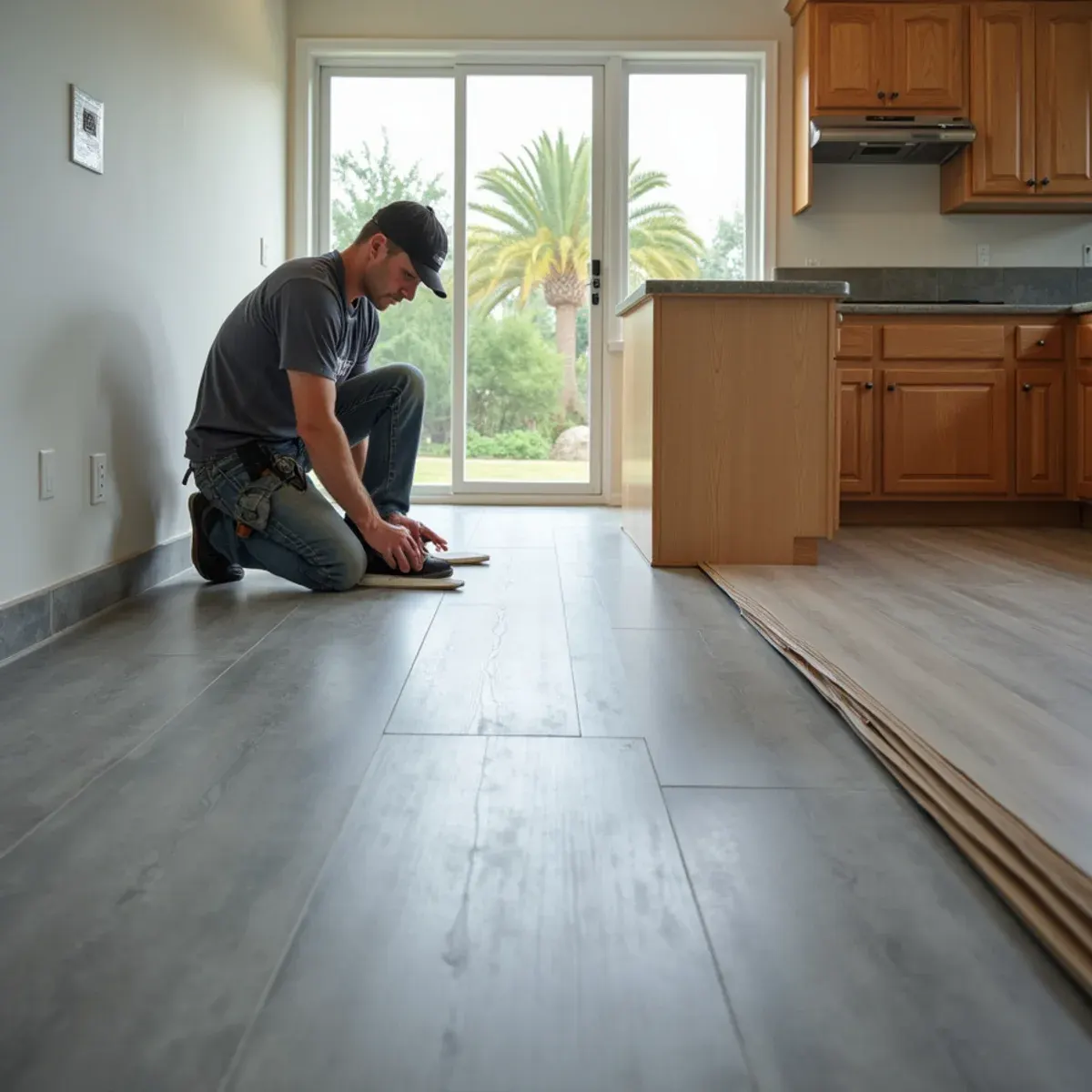
In the Colony District the walls are the reason a vinyl floor takes longer to dry. Lath and plaster holds several times the water drywall does and releases it far more slowly, so a wet wall keeps feeding moisture back into the plank edges and the substrate around the perimeter long after the middle of the room reads dry. We meter walls and floor on the same schedule in those houses. Calling the floor finished while the base of the plaster is still loaded is exactly how the seams lift a second time.
Anaheim is really three different jobs. The West Anaheim postwar tracts are straightforward slab work, closest to what we do every day in Cypress. Anaheim Hills is not, because multi-level homes on graded lots let water under a floating floor run downhill inside the assembly and surface on the level below, often in a room nobody thought was involved. And in the Resort District, hotel and restaurant vinyl runs continuously through public space, so the work gets phased overnight rather than cordoned off for days at a time.
What Anaheim Changes About Vinyl & Laminate Floors
1Plaster keeps re-wetting the floor perimeter
Wet lath and plaster in the Colony District behaves like a reservoir at the base of every wall. It gives moisture back into the plank edges and the substrate for days after the open field of the floor has dried. We track wall readings alongside floor readings and hold equipment until both flatten, which is why these jobs run longer than a comparable tract house across town.
2Hillside levels move water downhill
In Anaheim Hills the floor assembly is not level and the water knows it. A leak on an upper level travels under the plank, follows the framing down the slope, and comes out on the level below, sometimes two rooms away. We start metering downslope of the source rather than around it, because the visible damage is almost never the low point of the loss.
3Resort District floors dry in phases
Hotel corridors and restaurant dining rooms near the Resort District cannot be handed over for four days. We break the run into sections, keep a walkable path open, park equipment out of sight lines during service hours, and do the heavy lifting overnight. Documentation for the property manager gets updated per section, so nobody has to guess which part of the floor is cleared.
How the Work Runs
The method is the same one we use on every vinyl & laminate floors job, documented to the IICRC S500:2025 standard. Here it is in short — the full vinyl & laminate floor water damage process explains each stage in detail.
- Map the wet area before lifting anything
- Lift and number the planks
- Strip what sat under the floor
- Dry the slab to a documented standard
- In-situ RH test before anything goes down
- Reinstall or replace, honestly
The Anaheim Background Worth Knowing
The Anaheim Colony Historic District and the older streets around downtown contain homes built from the early 1900s through the 1930s, and they are constructed differently in ways that matter enormously during a water loss.
There is more on the housing stock, drainage and plumbing history of this city on our water damage restoration in Anaheim page.
Anaheim at a glance
- Dominant construction era
- 1900–2000
- Foundation type
- mixed on grade
- Supply piping found here
- galvanized steel, under-slab copper, original early-century piping in the Colony
- Drain line materials
- cast iron, clay
- Terrain and water table
- hillside-mixed, moderate water table
- Most common local failure
- lath-and-plaster assemblies that hold several times the water drywall does and release it far more slowly
- Highest-value local prevention
- acting immediately on any plaster-wall loss, because wet plaster keys soften and release from the lath
What It Costs in Anaheim
We do not quote a number over the phone before seeing the property — anyone who does is guessing. The variables that actually move the price on a vinyl & laminate floors job are how much floor has to come up, floating, glue-down, or sheet, whether the planks can be reused, and they are broken down in full on the vinyl & laminate floor water damage page. The assessment and the written estimate are free anywhere in Anaheim, day or night, with no obligation.
Vinyl & Laminate Floors Questions from Anaheim Homeowners
The walls, not the floor. Plaster over wood lath absorbs several times what drywall does and gives it back slowly, so the perimeter of your room keeps getting re-wet from the base of the wall while the center dries normally. A postwar West Anaheim house with drywall on slab simply does not have that reservoir. We hold equipment until the wall readings flatten too, which typically adds a few days.
Because the plank is waterproof and the space under it is not. Water gets in at the seams and the perimeter, spreads across the slab, and then has no way out, because the plank blocks evaporation. The flooring is usually the only part of the assembly that is fine. Lifting it is how we reach the underlayment and the concrete, which are the parts holding the moisture.
No. That is one of the few places in this work where the answer is flat. The core is compressed wood fiber and glue, and once water breaks that compression the fibers stay expanded. Drying stops it getting worse; it does not reverse it. If only a few boards near the leak have swollen and the rest reads dry, a partial replacement is sometimes possible, though matching an older run is rarely clean.
Yes, and we approach them differently. Lath and plaster holds much more water than drywall and dries far more slowly, so it needs more equipment and considerably more patience — but it can usually be saved in place, and original plaster is not something a repair can replace.