
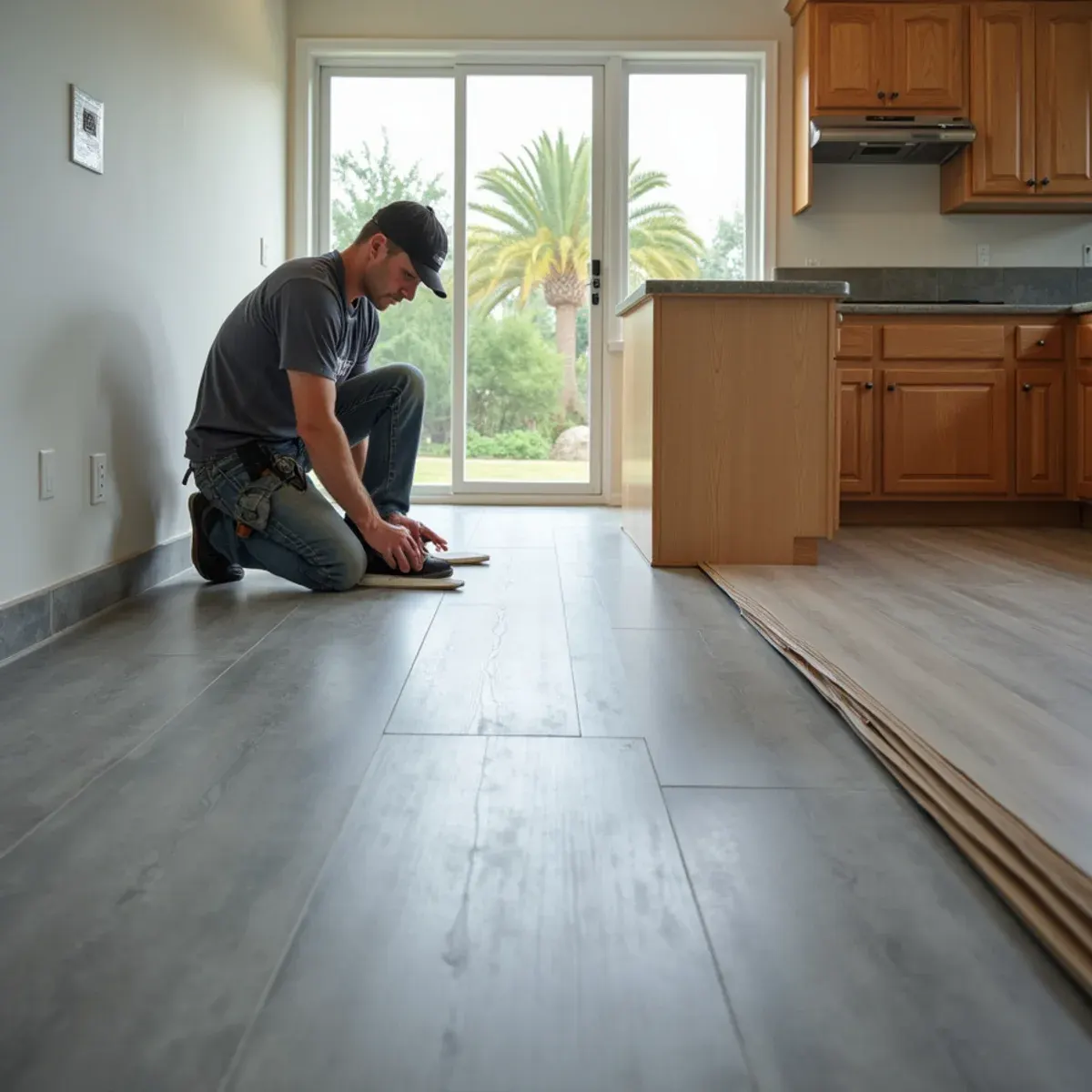
In a manufactured home this job barely resembles the standard one, and Stanton has a great many manufactured homes. Under the vinyl or laminate is particleboard decking, and under that is a belly wrap, a sealed membrane slung beneath the floor frame to hold insulation in place. Water that gets past the flooring does not drain out. It pools in the wrap and sits, sometimes for months, while the finished floor above looks completely ordinary. By the time a laminate edge swells or a vinyl seam lifts, the decking has usually gone soft.
We will tell you plainly what that means. Particleboard decking that has been wet inside a belly wrap does not dry back into a floor you can trust underfoot. The wrap has to be opened and drained, the wet insulation pulled, and the soft decking cut out and replaced. The vinyl plank on top often does come back and can be reinstalled over new decking. Stanton's older apartment stock on slab is the conventional half of this work, and lift, dry, reinstall there moves far faster than anything in the parks.
What Stanton Changes About Vinyl & Laminate Floors
1The belly wrap holds water, not drains it
That membrane exists to keep insulation and rodents in place, and it does the job well enough to keep water in too. A supply line weeping under a bathroom fills the wrap and the water stays there. Nothing shows on the floor and nothing drips on the ground beneath the coach. We open the wrap from below, drain it, and pull the saturated insulation before any drying starts.
2Particleboard decking rarely comes back
Particleboard swells and loses its bond permanently once it has been soaked. You can dry it to a number and it still crumbles at the fasteners. We cut back to sound decking, replace with material rated for the application, and reinstall the plank over that. Anyone quoting you a fan rental and a dry certificate for wet particleboard decking is selling you a repeat visit.
3Slab apartments are the faster half
Stanton is dense, and a lot of the housing is older apartments on slab where none of this applies. There the vinyl lifts, the slab dries with mats and dehumidifiers, and the plank goes back down. We say which version you are in on the first walkthrough, because the two timelines are not remotely comparable and the difference is not something to discover on day four.
How the Work Runs
The method is the same one we use on every vinyl & laminate floors job, documented to the IICRC S500:2025 standard. Here it is in short — the full vinyl & laminate floor water damage process explains each stage in detail.
- Map the wet area before lifting anything
- Lift and number the planks
- Strip what sat under the floor
- Dry the slab to a documented standard
- In-situ RH test before anything goes down
- Reinstall or replace, honestly
The Stanton Background Worth Knowing
Mobile and manufactured homes need a genuinely different restoration approach, and the reason is what they are built from. The floor system is typically particleboard or OSB over a wood frame with insulation and a vapor barrier belly wrap underneath — and particleboard exposed to water swells, loses structural integrity, and does not recover. It cannot be dried back to serviceable the way plywood often can.
There is more on the housing stock, drainage and plumbing history of this city on our water damage restoration in Stanton page.
Stanton at a glance
- Dominant construction era
- 1950–1975
- Foundation type
- mixed on grade
- Supply piping found here
- galvanized steel, copper, manufactured-home PEX and poly
- Drain line materials
- cast iron
- Terrain and water table
- flat, moderate water table
- Most common local failure
- underfloor leaks in manufactured homes, sealed inside the belly wrap where they cannot evaporate
- Highest-value local prevention
- checking for soft spots underfoot, because a manufactured-home floor gives no other warning
What It Costs in Stanton
We do not quote a number over the phone before seeing the property — anyone who does is guessing. The variables that actually move the price on a vinyl & laminate floors job are how much floor has to come up, floating, glue-down, or sheet, whether the planks can be reused, and they are broken down in full on the vinyl & laminate floor water damage page. The assessment and the written estimate are free anywhere in Stanton, day or night, with no obligation.
Vinyl & Laminate Floors Questions from Stanton Homeowners
The vinyl is doing exactly what it is supposed to do and hiding the problem. Sponginess means the particleboard decking under it has been wet long enough to lose its structure, and the water is almost certainly still sitting in the belly wrap below. It will not dry out on its own, because the wrap is sealed. The honest fix is opening the wrap, draining it, replacing the soft decking and reinstalling the plank.
Because the plank is waterproof and the space under it is not. Water gets in at the seams and the perimeter, spreads across the slab, and then has no way out, because the plank blocks evaporation. The flooring is usually the only part of the assembly that is fine. Lifting it is how we reach the underlayment and the concrete, which are the parts holding the moisture.
No. That is one of the few places in this work where the answer is flat. The core is compressed wood fiber and glue, and once water breaks that compression the fibers stay expanded. Drying stops it getting worse; it does not reverse it. If only a few boards near the leak have swollen and the rest reads dry, a partial replacement is sometimes possible, though matching an older run is rarely clean.
Yes, and we say so explicitly because a lot of companies will not. Manufactured homes need a different approach — opening the belly wrap to dry the floor cavity, removing saturated insulation, and honestly assessing particleboard decking, which usually cannot be dried back to serviceable.