
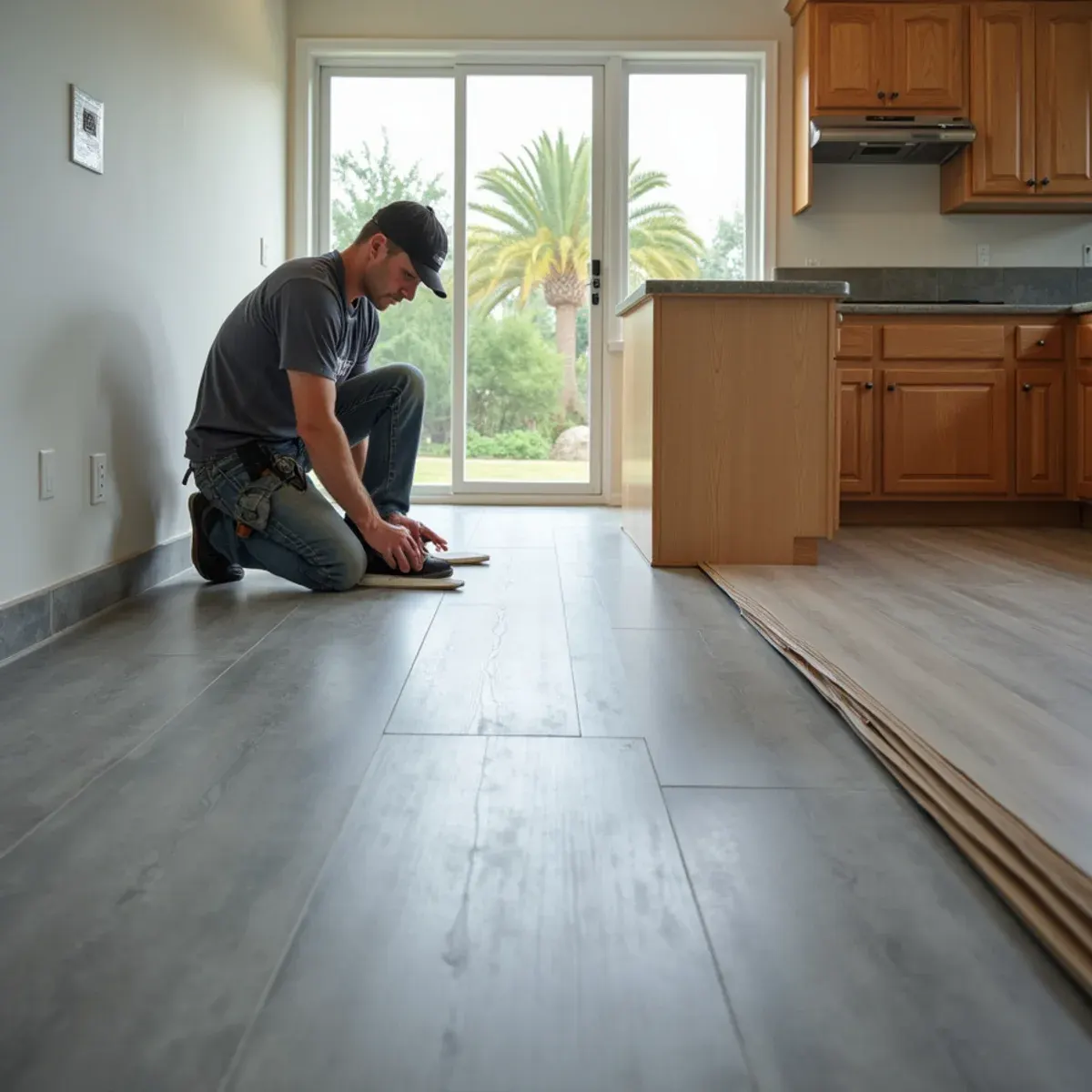
Before anyone lifts a plank we settle which direction the water came from. La Habra gives two common answers and they lead to completely different repairs. From below, the under-slab copper in houses built between 1950 and 1980 has reached the age where pinholes start, and a hot-side failure warms the concrete and wets it from underneath. From above, decades of added patios, planters and raised beds have re-graded these gently rolling lots so surface water now runs at the house instead of away from it, entering at door thresholds.
The city sits at the head of the Coyote Creek watershed, hard against the LA County line with La Habra Heights on higher ground just across it. Water leaves this area quickly, on the same creek that eventually runs past our shop in Cypress, but it also arrives quickly from above, and the rolling ground concentrates it in the low spots of a neighborhood rather than spreading it evenly. Under a floating vinyl floor that concentration is the whole problem, because a small volume in one place still spreads across a slab and sits there.
What La Habra Changes About Vinyl & Laminate Floors
1Telling below from above in one visit
A hot-line slab leak reads as a warm patch and a creeping water meter. Exterior water reads as a wet threshold, a clean entry line at a door and a still meter. That is a twenty-minute distinction and it determines whether you are calling a plumber, a landscaper or your insurer. We make it before opening anything, because guessing wrong here costs a day and sometimes a floor.
2Hardscape that reversed the original grade
Most of these lots drained correctly in 1965. Since then they have collected patios poured to the slab edge, planters set against the wall, and low walls that pond water where it used to run off. We can dry the substrate and reset your floor, and if the grade still points at the house it will happen again. That is a landscaping fix rather than a restoration one, and we say so plainly.
3Slab RH before the floor goes back
Under-slab leaks charge the soil beneath the concrete, and that soil gives moisture back for weeks after the plumbing repair is finished. Surface meters read the top eighth of an inch and miss it entirely. We drill in-situ relative humidity probes and hold the reinstall until the number is inside what your flooring product allows, which for glue-down vinyl is stricter than most people assume.
How the Work Runs
The method is the same one we use on every vinyl & laminate floors job, documented to the IICRC S500:2025 standard. Here it is in short — the full vinyl & laminate floor water damage process explains each stage in detail.
- Map the wet area before lifting anything
- Lift and number the planks
- Strip what sat under the floor
- Dry the slab to a documented standard
- In-situ RH test before anything goes down
- Reinstall or replace, honestly
The La Habra Background Worth Knowing
Copper is good pipe. What it is not is immortal, and the way it went in during this era shortened its life. Soft copper tubing was laid in the sand under the slab before the pour, sometimes in direct contact with aggregate, often with tight bends that thinned the wall on the outside of the curve. Add fifty to seventy years of water moving through the inside and soil chemistry working on the outside, and it develops pinholes. The hot line almost always goes first, because heat accelerates every part of that process.
There is more on the housing stock, drainage and plumbing history of this city on our water damage restoration in La Habra page.
La Habra at a glance
- Dominant construction era
- 1950–1980
- Foundation type
- slab on grade
- Supply piping found here
- under-slab copper, galvanized steel
- Drain line materials
- cast iron
- Terrain and water table
- rolling, moderate water table
- Most common local failure
- under-slab copper failures in 1960s tract housing, plus drainage that decades of added hardscape has redirected
- Highest-value local prevention
- watching where water actually runs during the first storm, because the ground here is not flat
What It Costs in La Habra
We do not quote a number over the phone before seeing the property — anyone who does is guessing. The variables that actually move the price on a vinyl & laminate floors job are how much floor has to come up, floating, glue-down, or sheet, whether the planks can be reused, and they are broken down in full on the vinyl & laminate floor water damage page. The assessment and the written estimate are free anywhere in La Habra, day or night, with no obligation.
Vinyl & Laminate Floors Questions from La Habra Homeowners
No, and anyone offering to is selling you a second failure. Laminate has a compressed fiberboard core. Once water reaches it the core swells and the fibers do not return, so the edges stay high permanently, and sanding only removes the printed wear layer. The swollen planks come out. The question worth asking is whether the run can be repaired from matching stock or has to be replaced whole.
Because the plank is waterproof and the space under it is not. Water gets in at the seams and the perimeter, spreads across the slab, and then has no way out, because the plank blocks evaporation. The flooring is usually the only part of the assembly that is fine. Lifting it is how we reach the underlayment and the concrete, which are the parts holding the moisture.
No. That is one of the few places in this work where the answer is flat. The core is compressed wood fiber and glue, and once water breaks that compression the fibers stay expanded. Drying stops it getting worse; it does not reverse it. If only a few boards near the leak have swollen and the rest reads dry, a partial replacement is sometimes possible, though matching an older run is rarely clean.
Do a meter test. Shut off every fixture and the irrigation, note the leak indicator, and check it again a few hours later with nobody using water. If it moved, something is losing water. In 1960s La Habra tract homes that is most often the hot line under the slab, and the giveaway is a warm patch of floor or the sound of water running behind a closed system.