
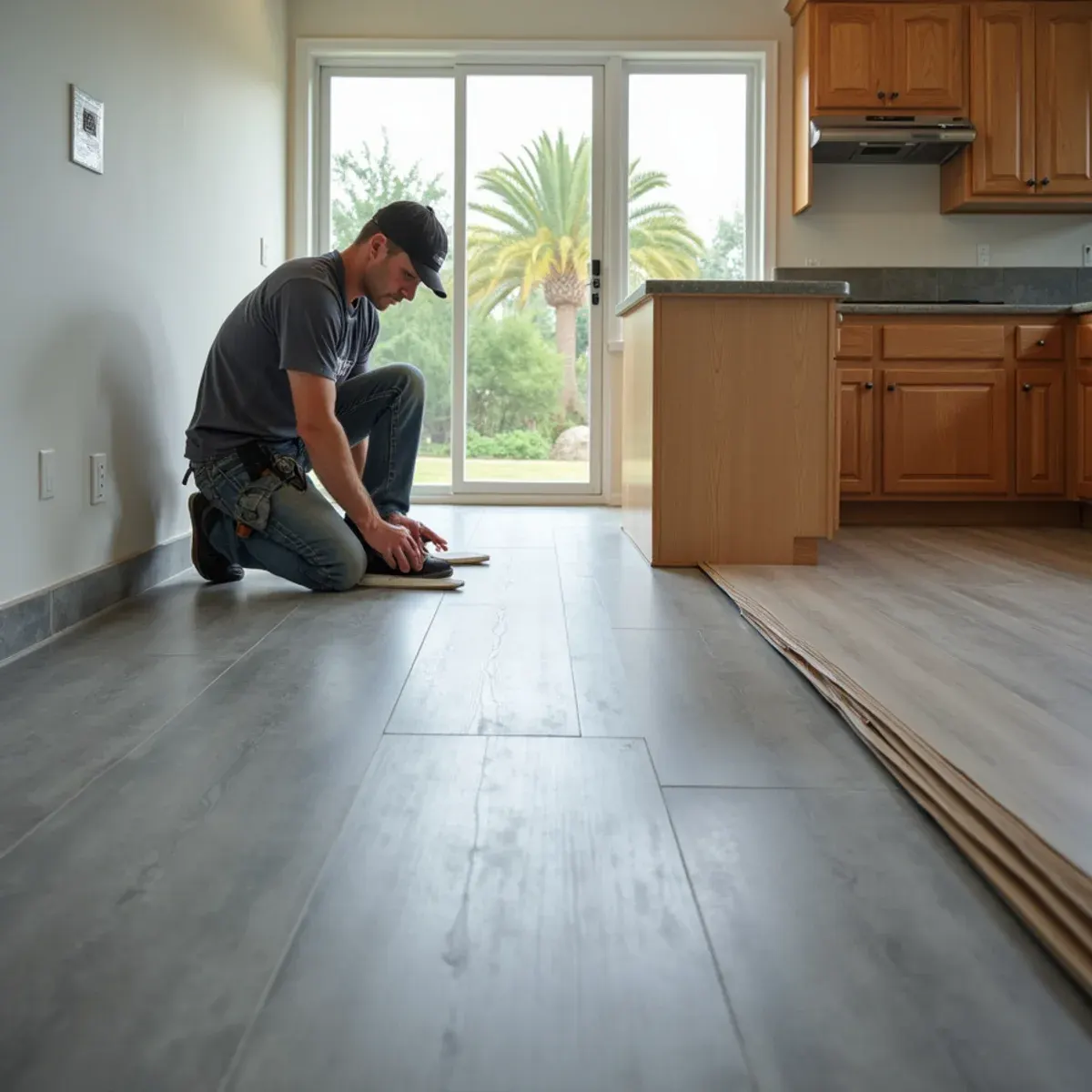
Where you live in Whittier decides how your floor gets wet. Uptown around Greenleaf Avenue is late-Victorian bay windows, Craftsman porches and 1920s Spanish Revival under clay tile, nearly all raised foundations with original-era systems, where a supply leak drips into crawl-space dirt for weeks and the first sign upstairs is a soft spot or a smell. College Hills, subdivided in 1923 as the city's first planned hillside development, has steep grades and curving streets that send storm water at the uphill wall of houses. East Whittier is conventional postwar slab and behaves like it.
That range matters because vinyl plank has gone into all three over the last fifteen years, usually as an affordable upgrade over whatever was there before. Over an Uptown fir subfloor the plank seals in moisture that the old floor used to release. On a College Hills lot, water off the street and the slope enters at the low door and runs under the floating field along the level pad. In East Whittier it sits on unsealed 1950s concrete. One product, one city, three drying plans and three very different salvage rates.
What Whittier Changes About Vinyl & Laminate Floors
1Uptown crawl spaces and original subfloors
The raised foundations Uptown give us access from below, which is the best news in this whole service. We can often dry a wet subfloor from the crawl space and lift only the planks over the worst area. What we check first is joist tops and the sill, because water that dripped into dirt for weeks in one of these houses has usually been working on framing longer than on the floor.
2Steep grades and equipment access
College Hills and the streets climbing toward Turnbull Canyon have grades and driveways that make equipment placement a real planning question: hose runs, extension distances, and where a truck can actually sit. It affects scheduling more than technique. We would rather tell you the first morning that a slope job needs a different setup than turn up with the wrong configuration and lose the day.
3Clay tile roofs and where water started
In the older Spanish Revival stock, water reaching a ground-floor plank floor sometimes began at a displaced clay tile or a failed valley two stories up and traveled inside the walls. We trace it upward before treating the floor, because drying a substrate while the source is still running just means paying for the equipment twice and finding the same wet slab in a month.
How the Work Runs
The method is the same one we use on every vinyl & laminate floors job, documented to the IICRC S500:2025 standard. Here it is in short — the full vinyl & laminate floor water damage process explains each stage in detail.
- Map the wet area before lifting anything
- Lift and number the planks
- Strip what sat under the floor
- Dry the slab to a documented standard
- In-situ RH test before anything goes down
- Reinstall or replace, honestly
The Whittier Background Worth Knowing
A leak under a raised foundation does not announce itself the way a slab leak does. There is no puddle on the floor and no warm spot underfoot, because the water drips down into the soil and stays there. What you get instead is a smell that is stronger in the morning, a board that feels slightly soft, and eventually a floor that has been quietly feeding fungal growth for months. By the time an Uptown homeowner calls us about a crawl space leak, the question is rarely how to dry it. It is how much of the joist and subfloor is still doing its job.
There is more on the housing stock, drainage and plumbing history of this city on our water damage restoration in Whittier page.
Whittier at a glance
- Dominant construction era
- 1890–1980
- Foundation type
- mixed on grade
- Supply piping found here
- original turn-of-century piping, galvanized steel, under-slab copper
- Drain line materials
- cast iron, clay
- Terrain and water table
- hillside-mixed, moderate water table
- Most common local failure
- raised-foundation crawl-space leaks in Uptown, and slope drainage failures in the hillside tracts
- Highest-value local prevention
- an annual crawl-space or slope-drain check, depending which Whittier you live in
What It Costs in Whittier
We do not quote a number over the phone before seeing the property — anyone who does is guessing. The variables that actually move the price on a vinyl & laminate floors job are how much floor has to come up, floating, glue-down, or sheet, whether the planks can be reused, and they are broken down in full on the vinyl & laminate floor water damage page. The assessment and the written estimate are free anywhere in Whittier, day or night, with no obligation.
Vinyl & Laminate Floors Questions from Whittier Homeowners
Whether the original floor is worth uncovering. Once planks come up we can see it, and sometimes it is intact fir or oak under a layer of adhesive while sometimes the installation itself already damaged it past saving. Meanwhile the crawl space lets us dry the subfloor from below, which protects both floors at once. We photograph what we find and give you the choice before anything leaves the house.
Because the plank is waterproof and the space under it is not. Water gets in at the seams and the perimeter, spreads across the slab, and then has no way out, because the plank blocks evaporation. The flooring is usually the only part of the assembly that is fine. Lifting it is how we reach the underlayment and the concrete, which are the parts holding the moisture.
No. That is one of the few places in this work where the answer is flat. The core is compressed wood fiber and glue, and once water breaks that compression the fibers stay expanded. Drying stops it getting worse; it does not reverse it. If only a few boards near the leak have swollen and the rest reads dry, a partial replacement is sometimes possible, though matching an older run is rarely clean.
It cuts both ways. A crawl space leak hides longer, because the water drips into soil instead of pooling on your floor, so it often runs for months and reaches the framing before anyone notices. The upside is real though: the plumbing is accessible, so locating and repairing it does not mean breaking concrete. On balance, detection is your weak point in Uptown, which is why an annual look under the house is worth doing.