
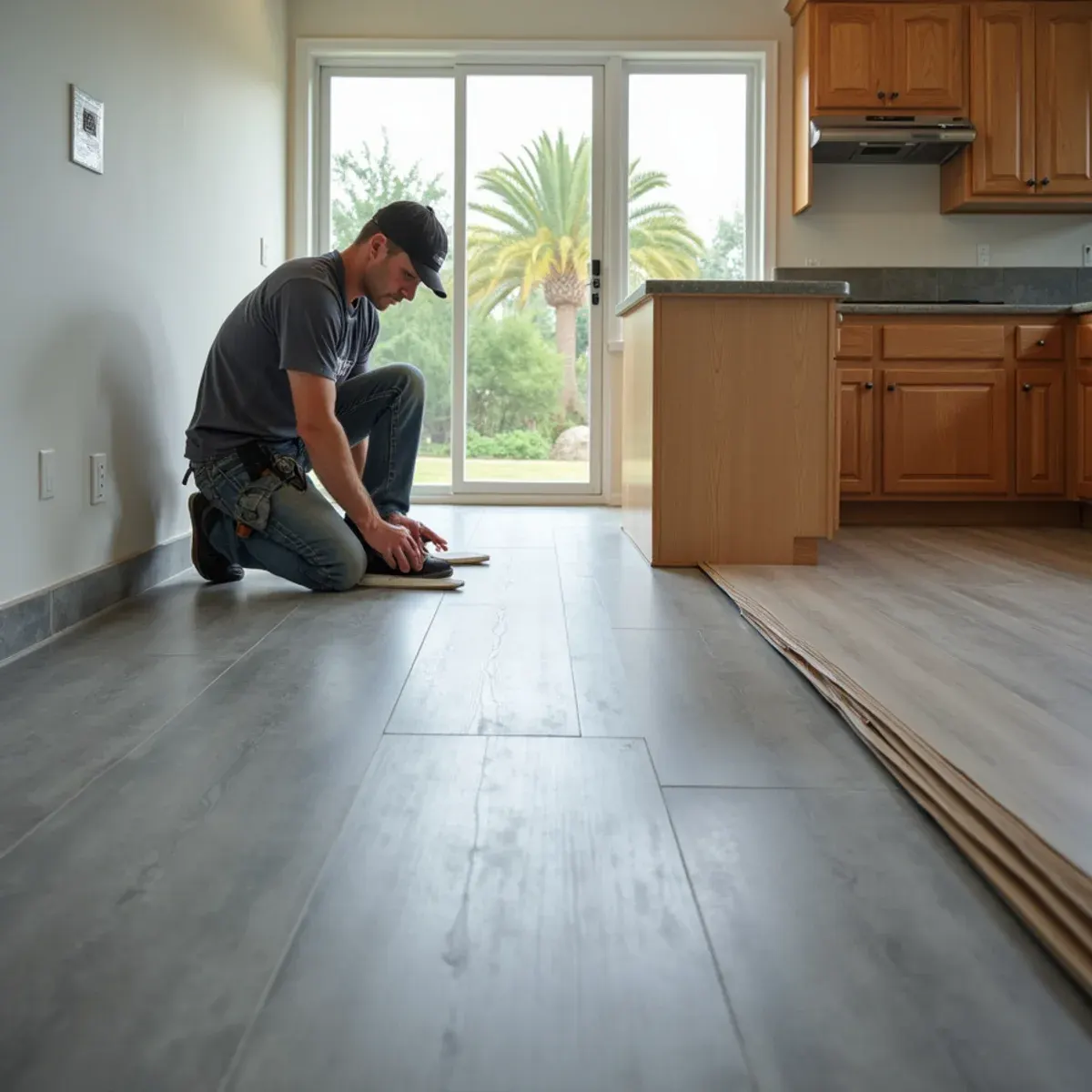
Sometimes the floor fails and there was never a leak. Pico Rivera was built on the strip of ground between two flood-control channels, the San Gabriel River on one side and the Rio Hondo on the other, with a shallow water table under most of it. Slabs poured here between 1945 and 1965 went down on graded dirt with nothing beneath them. They wick moisture up out of the ground and release it through the surface continuously. Put a glue-down vinyl floor over that and the adhesive lets go, the seams lift, and the installer takes blame for a condition that predated him.
That geography also decides what happens during real storms. With channels on both sides and a high water table beneath, the ground here charges fast and stays charged, so the slab's baseline moisture load climbs for weeks after the rain has stopped. When an actual leak lands on top of that, and the postwar plumbing generation delivers plenty of them, drying takes longer than the same leak would take in a drier city, because we are fighting the water that spilled and the water the ground keeps giving back. Blocks on both sides of Rosemead Boulevard behave the same way.
What Pico Rivera Changes About Vinyl & Laminate Floors
1In-situ RH is the whole decision here
A surface meter reads the top eighth of an inch of concrete and tells you very little in this city. We drill in-situ relative humidity probes, seal them, let them equilibrate and read a real number against what your flooring product allows. In Pico Rivera that number runs higher than people expect even with the leak long since repaired, and it separates a floor that lasts from one that fails again next spring.
2Vapor drive is not a covered loss
If the reason your plank floor lifted is ground moisture through an unsealed slab, that is a building condition rather than a sudden water event, and pretending otherwise on a claim helps nobody. We document what we actually find. Sometimes it is both, a real leak on a slab that was already running high, and separating the two honestly is what makes the covered part of the claim hold up.
3Product choice after a wet season
When a slab cannot be brought inside spec, the answer is not more equipment, it is a different assembly: a floating floor over a rated vapor retarder instead of plank glued straight to concrete. That is a real conversation to have before the reinstall, particularly on the blocks closest to the channels, where the ground stays wet longest after a sustained storm.
How the Work Runs
The method is the same one we use on every vinyl & laminate floors job, documented to the IICRC S500:2025 standard. Here it is in short — the full vinyl & laminate floor water damage process explains each stage in detail.
- Map the wet area before lifting anything
- Lift and number the planks
- Strip what sat under the floor
- Dry the slab to a documented standard
- In-situ RH test before anything goes down
- Reinstall or replace, honestly
The Pico Rivera Background Worth Knowing
On a hillside, storm water leaves. In Pico Rivera it soaks in, and when the soil is already near capacity it stops soaking in and simply stands. That is why a yard here can hold water two days after the rain stops while a yard up in the Whittier hills is dry by morning. The lawn is not draining badly. The ground underneath it is full. Once that happens, every path water can take toward your house becomes the path it takes: the garage threshold, the slider track, the gap where a patio slab has settled back toward the wall.
There is more on the housing stock, drainage and plumbing history of this city on our water damage restoration in Pico Rivera page.
Pico Rivera at a glance
- Dominant construction era
- 1945–1965
- Foundation type
- slab on grade
- Supply piping found here
- original galvanized steel, copper
- Drain line materials
- cast iron
- Terrain and water table
- flat, shallow water table
- Most common local failure
- ground saturating fast during sustained storms because the water table between two channels sits high
- Highest-value local prevention
- clearing area drains and confirming downspouts discharge well away from the foundation
What It Costs in Pico Rivera
We do not quote a number over the phone before seeing the property — anyone who does is guessing. The variables that actually move the price on a vinyl & laminate floors job are how much floor has to come up, floating, glue-down, or sheet, whether the planks can be reused, and they are broken down in full on the vinyl & laminate floor water damage page. The assessment and the written estimate are free anywhere in Pico Rivera, day or night, with no obligation.
Vinyl & Laminate Floors Questions from Pico Rivera Homeowners
Because the slab is not ready, and in this city that is normal rather than unusual. The leak fed the soil under the concrete, and with the water table this shallow between the two channels that soil gives moisture back slowly. Our probes read what the slab is actually releasing, not what the surface feels like. Laying plank over a slab still above spec is how people end up doing this a second time at their own expense.
Because the plank is waterproof and the space under it is not. Water gets in at the seams and the perimeter, spreads across the slab, and then has no way out, because the plank blocks evaporation. The flooring is usually the only part of the assembly that is fine. Lifting it is how we reach the underlayment and the concrete, which are the parts holding the moisture.
No. That is one of the few places in this work where the answer is flat. The core is compressed wood fiber and glue, and once water breaks that compression the fibers stay expanded. Drying stops it getting worse; it does not reverse it. If only a few boards near the leak have swollen and the rest reads dry, a partial replacement is sometimes possible, though matching an older run is rarely clean.
Not in the way people picture it. The channels are engineered, and what we actually see is a groundwater and surface drainage problem rather than a channel overtopping. Because the water table between the two runs high and the ground is flat, soil here reaches saturation faster than it does a few miles inland. Once it does, storm water stops soaking in and starts looking for the lowest opening in your house, which is almost always the garage.