
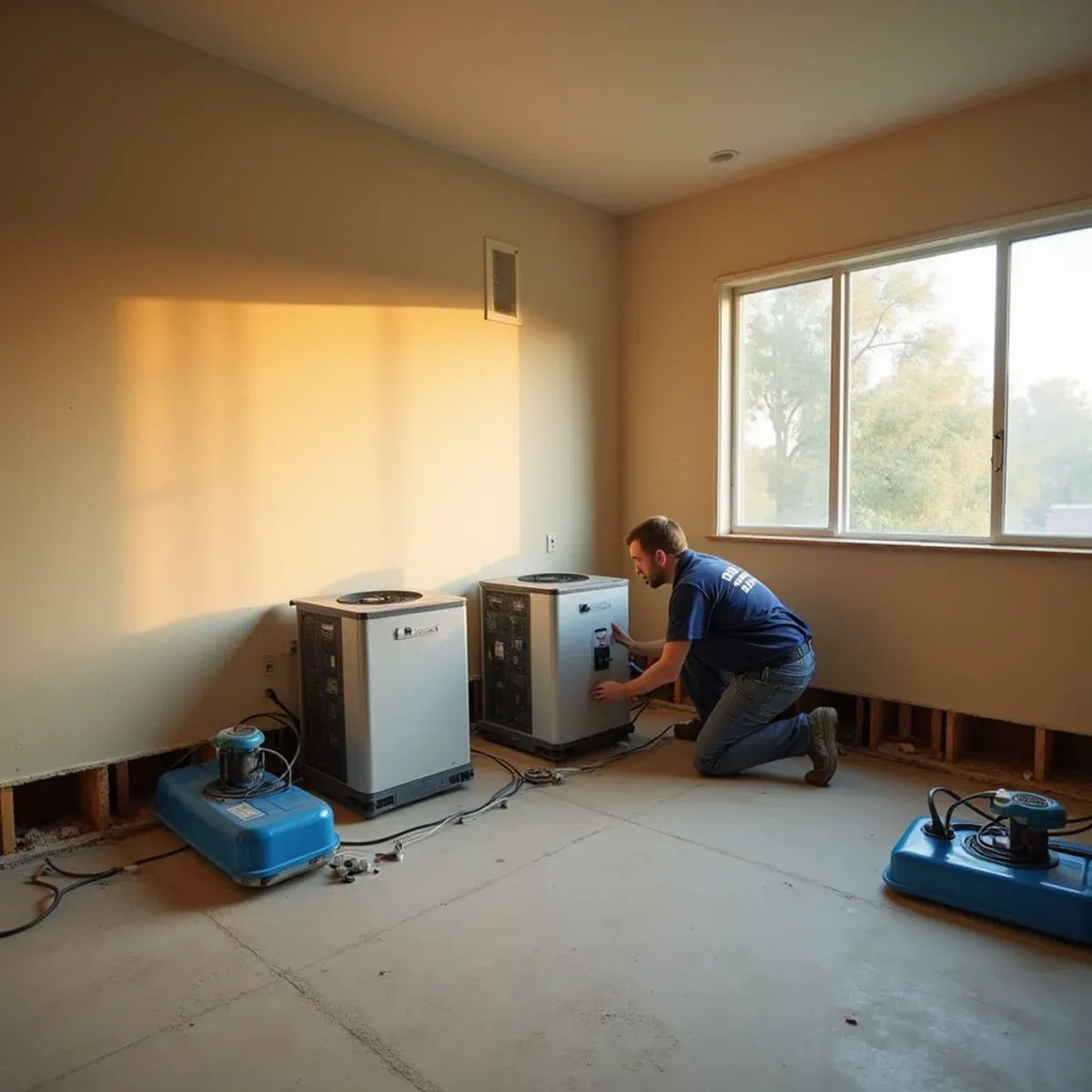
Your slab is never going to read bone dry in Pico Rivera, and it shouldn't have to. The city was built on the strip of ground between the San Gabriel River and the Rio Hondo, the water table underneath is shallow, and most of the housing is 1950s and early-1960s tract poured before under-slab vapor barriers were standard practice. The concrete in your floor carries a mild moisture load on a perfectly dry August day. That's normal here, and it isn't what we're being paid to remove.
Which is why we don't chase a number out of a manual. S500:2025 says the dry standard comes from unaffected material in the same structure, and in Pico Rivera that instruction earns its keep. We take reference readings from untouched slab and framing elsewhere in your own house, document them, then dry the affected area back to those. Chasing a textbook value would run equipment for days with nothing to show for it and would tell you your floor is wet when it's simply a Pico Rivera floor.
What Pico Rivera Changes About Structural Drying
1The dry standard comes from your own slab
S500:2025 sets the target from unaffected material in the same structure, and here that isn't a formality. We take reference readings from untouched slab and framing elsewhere in your house, document them, and dry the affected area back to those numbers. Chasing a value from a manual would run equipment for days against a background condition the whole city shares.
2Slabs poured without a vapor barrier
Housing from the 1945-to-1965 build-out generally sits on slab with no under-slab vapor retarder, so ground moisture moves upward continuously. That matters when the flooring question comes up, because a floor covering that traps vapor over a slab like this can trap it again long after we've gone. We flag it during the job rather than let it become next year's problem.
3After a long storm the ground stays loaded
Sitting between the San Gabriel River and the Rio Hondo, the soil here takes days to shed a sustained storm. Drying schedules stretch accordingly, and readings that would fall overnight on an inland job move slower. We plan for it, monitor daily, and don't pull equipment on a calendar date when the material hasn't reached the standard we set.
How the Work Runs
The method is the same one we use on every structural drying job, documented to the IICRC S500:2025 standard. Here it is in short — the full structural drying & dehumidification process explains each stage in detail.
- Establish the dry standard
- Calculate the load and build the chamber
- Place air movers for surface evaporation
- Run LGR dehumidification to capture the moisture
- Monitor and adjust daily
- Verify, document, and demobilize
The Pico Rivera Background Worth Knowing
On a hillside, storm water leaves. In Pico Rivera it soaks in, and when the soil is already near capacity it stops soaking in and simply stands. That is why a yard here can hold water two days after the rain stops while a yard up in the Whittier hills is dry by morning. The lawn is not draining badly. The ground underneath it is full. Once that happens, every path water can take toward your house becomes the path it takes: the garage threshold, the slider track, the gap where a patio slab has settled back toward the wall.
There is more on the housing stock, drainage and plumbing history of this city on our water damage restoration in Pico Rivera page.
Pico Rivera at a glance
- Dominant construction era
- 1945–1965
- Foundation type
- slab on grade
- Supply piping found here
- original galvanized steel, copper
- Drain line materials
- cast iron
- Terrain and water table
- flat, shallow water table
- Most common local failure
- ground saturating fast during sustained storms because the water table between two channels sits high
- Highest-value local prevention
- clearing area drains and confirming downspouts discharge well away from the foundation
What It Costs in Pico Rivera
We do not quote a number over the phone before seeing the property — anyone who does is guessing. The variables that actually move the price on a structural drying job are size of the drying chamber, class of water intrusion, material types involved, and they are broken down in full on the structural drying & dehumidification page. The assessment and the written estimate are free anywhere in Pico Rivera, day or night, with no obligation.
Structural Drying Questions from Pico Rivera Homeowners
Probably not. Between the San Gabriel River and the Rio Hondo, with a shallow water table and 1950s slabs poured without a vapor barrier, concrete here carries background moisture year-round. That's why we take reference readings from unaffected slab in your own house at the start of the job. When the affected area matches that reference, the structure is dry by the S500:2025 standard even though the number on the screen isn't zero.
Three to five days covers most residential losses. Saturated hardwood, plaster, or a concrete slab can run seven or more. We will give you an estimated window after the first readings and update you daily — and equipment comes out when the numbers say so, not on a fixed schedule.
We would rather you did not. Drying is a continuous process, and every hour off extends the total run — which usually costs more than the sleep is worth. If noise is genuinely unmanageable we can often reconfigure the chamber or reposition units to reduce it. Talk to us instead of unplugging them.
Not in the way people picture it. The channels are engineered, and what we actually see is a groundwater and surface drainage problem rather than a channel overtopping. Because the water table between the two runs high and the ground is flat, soil here reaches saturation faster than it does a few miles inland. Once it does, storm water stops soaking in and starts looking for the lowest opening in your house, which is almost always the garage.