
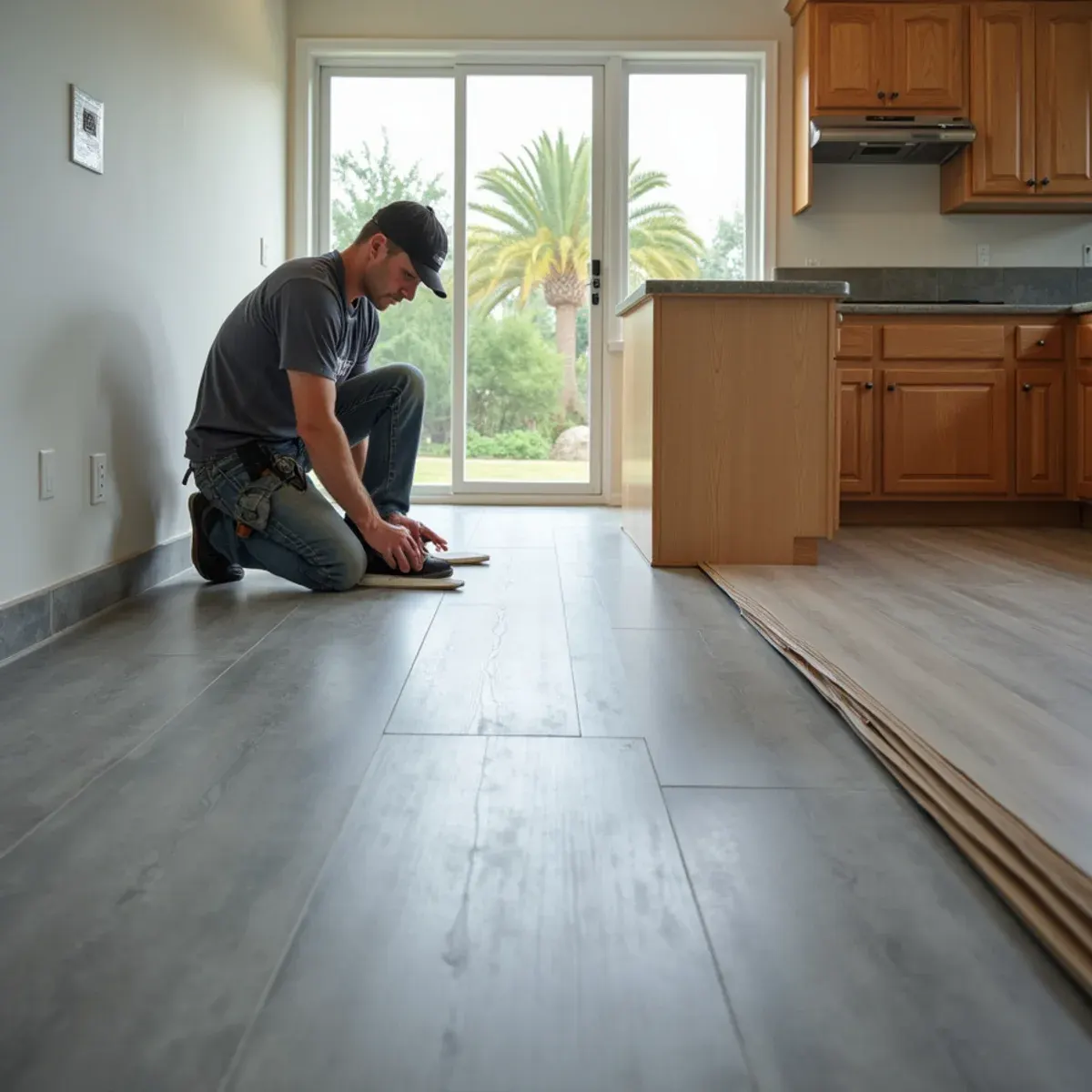
In a single afternoon here we will pull swollen laminate out of a house and dry a glue-down commercial vinyl floor in a shop two hundred feet away. Paramount is one of the more industrially dense cities in this area, with housing packed tightly between commercial corridors, so residential and commercial losses land on the same block and need completely different handling. Floating residential floors come up plank by plank and often go back down. Sheet vinyl and tile bonded to a slab in a business cannot be lifted and reset, so it either dries through the seams or gets cut out.
The city was assembled from the old Hynes and Clearwater dairy communities and filled in between 1945 and 1965 with slab-on-grade housing. The Los Angeles River runs in a concrete channel along the western edge, and across the whole city there is very little permeable ground: the surface is buildings, driveways, parking and street. Rain does not soak in anywhere. It runs to the gutter, and wherever a driveway or a lot pitches back toward a building, it arrives at the slab edge and gets under whatever floor is closest to the door.
What Paramount Changes About Vinyl & Laminate Floors
1Glue-down floors cannot be lifted and reset
Commercial spaces here run sheet vinyl or composition tile bonded directly to slab. That adhesive layer works as a moisture barrier in the wrong direction, because water that gets underneath at a seam or a cut edge cannot evaporate upward through it. Drying means either scoring and venting the floor so the substrate can release, or cutting the affected area out. We say which is realistic before quoting either.
2Small lots leave nowhere to stage
These houses sit on tight lots with short driveways and no side yard worth the name. Pulling a floor means the contents have to go somewhere and there often is no somewhere. We plan staging before demolition, either room-to-room rotation or a pack-out when the volume justifies it, because furniture parked in a Paramount driveway through a rain night is a second loss waiting to happen.
3Runoff enters at the slab edge
With almost no permeable ground, storm water here travels across hard surfaces at speed until something stops it. Where a lot or a driveway pitches back toward the building, that something is your threshold. It is a fast, shallow entry that gets under a floating floor immediately and reads as nearly nothing on the surface. We check door lines and slab edges first on any storm call in this city.
How the Work Runs
The method is the same one we use on every vinyl & laminate floors job, documented to the IICRC S500:2025 standard. Here it is in short — the full vinyl & laminate floor water damage process explains each stage in detail.
- Map the wet area before lifting anything
- Lift and number the planks
- Strip what sat under the floor
- Dry the slab to a documented standard
- In-situ RH test before anything goes down
- Reinstall or replace, honestly
The Paramount Background Worth Knowing
On a typical Paramount lot, the house, the driveway, the walkways and the rear slab cover most of the parcel. What is left is a narrow side yard, and everything that lands on the roof and the paving is supposed to leave through a couple of small area drains. That system has no margin. When a grate silts up, when a downspout dumps straight onto paving, or when the outlet at the curb has been crushed by a parked truck, the water has no soil to soak into and nowhere else to be. It ponds against the slab edge and comes in at the lowest threshold, which is usually a garage or a side door.
There is more on the housing stock, drainage and plumbing history of this city on our water damage restoration in Paramount page.
Paramount at a glance
- Dominant construction era
- 1945–1965
- Foundation type
- slab on grade
- Supply piping found here
- original galvanized steel, copper
- Drain line materials
- cast iron
- Terrain and water table
- flat, moderate water table
- Most common local failure
- residential and commercial losses on the same block, needing very different handling
- Highest-value local prevention
- clearing area drains before the season on lots with very little permeable ground
What It Costs in Paramount
We do not quote a number over the phone before seeing the property — anyone who does is guessing. The variables that actually move the price on a vinyl & laminate floors job are how much floor has to come up, floating, glue-down, or sheet, whether the planks can be reused, and they are broken down in full on the vinyl & laminate floor water damage page. The assessment and the written estimate are free anywhere in Paramount, day or night, with no obligation.
Vinyl & Laminate Floors Questions from Paramount Homeowners
Less time than you fear if we scope it properly. Glue-down tile cannot be lifted and put back, so the question is whether the wet area is small enough to cut out and replace, or wide enough that the substrate has to dry through scored seams with equipment running. Either way we can usually section the work and keep part of the floor open for business. We will walk it and give you an honest number of days.
Because the plank is waterproof and the space under it is not. Water gets in at the seams and the perimeter, spreads across the slab, and then has no way out, because the plank blocks evaporation. The flooring is usually the only part of the assembly that is fine. Lifting it is how we reach the underlayment and the concrete, which are the parts holding the moisture.
No. That is one of the few places in this work where the answer is flat. The core is compressed wood fiber and glue, and once water breaks that compression the fibers stay expanded. Drying stops it getting worse; it does not reverse it. If only a few boards near the leak have swollen and the rest reads dry, a partial replacement is sometimes possible, though matching an older run is rarely clean.
Almost certainly your area drains. Paramount lots have very little permeable ground, so everything that falls on the roof and the paving has to leave through a couple of small drains. If a grate silts up or the outlet is crushed, the water ponds against the slab and enters at the lowest threshold, which is usually the garage. Rodding the drains and checking the outlet before the season costs far less than drying the garage wall afterward.