
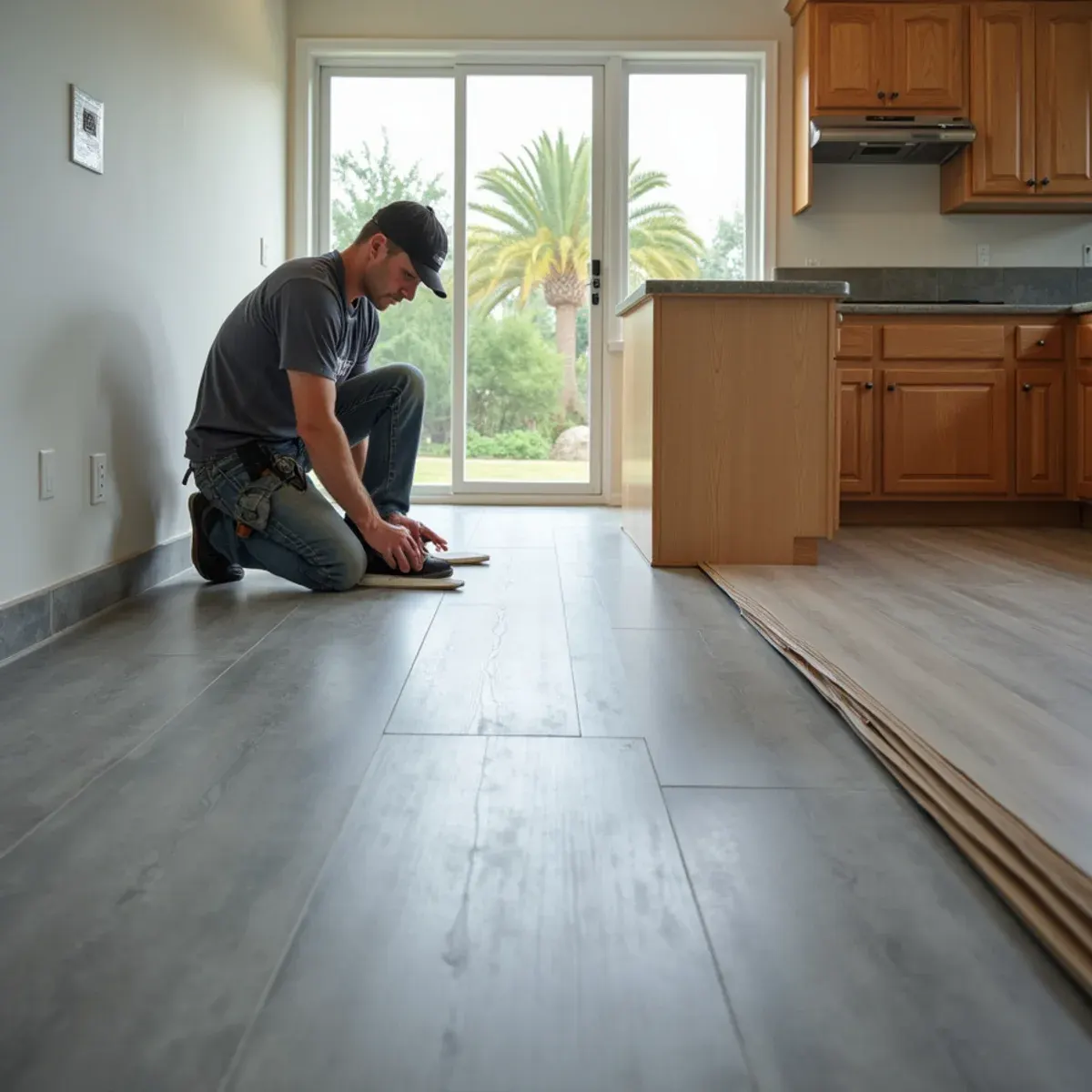
Before we quote a drying job in Fountain Valley we make sure there is a leak at all. This city is dead flat and sits on what was once called Gospel Swamp, with the shallowest water table in Orange County under it. Moisture moving up through a slab is a routine background condition here, not an emergency. When laminate edges swell along one side of a room, or vinyl seams lift in a pattern with no fixture anywhere nearby, vapor emission is at least as likely as a pipe, and the two get corrected very differently.
Telling them apart takes real testing rather than a guess: in-situ relative humidity probes at depth, a look at where the moisture concentrates, and a thermal scan for a hot line. If it is a leak, we find it and dry the slab. If it is vapor, no amount of drying helps, because the slab will keep doing what it is doing. The answer there is a moisture-control coating or an underlayment rated for the reading. In the tracts around Mile Square Park, plenty of those slabs went in without a vapor retarder anyone would accept today.
What Fountain Valley Changes About Vinyl & Laminate Floors
1Slab vapor mistaken for a leak
The shallowest water table in the county sits under this whole city, and concrete wicks. Laminate cores swell and vinyl seams lift from that alone, with no plumbing involved. Drying a floor that has no leak produces a dry certificate and a repeat failure. We test first and tell you which one you have, even when the answer means there is far less for us to do.
2Dead flat ground spreads water evenly
There is no slope in Fountain Valley to tell you where the water came from. On a graded lot a floor leak shows you a direction. Here it spreads in an even field under the plank and the wettest point is not necessarily near the source. We map the whole floor with a grid pattern rather than following an obvious trail, because there is no trail to follow.
3The reinstall spec matters more than drying time
On a slab this active, the decision that determines whether your floor survives is what goes between the concrete and the plank, not how many days the fans ran. That means a documented RH number, a product rated for it, and a moisture-control layer where the numbers demand one. We would rather spend the conversation there than on shaving a day off the equipment schedule.
How the Work Runs
The method is the same one we use on every vinyl & laminate floors job, documented to the IICRC S500:2025 standard. Here it is in short — the full vinyl & laminate floor water damage process explains each stage in detail.
- Map the wet area before lifting anything
- Lift and number the planks
- Strip what sat under the floor
- Dry the slab to a documented standard
- In-situ RH test before anything goes down
- Reinstall or replace, honestly
The Fountain Valley Background Worth Knowing
Groundwater beneath Fountain Valley sits close enough to the surface that moisture vapor migration up through concrete slabs is a routine background condition rather than an anomaly. Homeowners here regularly describe a slab that feels cool and damp, or a closet on an exterior wall that never quite feels dry, without any leak at all.
There is more on the housing stock, drainage and plumbing history of this city on our water damage restoration in Fountain Valley page.
Fountain Valley at a glance
- Dominant construction era
- 1960–1980
- Foundation type
- slab on grade
- Supply piping found here
- under-slab copper
- Drain line materials
- cast iron
- Terrain and water table
- flat, shallow water table
- Most common local failure
- slab vapor emission mistaken for a leak, and flooring failures caused by installing over an untested slab
- Highest-value local prevention
- clearing the yard and area drains before the season, because a blocked drain on dead-flat ground ponds water against the house
What It Costs in Fountain Valley
We do not quote a number over the phone before seeing the property — anyone who does is guessing. The variables that actually move the price on a vinyl & laminate floors job are how much floor has to come up, floating, glue-down, or sheet, whether the planks can be reused, and they are broken down in full on the vinyl & laminate floor water damage page. The assessment and the written estimate are free anywhere in Fountain Valley, day or night, with no obligation.
Vinyl & Laminate Floors Questions from Fountain Valley Homeowners
In Fountain Valley that is usually the concrete rather than plumbing. Groundwater sits so close under this city that moisture rises through the slab continuously, and a laminate core over it swells from below no matter where the fixtures are. We confirm with in-situ RH readings before anyone opens a wall hunting for a leak. If it is vapor, the answer is a moisture-control layer and a rated product, not a plumber.
Because the plank is waterproof and the space under it is not. Water gets in at the seams and the perimeter, spreads across the slab, and then has no way out, because the plank blocks evaporation. The flooring is usually the only part of the assembly that is fine. Lifting it is how we reach the underlayment and the concrete, which are the parts holding the moisture.
No. That is one of the few places in this work where the answer is flat. The core is compressed wood fiber and glue, and once water breaks that compression the fibers stay expanded. Drying stops it getting worse; it does not reverse it. If only a few boards near the leak have swollen and the rest reads dry, a partial replacement is sometimes possible, though matching an older run is rarely clean.
The city sits on former wetland with one of the shallowest water tables in Orange County, so moisture vapor migrating up through slabs is a normal background condition here rather than a defect. It matters most when installing flooring over the slab, which is why we test with in-situ RH probes before anything goes back down.