
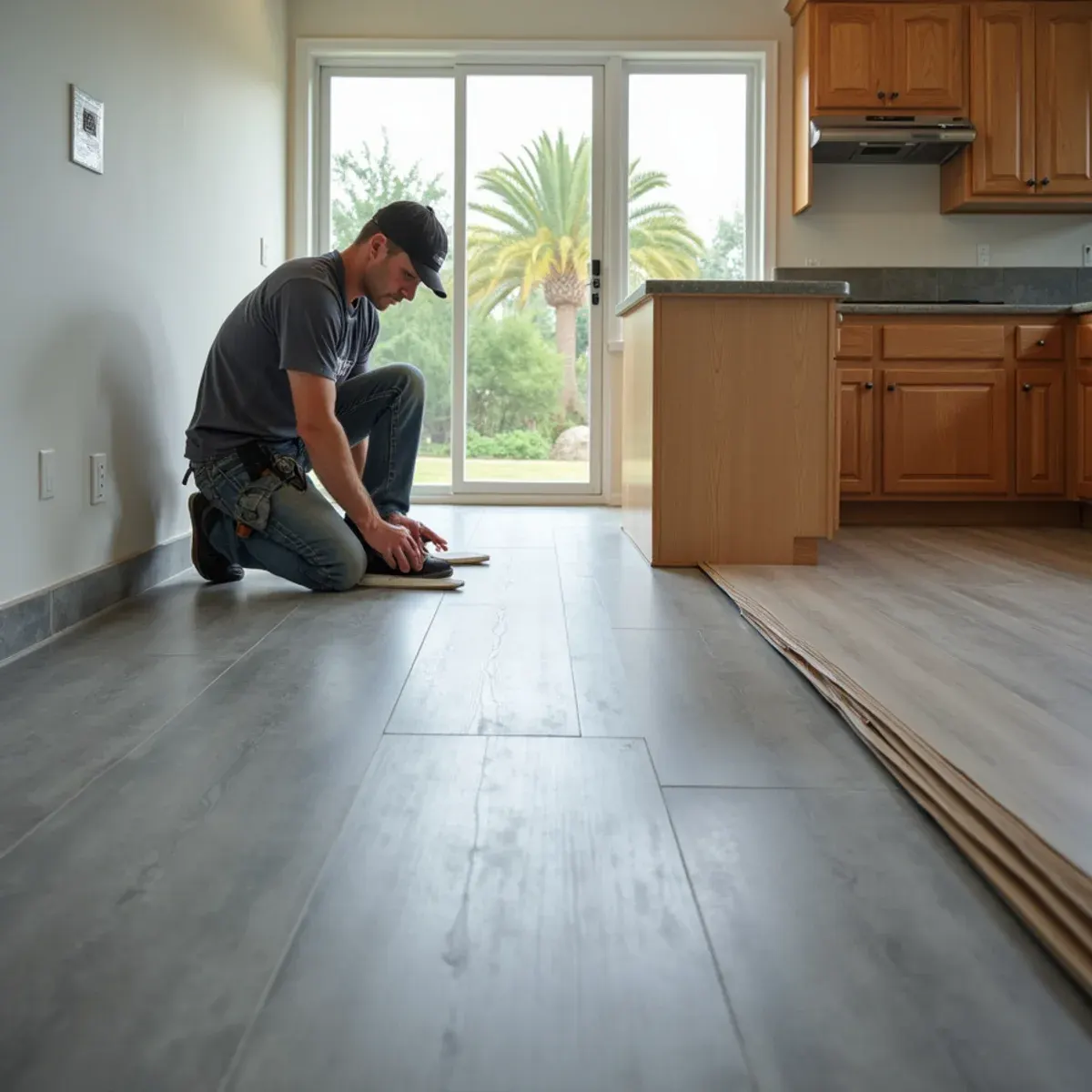
In Floral Park, French Park and Washington Square, the vinyl plank is almost never the original floor. Lift it and you tend to find old-growth Douglas fir or narrow hardwood with no modern equivalent, sometimes over a raised subfloor, sometimes under one or two earlier layers of linoleum and adhesive. That wood is the real asset in the room, and it is why we lift carefully in sequence rather than prying. A waterproof plank held water against it for as long as the leak ran, and bringing that wood back is the whole point of the job.
These are also lath-and-plaster houses in the county's oldest city, and wet plaster releases from the lath long after a floor reads dry, which drags out the perimeter of every job. Historic preservation review generally concerns what shows from the street rather than your flooring, though if your house sits under a Mills Act contract it is worth a call before any demolition. The other Santa Ana is dense postwar apartments where the floor is a recent vinyl retrofit over slab, and that work is fast, conventional and nothing like the district houses.
What Santa Ana Changes About Vinyl & Laminate Floors
1Original fir under a modern vinyl retrofit
Old-growth Douglas fir and the narrow hardwoods used in these houses are tighter grained than anything available now, and they dry better than people expect. The failure mode is impatience: prying the vinyl up in pieces, gouging the wood underneath, then sanding while it is still moving. We lift in order, dry from both faces where a crawl space allows, and let moisture content settle before anyone talks about refinishing.
2Plaster key failure stretches the perimeter
When plaster gets wet, the keys that lock it to the wood lath soften and let go, sometimes weeks after the water event. That puts wall repair on a different clock from floor drying and keeps moisture cycling into the plank edges at the base of the wall. We monitor the plaster separately and warn you early if a wall is going to need work after the floor is finished.
3Older flooring layers get tested first
Under vinyl in a pre-1980 Santa Ana house there are often earlier layers, sheet flooring, backing and adhesive, that can contain regulated materials. We do not disturb suspect layers on assumption either way. Sampling and lab confirmation come first, and if results require an abatement contractor we say so and coordinate rather than working around it.
How the Work Runs
The method is the same one we use on every vinyl & laminate floors job, documented to the IICRC S500:2025 standard. Here it is in short — the full vinyl & laminate floor water damage process explains each stage in detail.
- Map the wet area before lifting anything
- Lift and number the planks
- Strip what sat under the floor
- Dry the slab to a documented standard
- In-situ RH test before anything goes down
- Reinstall or replace, honestly
The Santa Ana Background Worth Knowing
Lath and plaster is wood strips nailed across the studs with several coats of plaster troweled over them. The plaster that squeezes through the gaps between lath forms keys that hook over the wood and hold the whole wall in place. That construction is why plaster walls last a century — and why they behave so differently from drywall when wet.
There is more on the housing stock, drainage and plumbing history of this city on our water damage restoration in Santa Ana page.
Santa Ana at a glance
- Dominant construction era
- 1900–1970
- Foundation type
- mixed on grade
- Supply piping found here
- original early-century piping, galvanized steel, copper
- Drain line materials
- cast iron, clay
- Terrain and water table
- flat, moderate water table
- Most common local failure
- plaster key failure, where wet plaster softens and releases from the wood lath holding it to the wall
- Highest-value local prevention
- starting aggressive drying within hours on any plaster loss — waiting is the one thing that costs you the wall
What It Costs in Santa Ana
We do not quote a number over the phone before seeing the property — anyone who does is guessing. The variables that actually move the price on a vinyl & laminate floors job are how much floor has to come up, floating, glue-down, or sheet, whether the planks can be reused, and they are broken down in full on the vinyl & laminate floor water damage page. The assessment and the written estimate are free anywhere in Santa Ana, day or night, with no obligation.
Vinyl & Laminate Floors Questions from Santa Ana Homeowners
Not without checking first. Sheet flooring, backing and mastic from that era can contain regulated materials, and cutting or scraping them is what makes that a problem. We stabilize the water situation, then have suspect layers sampled and confirmed by a lab before anything gets disturbed. If the results come back requiring licensed abatement, we coordinate that step rather than guessing. It adds a little time and it protects the house and the people in it.
Because the plank is waterproof and the space under it is not. Water gets in at the seams and the perimeter, spreads across the slab, and then has no way out, because the plank blocks evaporation. The flooring is usually the only part of the assembly that is fine. Lifting it is how we reach the underlayment and the concrete, which are the parts holding the moisture.
No. That is one of the few places in this work where the answer is flat. The core is compressed wood fiber and glue, and once water breaks that compression the fibers stay expanded. Drying stops it getting worse; it does not reverse it. If only a few boards near the leak have swollen and the rest reads dry, a partial replacement is sometimes possible, though matching an older run is rarely clean.
Usually, if drying starts quickly. Plaster holds much more water than drywall and dries far more slowly, so it needs more equipment and often desiccant dehumidification. The risk is the plaster keys softening and releasing from the lath, which is why waiting is the one thing that genuinely costs you the wall.