
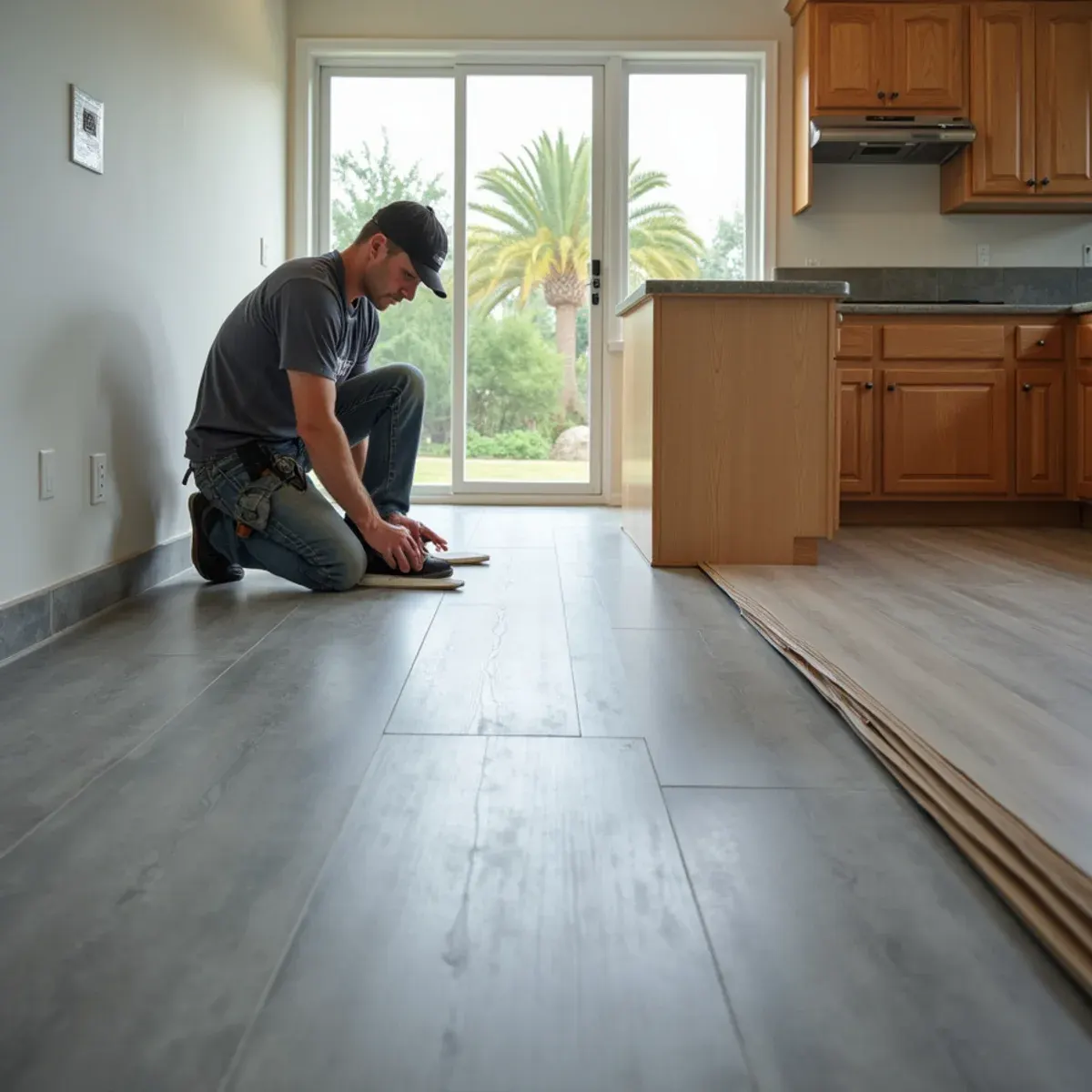
It usually shows up the morning after a storm. Wind drives rain against a west-facing window, the flashing behind it has been giving up to salt air for twenty years, and water runs down inside the wall and out under the vinyl plank along the exterior wall. The plank does precisely what it was designed to do and keeps that water underneath. What you see is a floor that looks fine and a baseboard that has gone dark, and the wet zone follows the wall line rather than radiating out from a fixture the way a plumbing leak does.
Huntington Harbour adds a second problem. Waterfront and canal-front homes sit on slabs with tidal groundwater beneath them and seawalls holding the difference, so baseline moisture in that concrete moves and a reinstall has to be judged against tested numbers rather than a dry-looking surface. Downtown is a logistics problem instead. Narrow lots with no driveway mean long hose runs out to the street and equipment staged where it will not block a neighbor. Salt also ruins the fasteners and transition trims we would otherwise reuse.
What Huntington Beach Changes About Vinyl & Laminate Floors
1Perimeter wetting from corroded flashing
Salt air eats window and door flashing far faster here than a few miles inland, and wind-driven rain finds every failure. The water enters high, travels inside the wall, and emerges under the floating floor at the base plate. That is why the wet readings in these homes trace the exterior walls. We start metering at the wall line and work inward, not the other way around.
2Tidal groundwater under Harbour slabs
Canal-front and waterfront slabs in Huntington Harbour sit above groundwater that moves with the tide, so the moisture load in the concrete is not a fixed number. A single reading proves very little. We take in-situ readings over more than one day before clearing a slab for reinstall, because a floor put back on a favorable tide will lift on an unfavorable one.
3No driveway downtown means long runs
The narrow lots downtown leave nowhere to park a truck close to the work. Extraction hose gets run out to the street, dehumidifier condensate has to be routed a long way, and equipment has to be staged so a neighbor can still get in and out. It adds setup time on every visit, and we would rather plan it than discover it at eleven at night.
How the Work Runs
The method is the same one we use on every vinyl & laminate floors job, documented to the IICRC S500:2025 standard. Here it is in short — the full vinyl & laminate floor water damage process explains each stage in detail.
- Map the wet area before lifting anything
- Lift and number the planks
- Strip what sat under the floor
- Dry the slab to a documented standard
- In-situ RH test before anything goes down
- Reinstall or replace, honestly
The Huntington Beach Background Worth Knowing
Salt does not damage buildings directly. It damages the details that keep water out, and then water does the rest.
There is more on the housing stock, drainage and plumbing history of this city on our water damage restoration in Huntington Beach page.
Huntington Beach at a glance
- Dominant construction era
- 1960–1990
- Foundation type
- slab on grade
- Supply piping found here
- under-slab copper
- Drain line materials
- cast iron, ABS
- Terrain and water table
- coastal-flat, shallow water table
- Most common local failure
- wind-driven rain entering through salt-corroded window flashing and failed exterior sealant
- Highest-value local prevention
- renewing exterior caulking and flashing on a far shorter cycle than inland guidance suggests
What It Costs in Huntington Beach
We do not quote a number over the phone before seeing the property — anyone who does is guessing. The variables that actually move the price on a vinyl & laminate floors job are how much floor has to come up, floating, glue-down, or sheet, whether the planks can be reused, and they are broken down in full on the vinyl & laminate floor water damage page. The assessment and the written estimate are free anywhere in Huntington Beach, day or night, with no obligation.
Vinyl & Laminate Floors Questions from Huntington Beach Homeowners
In Huntington Beach it is usually both, and it started at the wall. Salt-corroded flashing lets wind-driven rain into the wall cavity, and it exits at the base plate right under a floating floor that holds it there. Dark baseboards are the only visible symptom. We check the flashing and the wall cavity as well as the floor, because drying under the plank without fixing the entry point buys you one dry season.
Because the plank is waterproof and the space under it is not. Water gets in at the seams and the perimeter, spreads across the slab, and then has no way out, because the plank blocks evaporation. The flooring is usually the only part of the assembly that is fine. Lifting it is how we reach the underlayment and the concrete, which are the parts holding the moisture.
No. That is one of the few places in this work where the answer is flat. The core is compressed wood fiber and glue, and once water breaks that compression the fibers stay expanded. Drying stops it getting worse; it does not reverse it. If only a few boards near the leak have swollen and the rest reads dry, a partial replacement is sometimes possible, though matching an older run is rarely clean.
Ambient humidity near the coast stays high enough for long enough that materials dry slowly on their own, which widens the window in which growth can establish after any moisture event. Combined with salt-accelerated failures of exterior sealants and flashings, coastal homes simply get more moisture intrusion and dry from it more slowly.