
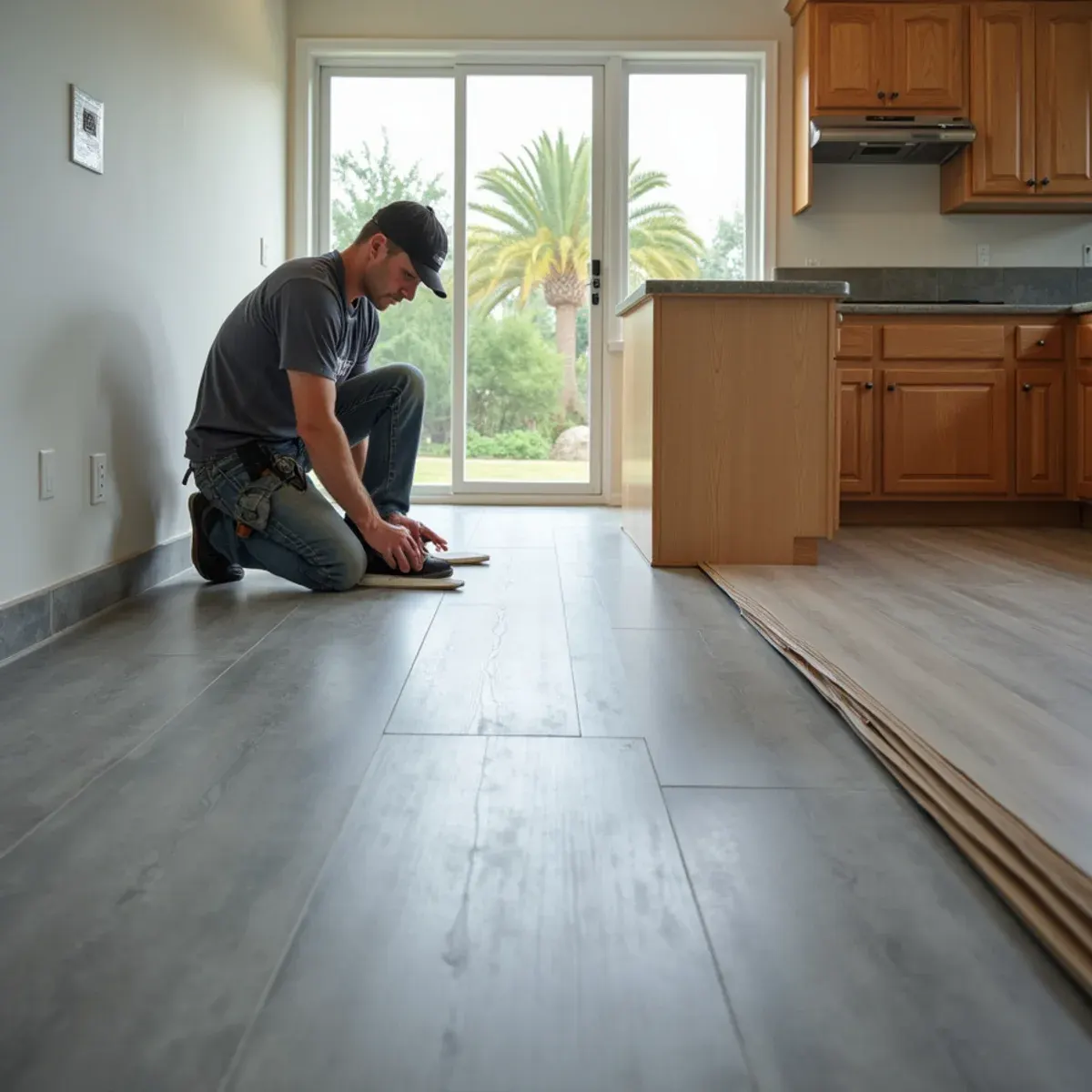
We bring a probe before we bring a fan in Westminster. Slabs here sit close to a shallow water table near the Bolsa Chica channel, which means they carry a high baseline moisture load even when nothing has leaked. That matters more for vinyl and laminate than for anything else in the house, because a floating floor is a lid. Put it back over a slab that is still giving off vapor and you get the same swollen laminate edges and lifted vinyl seams a few months later, with no leak anywhere to blame for it.
So we run in-situ relative humidity testing rather than a surface reading: probes drilled to depth, left to equalize, numbers written down. Sometimes the honest answer is that the slab will not reach the flooring manufacturer's threshold without a moisture-control coating or a different underlayment, and you are far better off knowing that before the reinstall than after. A good share of this work is commercial too, in the restaurants and shops along Bolsa Avenue occupying 1950s and 1960s buildings whose slabs went in before anyone specified a vapor retarder.
What Westminster Changes About Vinyl & Laminate Floors
1A shallow water table keeps slabs damp
Proximity to the Bolsa Chica channel puts groundwater close to the underside of these slabs. Concrete wicks, so the baseline moisture in a Westminster slab is higher than in a comparable house further inland. It is not a defect and it is not a leak. It is a condition your flooring has to be specified around, and ignoring it is the most common cause of a second failure.
2In-situ RH testing, not a surface meter
A surface meter reads the top few millimeters and will happily tell you a slab is dry while the depth of it is still loaded. In-situ probes go to the correct depth for the slab, sit until they equalize, and give a number a flooring manufacturer will actually recognize. We document those readings for you and for the insurer, and we will not sign off a reinstall without them.
3Bolsa Avenue kitchens dry around service
The restaurants and small retail along Bolsa Avenue sit in buildings older than the businesses in them, with commercial vinyl over untested slabs. Those tenants cannot close for a week. We work in sections, keep the front of house usable, and schedule slab work between services, with the documentation a health inspector or a landlord will ask for.
How the Work Runs
The method is the same one we use on every vinyl & laminate floors job, documented to the IICRC S500:2025 standard. Here it is in short — the full vinyl & laminate floor water damage process explains each stage in detail.
- Map the wet area before lifting anything
- Lift and number the planks
- Strip what sat under the floor
- Dry the slab to a documented standard
- In-situ RH test before anything goes down
- Reinstall or replace, honestly
The Westminster Background Worth Knowing
Westminster's shallow groundwater means many slabs here carry a higher baseline moisture load than slabs a few miles inland. In an undamaged home with breathable flooring that is usually a non-issue. It becomes an issue in two situations.
There is more on the housing stock, drainage and plumbing history of this city on our water damage restoration in Westminster page.
Westminster at a glance
- Dominant construction era
- 1950–1970
- Foundation type
- slab on grade
- Supply piping found here
- under-slab copper, galvanized steel
- Drain line materials
- cast iron
- Terrain and water table
- coastal-flat, shallow water table
- Most common local failure
- flooring installed over a slab that was never tested and is still releasing vapor
- Highest-value local prevention
- in-situ slab relative humidity testing before any new floor goes down
What It Costs in Westminster
We do not quote a number over the phone before seeing the property — anyone who does is guessing. The variables that actually move the price on a vinyl & laminate floors job are how much floor has to come up, floating, glue-down, or sheet, whether the planks can be reused, and they are broken down in full on the vinyl & laminate floor water damage page. The assessment and the written estimate are free anywhere in Westminster, day or night, with no obligation.
Vinyl & Laminate Floors Questions from Westminster Homeowners
Most likely slab vapor rather than a pipe. With the water table this close near the channel, these slabs release moisture continuously, and a laminate core sitting on top of that will swell at the edges over months. No leak is ever found because there is not one. The fix is not more drying, it is testing the slab to a real number and specifying a moisture-control layer or a different product before the floor goes back.
Because the plank is waterproof and the space under it is not. Water gets in at the seams and the perimeter, spreads across the slab, and then has no way out, because the plank blocks evaporation. The flooring is usually the only part of the assembly that is fine. Lifting it is how we reach the underlayment and the concrete, which are the parts holding the moisture.
No. That is one of the few places in this work where the answer is flat. The core is compressed wood fiber and glue, and once water breaks that compression the fibers stay expanded. Drying stops it getting worse; it does not reverse it. If only a few boards near the leak have swollen and the rest reads dry, a partial replacement is sometimes possible, though matching an older run is rarely clean.
Westminster has a shallow water table, so slabs here carry more baseline moisture than slabs further inland. Normally that is harmless, but it matters when installing flooring over the slab and it means drying after a loss takes longer. We test with in-situ relative humidity probes before any new floor goes down.