
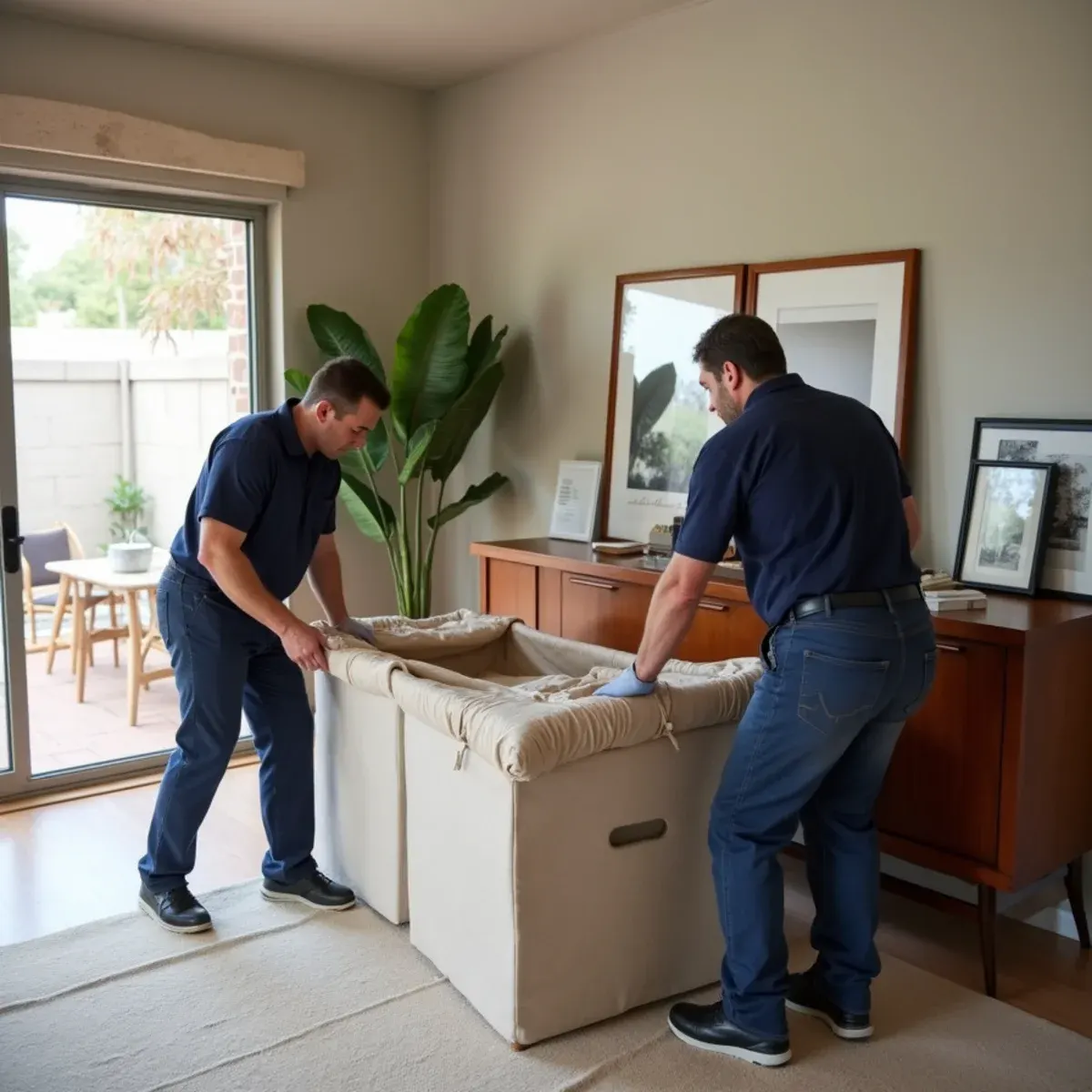
On a lot of Paramount blocks a house shares a property line with a machine shop or a distribution yard. That mix shows up in our contents work more than anywhere else nearby. In the same week we will inventory a family's furniture off Rosecrans and a tenant's raw stock, tooling and shipping records in a building around the corner. Those are different claims, different coverage and different documentation, and the only thing they have in common is that there is nowhere to park a truck. Industry takes the curb space all day.
The city was assembled from the old Hynes and Clearwater communities on dairy and hay land, and it built out dense, with housing packed tightly between commercial corridors and very little permeable ground on most lots. The Los Angeles River channel runs the western edge. When a storm comes hard, water on those lots has nowhere to soak in, so it moves to the lowest opening it can find, which is usually a garage or a ground-floor unit where the household's boxes are stacked directly on the slab.
What Paramount Changes About Contents & Pack-Out
1Business personal property is documented differently
Inventory, raw stock, tooling and records claim under business personal property, and the carrier wants quantities, lot numbers, model and serial detail rather than room-by-room photographs. We build that schedule as we pack, and keep production-critical items separated so a shop can restart on partial stock instead of waiting until the whole building has been cleared and cleaned.
2No permeable ground, so drains decide everything
Most lots here are concrete or asphalt corner to corner, so a heavy hour of rain becomes surface water immediately. Area drains and yard drains are the only relief, and they fill with debris between storms. Clearing them is the cheapest contents protection on a lot with no soil, because once water crosses the threshold it goes straight to whatever is sitting on the floor.
3Staging space has to be arranged first
Dense housing plus industrial traffic means curb frontage is contested all day. Before a Paramount pack-out we sort out where the truck sits, where the packing table goes, and whether we shuttle from a smaller vehicle. Settling that in advance is what keeps a two-day job from becoming four, and keeps your neighbors and the tenants next door out of the argument entirely.
How the Work Runs
The method is the same one we use on every contents & pack-out job, documented to the IICRC S500:2025 standard. Here it is in short — the full contents restoration & pack-out process explains each stage in detail.
- Room-by-room photographic inventory
- Triage into three categories
- Careful packing and transport
- Cleaning and restoration by material type
- Climate-controlled storage
- Delivery and placement back
The Paramount Background Worth Knowing
On a typical Paramount lot, the house, the driveway, the walkways and the rear slab cover most of the parcel. What is left is a narrow side yard, and everything that lands on the roof and the paving is supposed to leave through a couple of small area drains. That system has no margin. When a grate silts up, when a downspout dumps straight onto paving, or when the outlet at the curb has been crushed by a parked truck, the water has no soil to soak into and nowhere else to be. It ponds against the slab edge and comes in at the lowest threshold, which is usually a garage or a side door.
There is more on the housing stock, drainage and plumbing history of this city on our water damage restoration in Paramount page.
Paramount at a glance
- Dominant construction era
- 1945–1965
- Foundation type
- slab on grade
- Supply piping found here
- original galvanized steel, copper
- Drain line materials
- cast iron
- Terrain and water table
- flat, moderate water table
- Most common local failure
- residential and commercial losses on the same block, needing very different handling
- Highest-value local prevention
- clearing area drains before the season on lots with very little permeable ground
What It Costs in Paramount
We do not quote a number over the phone before seeing the property — anyone who does is guessing. The variables that actually move the price on a contents & pack-out job are volume of contents, proportion of specialty items, storage duration, and they are broken down in full on the contents restoration & pack-out page. The assessment and the written estimate are free anywhere in Paramount, day or night, with no obligation.
Contents & Pack-Out Questions from Paramount Homeowners
No, and they should not be. Your household belongings claim under personal property on your policy. The tenant's stock and equipment claim under business personal property on theirs, usually with a different adjuster and a different deadline. We keep two inventories, two sets of photographs and two storage bays, tagged separately. Sharing a driveway does not make it one loss, and combining the paperwork slows both settlements down.
It depends on the scope. For a contained single-room loss we often move contents to an unaffected part of the home and block furniture in place. When the drying chamber covers most of the living area or reconstruction is extensive, off-site pack-out is usually both safer and faster.
Every item is photographed and barcoded at your home and tracked through cleaning, storage, and delivery. You receive the inventory, and at delivery we reconcile it with you item by item before we leave.
Almost certainly your area drains. Paramount lots have very little permeable ground, so everything that falls on the roof and the paving has to leave through a couple of small drains. If a grate silts up or the outlet is crushed, the water ponds against the slab and enters at the lowest threshold, which is usually the garage. Rodding the drains and checking the outlet before the season costs far less than drying the garage wall afterward.