
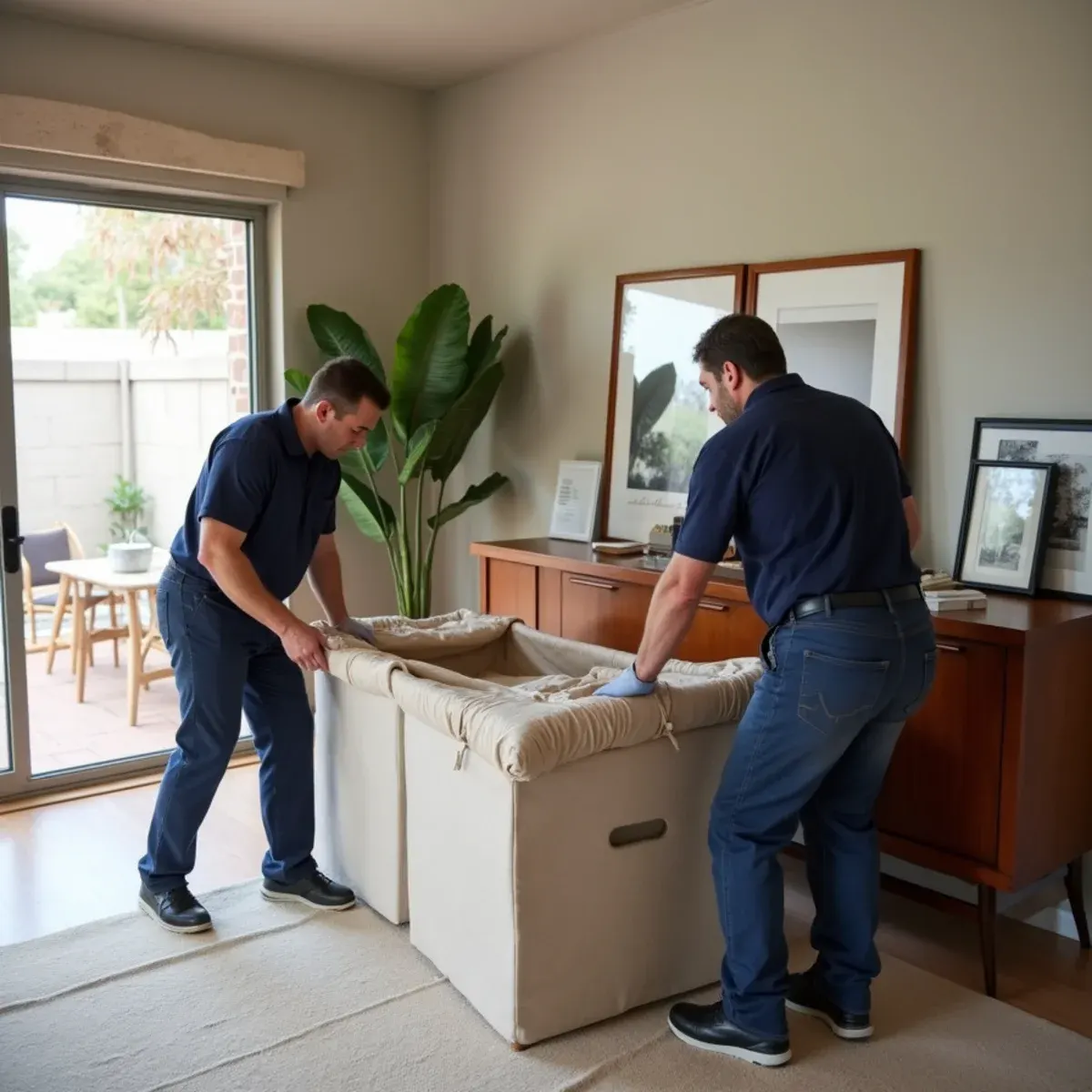
Jean Vandruff put turrets, pointed gables, arched doorways and gingerbread trim on ordinary 1950s tract houses here, and none of that woodwork can be bought today. That single fact drives how we handle a Downey contents loss. Emptying a room quickly is not about the boxes. It is about clearing enough floor to set drying equipment tight against wet materials, so the sheathing, the subfloor and the original casings can dry in place instead of being cut out. The pack-out is what buys you the option not to demolish.
Under the detailing these are standard 1950s slab houses with galvanized supply lines and cast-iron drains, and they fail the way that vintage fails: pinholes inside a wall, a slow slab leak, a lateral that finally gives up. The neighborhoods around the Cinderella tract, Orange Estates and Rancho Estates also hold period furniture and deep family archives. Downey was a working aerospace town, and the Columbia Memorial Space Center sits on that history. Plenty of houses here still have a career's worth of documents in a hall closet.
What Downey Changes About Contents & Pack-Out
1Clear the floor to save the casings
Original Downey trim, arched openings and turned porch posts are matched by nobody. Drying them in place needs air movers placed low and close, dehumidification held steady for days, and daily readings, none of which is possible with furniture and boxes against the walls. We prioritize emptying the perimeter of each wet room first, then set equipment, then finish the rest of the pack-out.
2Mid-century furniture needs slow drying
Period case goods with thin walnut and teak veneer, and cane or rush seating, delaminate and check when they are dried aggressively. Those pieces come out of the house early and dry slowly in controlled humidity rather than under direct airflow. If a joint has already released, regluing it is a furniture restorer's work and we will say so rather than clamping it in a warehouse.
3Career paperwork is common in these houses
A lot of Downey households hold decades of documents: service records, aerospace-era work papers, photographs from when the tract was new. Wet paper has hours, not days, before ink migrates and pages fuse together. Those boxes get pulled and frozen first, ahead of furniture, then sorted afterward when there is time to do it properly rather than under pressure.
How the Work Runs
The method is the same one we use on every contents & pack-out job, documented to the IICRC S500:2025 standard. Here it is in short — the full contents restoration & pack-out process explains each stage in detail.
- Room-by-room photographic inventory
- Triage into three categories
- Careful packing and transport
- Cleaning and restoration by material type
- Climate-controlled storage
- Delivery and placement back
The Downey Background Worth Knowing
The instinct on a wet wall is to open it, and sometimes that is correct. But IICRC S500:2025 is built around restoring rather than replacing wherever the drying goals can genuinely be met, and on a house with original arched casings and applied gingerbread, meeting those goals is worth some patience. We would rather spend three extra days with equipment running than pull a run of trim that would have to be milled from scratch to come back. The standard supports that choice and so does the arithmetic on the estimate, because custom millwork is not cheap and matching a fifties profile is not quick.
There is more on the housing stock, drainage and plumbing history of this city on our water damage restoration in Downey page.
Downey at a glance
- Dominant construction era
- 1950–1965
- Foundation type
- slab on grade
- Supply piping found here
- galvanized steel, under-slab copper
- Drain line materials
- cast iron
- Terrain and water table
- flat, moderate water table
- Most common local failure
- 1950s slab and galvanized failures in houses whose decorative woodwork makes careful, low-demolition drying worth paying for
- Highest-value local prevention
- drying in place wherever readings allow, because the trim and detailing on these houses cannot be bought
What It Costs in Downey
We do not quote a number over the phone before seeing the property — anyone who does is guessing. The variables that actually move the price on a contents & pack-out job are volume of contents, proportion of specialty items, storage duration, and they are broken down in full on the contents restoration & pack-out page. The assessment and the written estimate are free anywhere in Downey, day or night, with no obligation.
Contents & Pack-Out Questions from Downey Homeowners
It improves the odds considerably, and that is why we push for it. A dry-in-place attempt needs continuous equipment placement and daily moisture readings taken against the wood, and cluttered rooms make that impossible. It does not always work. Plaster that has released from the lath, or trim that has swollen and split, sometimes has to go. But that call should come from readings after a genuine attempt, not from a schedule written on day one.
It depends on the scope. For a contained single-room loss we often move contents to an unaffected part of the home and block furniture in place. When the drying chamber covers most of the living area or reconstruction is extensive, off-site pack-out is usually both safer and faster.
Every item is photographed and barcoded at your home and tracked through cleaning, storage, and delivery. You receive the inventory, and at delivery we reconcile it with you item by item before we leave.
Usually, yes. We go into the wall cavity through small ports low on the wall, hidden behind shoe molding or inside a closet, and dry from the inside out rather than taking the finished face off. That takes longer and needs more equipment than gutting the wall would, which is exactly the trade we think is worth making on a house with millwork that cannot be bought. Where it will not work, we tell you early.