
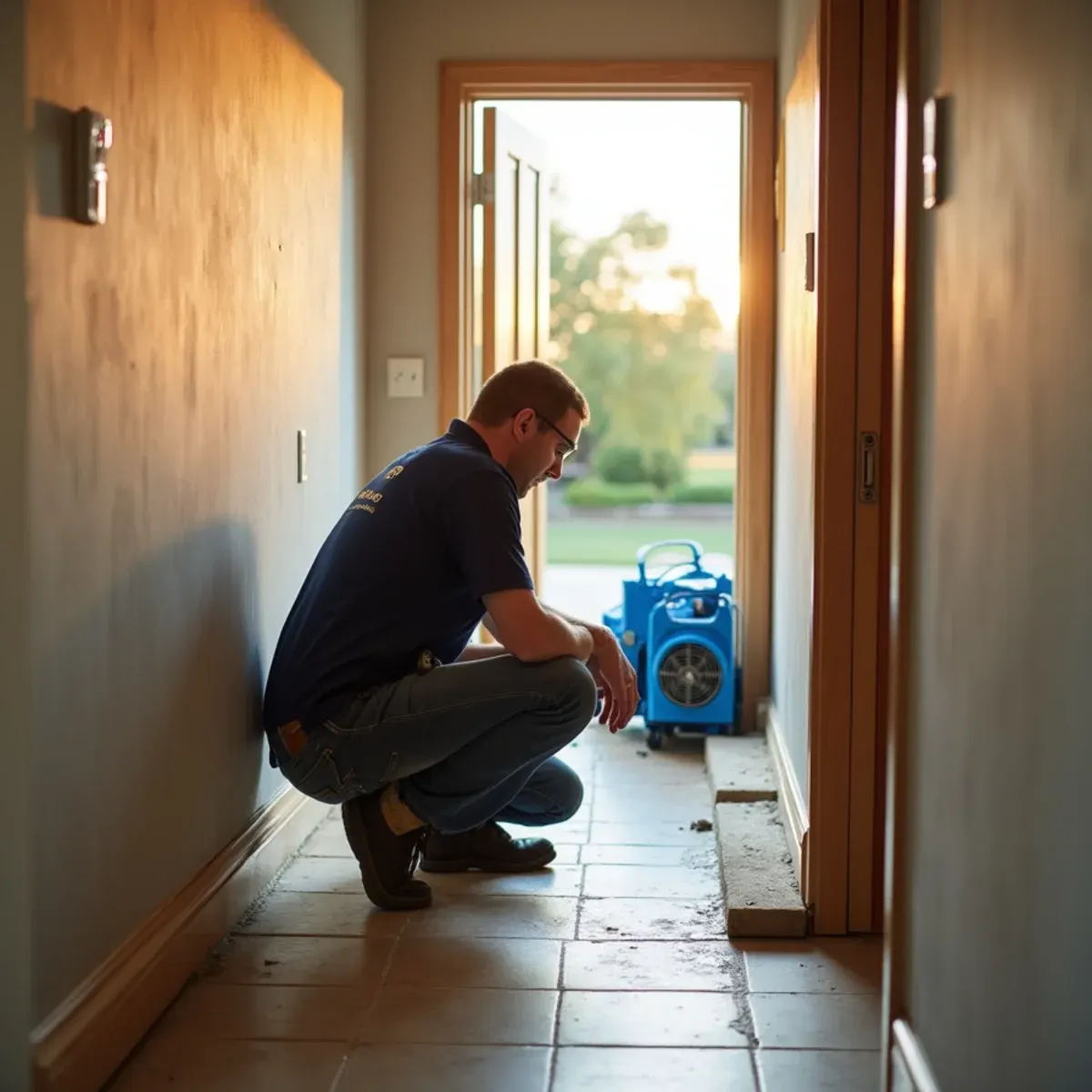
In Old Towne, the walls are lath and plaster over full-dimension studs, and a split in an old galvanized riser behaves nothing like it would in drywall. Plaster holds water without staining for a long time, then lets go all at once. The cavities are deeper, the framing is irregular, and the pipe itself may have been repaired three times since the house went up near the Plaza. We scan with thermal imaging before we touch anything, because a wrong guess in a hundred-year-old wall costs you real material.
Away from the historic district the picture flips. El Modena, Santiago Hills and the postwar tracts off Chapman are slab on grade with copper, and a burst there usually announces itself as a warm patch underfoot or a faint hiss in a quiet house. Orange Park Acres adds a third case: half-acre equestrian lots where the line to a barn or guest quarters runs a long way from the meter and from anyone who would notice. We're about thirteen minutes east of our Cypress base and dispatch as fast as conditions allow.
What Orange Changes About Burst Pipe Damage
1Lath and plaster cuts differently
Plaster over wood lath doesn't cut like drywall. It cracks past the line, the keys break loose in the bay above, and the dust is heavy. We score, cut small, and support the surrounding plaster before removing anything. Access ports for cavity drying go in low, where a baseboard will cover them once the wall is closed. Matching the original texture on the repair is slower work and worth doing.
2Crawl spaces swallow the evidence
Under an Old Towne raised foundation, water from a burst supply line drips into dirt instead of pooling on a floor, which is why these failures run for weeks before anyone calls. On every burst-pipe job in the historic district we open a crawl-space access and check the soil, the sill and the underside of the subfloor. Wet ground under a house keeps feeding the floor assembly long after the pipe is fixed.
3Slab tracts fail on another clock
The postwar tracts through El Modena and Santiago Hills are slab on grade with copper, and their burst-pipe behavior has nothing in common with Old Towne. Water spreads under flooring, warms a section of slab, and surfaces as a hot spot rather than a stain. We locate from above instead of crawling underneath, and the drying plan targets the floor assembly and the lower wall.
How the Work Runs
The method is the same one we use on every burst pipe damage job, documented to the IICRC S500:2025 standard. Here it is in short — the full burst pipe water damage repair process explains each stage in detail.
- Stop the source
- Locate the failure precisely
- Coordinate the plumbing repair
- Extract and open only what must be opened
- Cavity and structural drying
- Rebuild and finish
The Orange Background Worth Knowing
A slab leak announces itself eventually because concrete has nowhere to put the water. A crawl-space leak has somewhere to put it. Dirt absorbs a slow drip almost indefinitely, so the loss never produces the one thing homeowners watch for, which is water on a floor. Meanwhile the humidity under the house climbs, the fiberglass insulation between the joists soaks up moisture and sags, the subfloor picks up that moisture from below, and mold begins on the joists where it is invisible and undisturbed. Everything about this failure is built to stay quiet.
There is more on the housing stock, drainage and plumbing history of this city on our water damage restoration in Orange page.
Orange at a glance
- Dominant construction era
- 1888–1975
- Foundation type
- mixed on grade
- Supply piping found here
- original turn-of-century piping, galvanized steel, under-slab copper
- Drain line materials
- cast iron, clay
- Terrain and water table
- flat, moderate water table
- Most common local failure
- crawl-space leaks under raised-foundation historic homes, running for weeks because water drips into the dirt instead of pooling on a floor
- Highest-value local prevention
- an annual crawl-space inspection, which almost nobody does and which catches nearly everything early
What It Costs in Orange
We do not quote a number over the phone before seeing the property — anyone who does is guessing. The variables that actually move the price on a burst pipe damage job are how long the line ran before discovery, which floor it happened on, hot line versus cold line, and they are broken down in full on the burst pipe water damage repair page. The assessment and the written estimate are free anywhere in Orange, day or night, with no obligation.
Burst Pipe Damage Questions from Orange Homeowners
As little as we can justify. We locate the break with thermal imaging and a moisture meter first, so the opening gets sized to the repair rather than to the search. Cavity drying then runs through small ports, usually placed low where baseboard covers them. We can't promise zero removal, since saturated plaster with failed keys has to come out. But the goal on every Old Towne house is one small patch, not an open wall.
We restore the water damage and coordinate the plumbing repair, working with your plumber or bringing in a licensed one from our network. Handling both under one schedule is what keeps a burst pipe from turning into two weeks of contractor coordination.
More than people expect. A half-inch supply line at typical residential pressure moves in the range of 8 to 10 gallons a minute. That is roughly 500 gallons in an hour — comparable to filling a small backyard pool inside your walls and floor.
Pick a dry day, open the hatch, and use a good flashlight. You are looking at the soil directly under the bathrooms, kitchen, and laundry for dark damp patches, at the insulation for sagging or fallen batts, and at the piers and foundation vents for rust or white staining. Trust your nose as much as your eyes. If the access is too tight or you would rather not go under, we will do the inspection and photograph what is down there.