
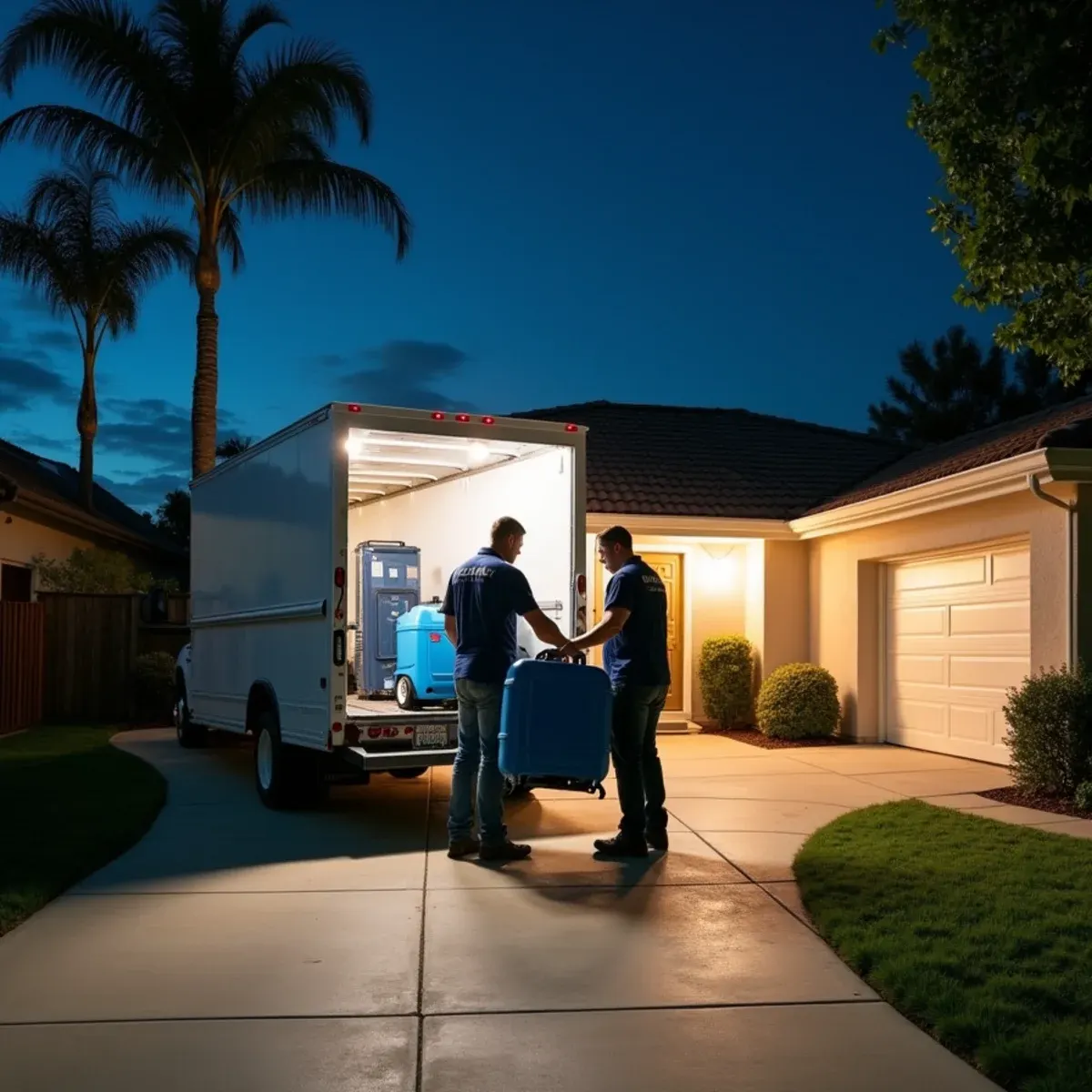
Old Towne Orange is about a square mile of raised-foundation houses radiating out from the Plaza traffic circle, and that single fact changes how we run the first hour. On a slab house, a supply leak announces itself on the floor. Under a 1905 Craftsman near Chapman University, the same leak drips into dirt and stays quiet for weeks while the subfloor and joists soak. So in Old Towne we open the crawl space early instead of last, and moisture mapping starts underneath the house and works upward from there.
The rest of Orange is a different job entirely. El Modena, Santiago Hills and Serrano Heights are postwar and later slab tract, where under-slab copper and leftover galvanized fail the way they do across the flat part of the county. Orange Park Acres adds half-acre equestrian lots with long service runs and constant irrigation. From our Cypress base we are about thirteen minutes west of the Plaza, and we dispatch as fast as conditions on Chapman and Katella allow rather than quoting you a number we cannot control.
What Orange Changes About Emergency Restoration
1The crawl space gets opened first
Under a raised foundation, water has somewhere to hide. It soaks the soil, raises humidity in the enclosed space, and works into joists, girders and the underside of the subfloor before anything shows upstairs. On Old Towne calls we pull an access panel and get meters and a camera under the house early, because the extent below the floor almost always exceeds what you can see standing in the room.
2Historic materials we cannot replace
Old-growth fir flooring, lath and plaster, original casings and single-pane sash are not available at a supply house. IICRC S500:2025 supports drying assemblies in place when readings justify it, and in Old Towne that is usually the right call. We use cavity and injection drying, small controlled access points, and daily documented readings instead of demolition that trades a two-week problem for a two-year one.
3Orange Park Acres complicates the leak test
Half-acre equestrian lots run irrigation, wash racks, barns and outbuildings off long service lines, so a meter that keeps turning does not automatically mean a house leak. We isolate the domestic line from the landscape and outbuilding branches before we call anything a slab leak. It adds time up front and saves a great deal of floor later. Truck access on unpaved drives also affects how we stage hose runs.
How the Work Runs
The method is the same one we use on every emergency restoration job, documented to the IICRC S500:2025 standard. Here it is in short — the full emergency water damage restoration process explains each stage in detail.
- Call answered and crew dispatched
- Arrival, safety check, and moisture mapping
- Documentation before anything is touched
- Extraction
- Controlled structural drying
- Cleaning, sanitizing, and final verification
The Orange Background Worth Knowing
A slab leak announces itself eventually because concrete has nowhere to put the water. A crawl-space leak has somewhere to put it. Dirt absorbs a slow drip almost indefinitely, so the loss never produces the one thing homeowners watch for, which is water on a floor. Meanwhile the humidity under the house climbs, the fiberglass insulation between the joists soaks up moisture and sags, the subfloor picks up that moisture from below, and mold begins on the joists where it is invisible and undisturbed. Everything about this failure is built to stay quiet.
There is more on the housing stock, drainage and plumbing history of this city on our water damage restoration in Orange page.
Orange at a glance
- Dominant construction era
- 1888–1975
- Foundation type
- mixed on grade
- Supply piping found here
- original turn-of-century piping, galvanized steel, under-slab copper
- Drain line materials
- cast iron, clay
- Terrain and water table
- flat, moderate water table
- Most common local failure
- crawl-space leaks under raised-foundation historic homes, running for weeks because water drips into the dirt instead of pooling on a floor
- Highest-value local prevention
- an annual crawl-space inspection, which almost nobody does and which catches nearly everything early
What It Costs in Orange
We do not quote a number over the phone before seeing the property — anyone who does is guessing. The variables that actually move the price on a emergency restoration job are water category, affected square footage and number of rooms, how many days of equipment, and they are broken down in full on the emergency water damage restoration page. The assessment and the written estimate are free anywhere in Orange, day or night, with no obligation.
Emergency Restoration Questions from Orange Homeowners
Usually not. Lath and plaster dries slowly but it dries, and we would rather spend three extra days on dehumidification than open a wall we cannot rebuild to match. We drill small, hidden access points at baseplate level, dry the cavity from inside, and log readings daily until the assembly hits the documented dry standard. If plaster has lost its key to the lath or is saturated to failure, we will tell you plainly and show you the readings.
We commit to being on-site within 60 minutes of a confirmed emergency call anywhere in Cypress, and we credit $100 off your invoice if we miss it. Most of the time we are there in 30 to 45 minutes because our trucks stage on Katella Avenue, right here in the city.
No. The emergency assessment and written estimate are free, 24 hours a day. You are not obligated to hire us after we walk the property, and we will tell you plainly if we think the damage is small enough to handle yourself.
Pick a dry day, open the hatch, and use a good flashlight. You are looking at the soil directly under the bathrooms, kitchen, and laundry for dark damp patches, at the insulation for sagging or fallen batts, and at the piers and foundation vents for rust or white staining. Trust your nose as much as your eyes. If the access is too tight or you would rather not go under, we will do the inspection and photograph what is down there.