
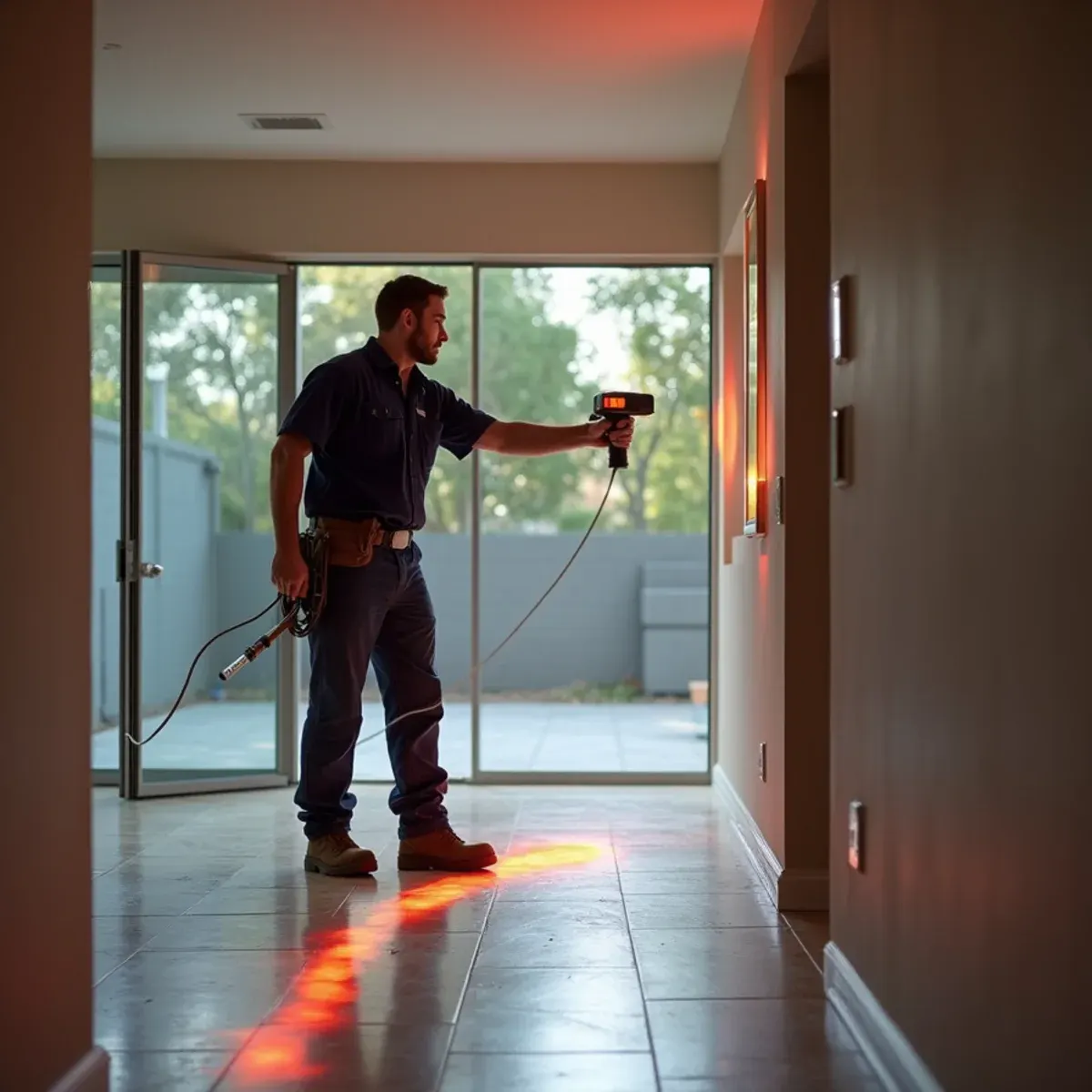
Before we run a meter test in Orange, we ask which side of the Plaza you live on. Old Towne's roughly square mile of Victorian and Craftsman houses sits on raised foundations — there is no slab to leak. What people there call a slab leak is almost always a supply line failing in the crawl space, dripping into dirt for weeks. Cross Tustin Street or head out toward El Modena and Santiago Hills, though, and you're on postwar and 1960s slab tract with copper poured into the concrete.
That copper is the real slab leak population in this city, and it's now fifty to seventy years old. The tell is rarely dramatic: a warm patch on a tile floor, a water heater cycling at night, a bill that climbed and never came back down. Out in Orange Park Acres the picture gets murkier, because half-acre lots run irrigation that hides a slow loss at the meter. We isolate the house side before we call anything a leak, then locate acoustically and with thermal imaging before we touch concrete.
What Orange Changes About Slab Leak Damage
1Old Towne has no slab to leak
Inside the historic district, nearly everything is on a raised foundation. When a homeowner near the Plaza tells us they have a slab leak, we're usually looking at a supply line dripping into crawl-space dirt, sometimes for weeks, with no floor stain to warn anybody. Same urgency, different job — access from below, and a soil-moisture problem to solve along with the pipe.
2Irrigation on Orange Park Acres lots
Half-acre equestrian properties out past Santiago Creek run irrigation loads that swamp a meter test. Before we call anything a slab leak, we isolate the house side and let the meter sit with everything on the property shut off. On several of these jobs the loss turned out to be a broken irrigation line in the pasture, not copper under the house.
3Single-story tract makes reroutes practical
The postwar plans through El Modena and around Hart Park are almost all single-story with usable attics and accessible stucco walls. That makes an overhead reroute a genuine alternative to breaking floor, especially when the same run has already failed once. On the larger Santiago Hills and Serrano Heights houses, with longer runs and finished ceilings, the math shifts back toward a targeted spot repair.
How the Work Runs
The method is the same one we use on every slab leak damage job, documented to the IICRC S500:2025 standard. Here it is in short — the full slab leak water damage repair process explains each stage in detail.
- Confirm it is actually a slab leak
- Electronic leak location
- Choose the repair approach with you
- Dry the slab and the affected assemblies
- Address the flooring and wall base
- Restore the floor and finish
The Orange Background Worth Knowing
A slab leak announces itself eventually because concrete has nowhere to put the water. A crawl-space leak has somewhere to put it. Dirt absorbs a slow drip almost indefinitely, so the loss never produces the one thing homeowners watch for, which is water on a floor. Meanwhile the humidity under the house climbs, the fiberglass insulation between the joists soaks up moisture and sags, the subfloor picks up that moisture from below, and mold begins on the joists where it is invisible and undisturbed. Everything about this failure is built to stay quiet.
There is more on the housing stock, drainage and plumbing history of this city on our water damage restoration in Orange page.
Orange at a glance
- Dominant construction era
- 1888–1975
- Foundation type
- mixed on grade
- Supply piping found here
- original turn-of-century piping, galvanized steel, under-slab copper
- Drain line materials
- cast iron, clay
- Terrain and water table
- flat, moderate water table
- Most common local failure
- crawl-space leaks under raised-foundation historic homes, running for weeks because water drips into the dirt instead of pooling on a floor
- Highest-value local prevention
- an annual crawl-space inspection, which almost nobody does and which catches nearly everything early
What It Costs in Orange
We do not quote a number over the phone before seeing the property — anyone who does is guessing. The variables that actually move the price on a slab leak damage job are how long the leak ran undetected, flooring type over the leak, repair method chosen, and they are broken down in full on the slab leak water damage repair page. The assessment and the written estimate are free anywhere in Orange, day or night, with no obligation.
Slab Leak Damage Questions from Orange Homeowners
Usually not in the original structure — those houses sit on raised foundations with a crawl space, so a failing supply line drips into dirt rather than under concrete. But plenty of Old Towne homes picked up kitchen or bath additions poured on grade in the 1950s and 60s, and those absolutely can leak under slab. We check both. The tell for a crawl-space leak is a musty smell and a rising bill with no visible water.
The meter test is the first step: shut off every fixture and watch the low-flow indicator. If it moves and nothing is wet above the floor, suspect the slab. Warm spots on the floor, running-water sounds from below, and flooring that lifts or cups without an obvious cause all point the same direction. We confirm it with thermal imaging and moisture mapping at no charge.
Not always. Depending on where the leak is and the condition of the system, rerouting the line overhead through the attic and walls avoids opening the concrete entirely. When a spot repair is the better option, precise electronic location keeps the opening small — typically a couple of feet, not a trench across the room.
Pick a dry day, open the hatch, and use a good flashlight. You are looking at the soil directly under the bathrooms, kitchen, and laundry for dark damp patches, at the insulation for sagging or fallen batts, and at the piers and foundation vents for rust or white staining. Trust your nose as much as your eyes. If the access is too tight or you would rather not go under, we will do the inspection and photograph what is down there.