
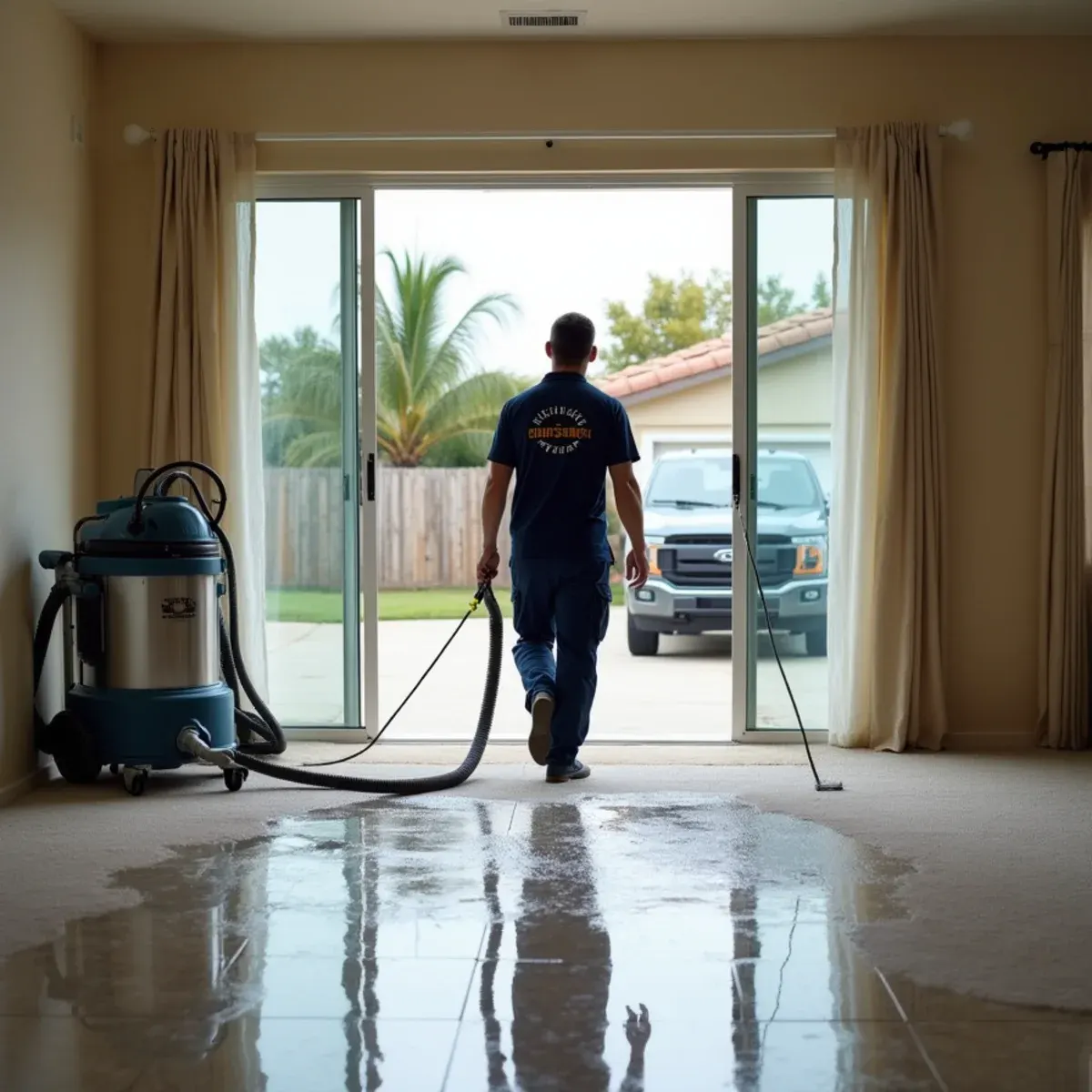
Old Towne changes what extraction even means. Under a raised-foundation Craftsman off Glassell or Chapman, there is no sheet of water on a floor to pull. It has already gone into the dirt, into the batt insulation between the joists, and into the underside of the subfloor. The removal work is a submersible pump set in the low corner of the crawl space, then hauling out insulation that will never dry and any storage the water reached. Cross Tustin Street into the postwar tracts and the job inverts completely.
Those two jobs want different equipment staged at the curb. In the slab tracts near El Modena and Santiago Hills we run weighted extraction heads over carpet in slow overlapping passes until the pad stops surrendering water, and we pull pad that has delaminated instead of pretending it will dry. In Old Towne we are often feeding hose through an eighteen-inch access hatch and back out to the truck. Orange Park Acres adds pure distance — long driveways mean long hose runs, and we plan that before the truck rolls.
What Orange Changes About Water Extraction
1Crawl-space pumping under historic raised floors
A crawl-space loss in Old Towne is usually found late, because water drips into soil instead of pooling where you'd see it. By then the dirt is saturated and the insulation is holding weight. We pump the free water, remove the fallen and soaked insulation, and take moisture readings in the joists and subfloor before anything gets closed back up.
2Hardwood floors limit weighted extraction
Many Old Towne houses have original narrow-strip oak. Weighted extraction tools are built for carpet over pad, not for pressing water across a wood floor. On hardwood we switch to low-pressure surface extraction and mat systems that draw water up through the boards, because forcing water sideways under finish is how you turn a wet floor into a cupped floor.
3Distance and access in Orange Park Acres
Half-acre equestrian lots put the front door a long way from the street. Truck-mounted extraction loses lift over long hose runs, so we bring extra line and, where the run is severe, stage a portable extractor closer to the loss and shuttle to the truck. Barn and outbuilding losses on these properties get the same treatment.
How the Work Runs
The method is the same one we use on every water extraction job, documented to the IICRC S500:2025 standard. Here it is in short — the full water extraction & removal process explains each stage in detail.
- Bulk removal with submersible pumps
- Truck-mounted extraction on carpet and pad
- Hard-surface and specialty extraction
- Cavity and void extraction
- Removing what cannot be saved
- Post-extraction moisture reading
The Orange Background Worth Knowing
A slab leak announces itself eventually because concrete has nowhere to put the water. A crawl-space leak has somewhere to put it. Dirt absorbs a slow drip almost indefinitely, so the loss never produces the one thing homeowners watch for, which is water on a floor. Meanwhile the humidity under the house climbs, the fiberglass insulation between the joists soaks up moisture and sags, the subfloor picks up that moisture from below, and mold begins on the joists where it is invisible and undisturbed. Everything about this failure is built to stay quiet.
There is more on the housing stock, drainage and plumbing history of this city on our water damage restoration in Orange page.
Orange at a glance
- Dominant construction era
- 1888–1975
- Foundation type
- mixed on grade
- Supply piping found here
- original turn-of-century piping, galvanized steel, under-slab copper
- Drain line materials
- cast iron, clay
- Terrain and water table
- flat, moderate water table
- Most common local failure
- crawl-space leaks under raised-foundation historic homes, running for weeks because water drips into the dirt instead of pooling on a floor
- Highest-value local prevention
- an annual crawl-space inspection, which almost nobody does and which catches nearly everything early
What It Costs in Orange
We do not quote a number over the phone before seeing the property — anyone who does is guessing. The variables that actually move the price on a water extraction job are volume and depth of water, flooring type, contamination level, and they are broken down in full on the water extraction & removal page. The assessment and the written estimate are free anywhere in Orange, day or night, with no obligation.
Water Extraction Questions from Orange Homeowners
Usually yes, and more than people expect. Soil under a raised foundation holds standing water in low spots long after the leak stops, and saturated insulation can hold gallons on its own. We pump what's free, remove insulation and any wet storage, and then measure the joists and subfloor. If the wood readings are elevated, extraction and removal is only step one — controlled drying under the house follows.
For a typical single-room residential loss, extraction runs one to three hours. Multi-room losses or Category 3 water can take most of a day because of containment setup and material removal. We will give you a realistic timeframe after the walkthrough, before we start.
Often we can save the carpet and only replace the pad, which is the cheaper and less disruptive path. The deciding factors are water category, how long it sat, and whether the pad is a moisture barrier type. Clean water caught quickly usually means the carpet stays.
Pick a dry day, open the hatch, and use a good flashlight. You are looking at the soil directly under the bathrooms, kitchen, and laundry for dark damp patches, at the insulation for sagging or fallen batts, and at the piers and foundation vents for rust or white staining. Trust your nose as much as your eyes. If the access is too tight or you would rather not go under, we will do the inspection and photograph what is down there.