
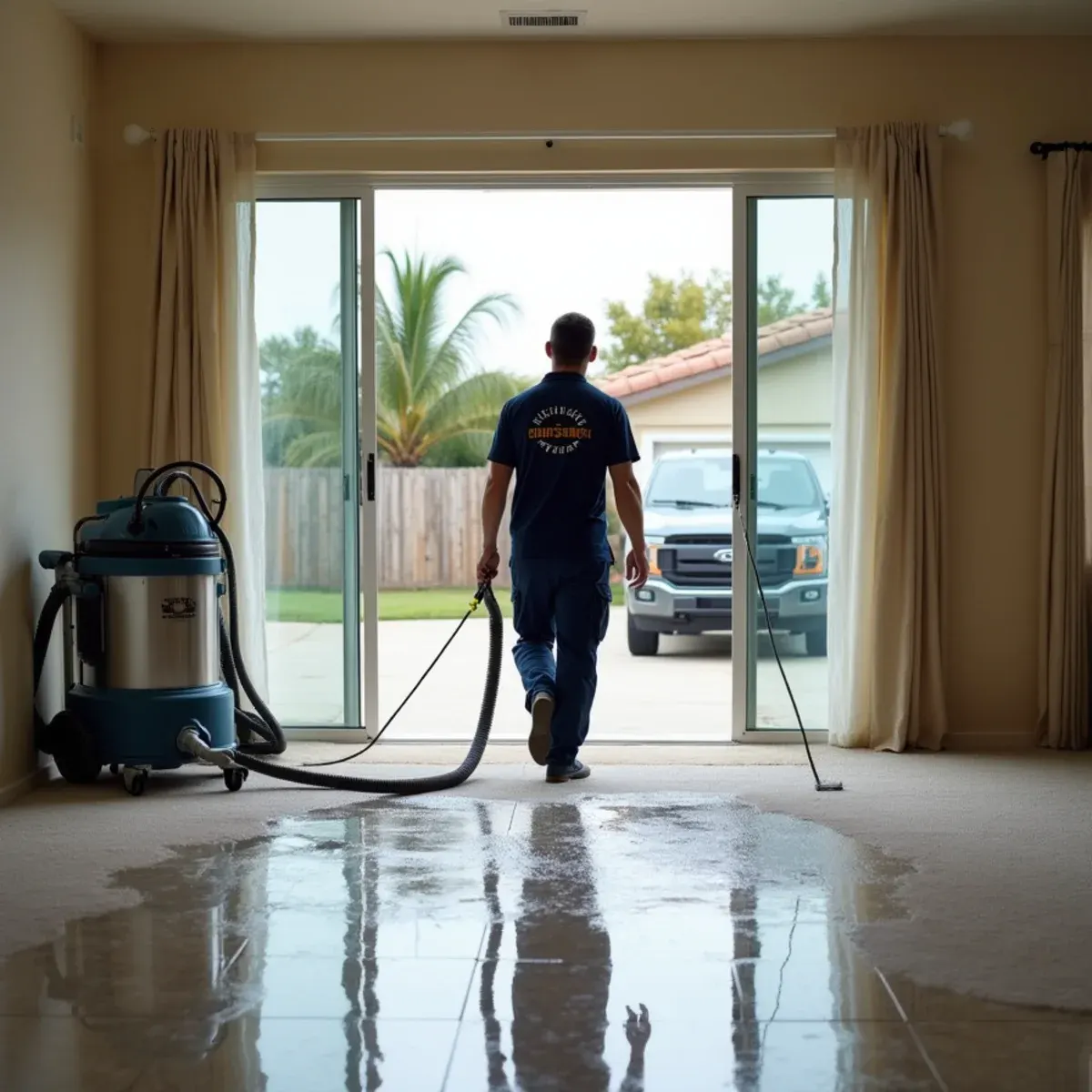
Villa Park is the smallest city in Orange County and the houses are among the biggest we work in. Custom single-story plans spread across half-acre lots mean a supply failure has room to travel, and it does. Water leaving a hall bath in a home off Center Drive or Santiago Boulevard can reach four or five rooms before anyone notices, simply because there are more rooms on one level and fewer walls tight enough to stop it. Square footage is the whole story on these calls.
It changes the equipment plan more than people realize. Truck-mounted extraction loses vacuum over long hose runs, and on a half-acre lot the truck may sit two hundred feet from the far bedroom. We stage portable extractors deep in the house and run them to the truck, or bring a second unit rather than accept weak lift where it matters most. The other Villa Park complication is irrigation: heavy landscape watering on lots this size makes a meter-based leak test almost meaningless unless the irrigation is isolated first, and that affects how quickly anyone identifies the source.
What Villa Park Changes About Water Extraction
1Long plumbing runs hide the source
Big custom floor plans put fixtures far apart, and the under-slab supply lines between them run a long way. A pinhole can sit twenty feet from the nearest sink, so the wet floor and the failure point aren't in the same room. We extract based on metered moisture boundaries rather than assuming the leak is under the wettest spot, and coordinate with leak detection instead of guessing.
2Hose distance costs you extraction power
Every additional length of vacuum hose reduces lift at the wand. On these lots that's not theoretical — the difference between a properly extracted pad and a merely damp one is often just hose length. We plan the truck position and staging before unloading, and use in-house portables on the far side of the plan so the last room gets the same extraction the first one did.
3Irrigation masks the leak signal
Half-acre landscaping on a shared meter means the meter is almost always moving. If your domestic supply isn't separated from irrigation, a leak test proves nothing, and homeowners lose weeks. Having irrigation on its own valve or meter turns a meter check into real information — and after a loss, it's the single change that most improves how fast the next one gets caught.
How the Work Runs
The method is the same one we use on every water extraction job, documented to the IICRC S500:2025 standard. Here it is in short — the full water extraction & removal process explains each stage in detail.
- Bulk removal with submersible pumps
- Truck-mounted extraction on carpet and pad
- Hard-surface and specialty extraction
- Cavity and void extraction
- Removing what cannot be saved
- Post-extraction moisture reading
The Villa Park Background Worth Knowing
In a tract, the plumbing sits where it sat in the last four houses we worked on. In Villa Park it is wherever the plan put it in 1974, and there is rarely a drawing left to consult. That is why locating a leak here can take longer than a homeowner expects. Water from a pinhole travels the path of least resistance under the slab and surfaces wherever the soil and the concrete let it, which on a plan this size can be an entire room away from the break. Guessing at the wet spot is how people end up cutting the wrong floor.
There is more on the housing stock, drainage and plumbing history of this city on our water damage restoration in Villa Park page.
Villa Park at a glance
- Dominant construction era
- 1962–1985
- Foundation type
- slab on grade
- Supply piping found here
- under-slab copper
- Drain line materials
- cast iron, ABS
- Terrain and water table
- rolling, moderate water table
- Most common local failure
- long under-slab runs in large custom floor plans, where a leak can sit far from any fixture and take longer to locate
- Highest-value local prevention
- separating irrigation from the domestic meter so a leak test actually means something
What It Costs in Villa Park
We do not quote a number over the phone before seeing the property — anyone who does is guessing. The variables that actually move the price on a water extraction job are volume and depth of water, flooring type, contamination level, and they are broken down in full on the water extraction & removal page. The assessment and the written estimate are free anywhere in Villa Park, day or night, with no obligation.
Water Extraction Questions from Villa Park Homeowners
We size the truck load to the address before dispatch, and Villa Park addresses get planned as large-footprint jobs by default. That means additional extraction units, extra hose, and enough air movers and dehumidification for the actual affected square footage rather than a standard three-room package. If the loss turns out larger than reported, we'll tell you what a second staging trip requires instead of stretching undersized equipment across too much floor.
For a typical single-room residential loss, extraction runs one to three hours. Multi-room losses or Category 3 water can take most of a day because of containment setup and material removal. We will give you a realistic timeframe after the walkthrough, before we start.
Often we can save the carpet and only replace the pad, which is the cheaper and less disruptive path. The deciding factors are water category, how long it sat, and whether the pad is a moisture barrier type. Clean water caught quickly usually means the carpet stays.
Start by taking irrigation out of the equation, because on a half-acre lot it is the largest variable you have. Shut the controller off for a full day, then read the meter twice with nothing running in the house. If the leak indicator is still moving, the loss is on the domestic side and worth locating. If it stops, you have a landscape valve or lateral line problem, which is a different and much cheaper trade.