
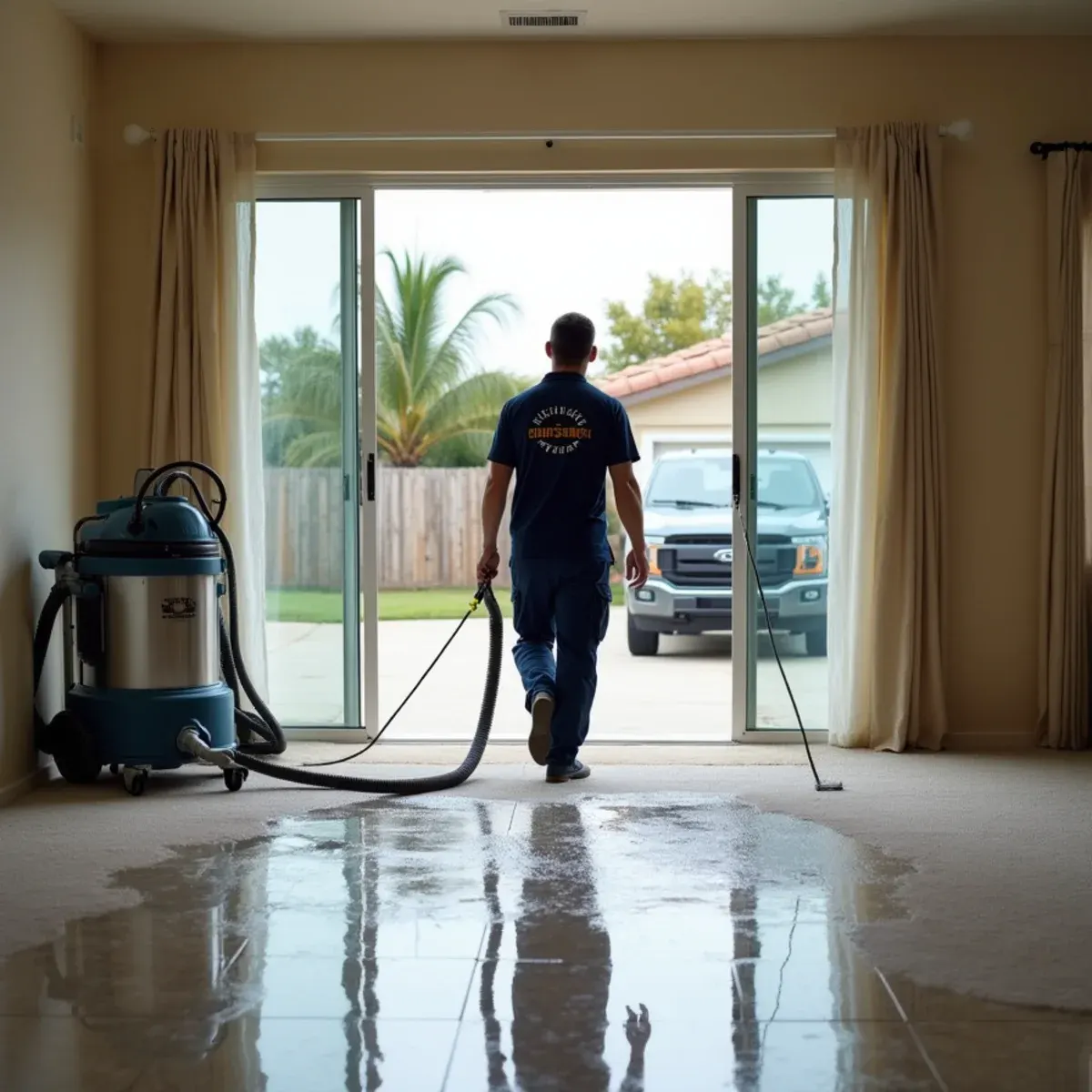
Before we bring a single hose in, we need to know which Tustin your house belongs to. An 1890s Old Town home near Main and C Street sits on a raised foundation, so water leaves through the floor and the real extraction happens underneath it. A 1970s tract house between Newport and Red Hill sits on slab, so the water stays on top and lives in the carpet pad. A Tustin Legacy condo built after 2005 is stacked, so the water goes down through the assembly into somebody else's ceiling.
That last one drives the urgency. In Columbus Square and Columbus Grove, and in the newer buildings around The District, a supply failure on an upper floor becomes a three-unit loss in under an hour. Bulk removal there is a race — extract the source unit first, then chase what has already migrated into the floor cavity and down the shear walls. In Old Town, the same failure is slower and quieter, and the pumping happens in a crawl space nobody has opened in years.
What Tustin Changes About Water Extraction
1Stacked units multiply the extraction footprint
In Tustin Legacy and Columbus Square, one failed supply line is rarely one job. Water crosses the floor, finds the nearest penetration, and drops. We extract the origin unit and the units below simultaneously where we can get access, because pulling only the top floor leaves gallons sitting in ceiling cavities that will show up as sagging drywall a day later.
2Old Town crawl spaces need pumps, not wands
Raised foundations along the older Old Town streets collect water in the crawl rather than on the finish floor. That calls for a submersible pump in the low point and removal of soaked subfloor insulation, not carpet extraction. It also means the visible damage upstairs badly understates the loss, which is why we open the access hatch on every raised-foundation call here.
31970s tract carpet and pad decisions
The mid-city tract stock still has plenty of original carpet over rebond pad. IICRC S500:2025 treats saturated pad in a clean-water loss as generally unsalvageable, and in practice it is: rebond that has been soaked delaminates. We extract the carpet in place, pull the pad, and keep the carpet where the fiber and backing justify it.
How the Work Runs
The method is the same one we use on every water extraction job, documented to the IICRC S500:2025 standard. Here it is in short — the full water extraction & removal process explains each stage in detail.
- Bulk removal with submersible pumps
- Truck-mounted extraction on carpet and pad
- Hard-surface and specialty extraction
- Cavity and void extraction
- Removing what cannot be saved
- Post-extraction moisture reading
The Tustin Background Worth Knowing
You can usually place your house without paperwork. Foundation vents around the perimeter and a floor that sits a step or two above grade means a raised foundation and a crawl space, which puts you in the Old Town generation. A slab sitting flush at grade with no vents puts you in the tract era. If you have a second-floor laundry, a tankless heater, or a manifold of colored plastic tubing in a closet, you are in the Legacy generation. Each of those buildings has an entirely different weak point, and knowing yours is most of the battle.
There is more on the housing stock, drainage and plumbing history of this city on our water damage restoration in Tustin page.
Tustin at a glance
- Dominant construction era
- 1880–2020
- Foundation type
- mixed on grade
- Supply piping found here
- original pre-war piping in Old Town, under-slab copper, modern PEX in Tustin Legacy
- Drain line materials
- cast iron, clay, ABS
- Terrain and water table
- flat, moderate water table
- Most common local failure
- wildly different failure modes street to street, because the era of the house decides everything
- Highest-value local prevention
- knowing which of the three Tustins your house belongs to before assuming any advice applies
What It Costs in Tustin
We do not quote a number over the phone before seeing the property — anyone who does is guessing. The variables that actually move the price on a water extraction job are volume and depth of water, flooring type, contamination level, and they are broken down in full on the water extraction & removal page. The assessment and the written estimate are free anywhere in Tustin, day or night, with no obligation.
Water Extraction Questions from Tustin Homeowners
We extract every affected unit we can get authorized access to, starting at the source so the supply stops adding volume. In your unit, the priority is releasing trapped water from the ceiling cavity in a controlled way rather than waiting for it to fall, then extracting flooring below. HOA-maintained assemblies often sit between units, so we document readings and photos for both your insurer and the association from the first hour.
For a typical single-room residential loss, extraction runs one to three hours. Multi-room losses or Category 3 water can take most of a day because of containment setup and material removal. We will give you a realistic timeframe after the walkthrough, before we start.
Often we can save the carpet and only replace the pad, which is the cheaper and less disruptive path. The deciding factors are water category, how long it sat, and whether the pad is a moisture barrier type. Clean water caught quickly usually means the carpet stays.
New plumbing removes corrosion from the list, not everything else. What fails in Legacy-era homes is connections and appliances: braided washer hoses, refrigerator ice-maker lines, angle stops, dishwasher fittings, and water heaters that are now well into their service life. Second-floor laundry rooms are the biggest single change from older Tustin housing, because a failure up there drains through two ceilings instead of across a garage slab. Age protects you from one category of failure and none of the others.