
A friend across town tells you what their plumber found, and in most cities that's useful. In Tustin it's often irrelevant. A 1905 house off Main Street in Old Town, a 1972 slab tract home near Tustin Sports Park and a 2012 home in Columbus Square are three different buildings with three different drainage systems, and a sewage backup behaves differently in each. Before we bring anything into the house, we want to know which Tustin we're in, because that decides where the water went.
Old Town sits on raised foundations over clay and early cast iron, so the contamination usually ends up under the floor rather than on it. The 1960s to 1980s middle of the city is slab with cast iron buried in concrete, where the backup surfaces at whichever fixture sits lowest. Tustin Legacy and Columbus Grove, built after 2005 on the old Marine Corps Air Station, have modern ABS and shared association lines — newer pipe, but a backup there is as much a management question as a plumbing one.
What Tustin Changes About Sewage Cleanup
1Old Town's clay under mature roots
The laterals under Old Town are clay with mortared joints and a century of tree roots around them. Once we've cleaned and verified, we push for a camera scope before any flooring goes back, because a line that's still half closed will do this again. It's a short job while access is already open and the floor is already up.
2Association lines in Tustin Legacy
In Columbus Square, Columbus Grove and the newer Legacy neighborhoods, the pipe that failed may not be yours. Shared laterals and common-area mains put the association's insurer in the file alongside your own, and sewer backup usually rides on a separate endorsement. We document the loss as its own file from hour one so your claim doesn't wait on somebody else's adjuster.
3Slab-era homes hide the extent
In the 1960s and 1970s tracts, sewage runs under vinyl, under laminate and along the base of walls without showing much on the surface. We map it with a meter and a thermal camera before we decide what comes out, then cut to the actual contamination line. Guessing high wastes your money; guessing low leaves Category 3 water inside a wall cavity.
How the Work Runs
The method is the same one we use on every sewage cleanup job, documented to the IICRC S500:2025 standard. Here it is in short — the full sewage backup cleanup process explains each stage in detail.
- Secure the area and set containment
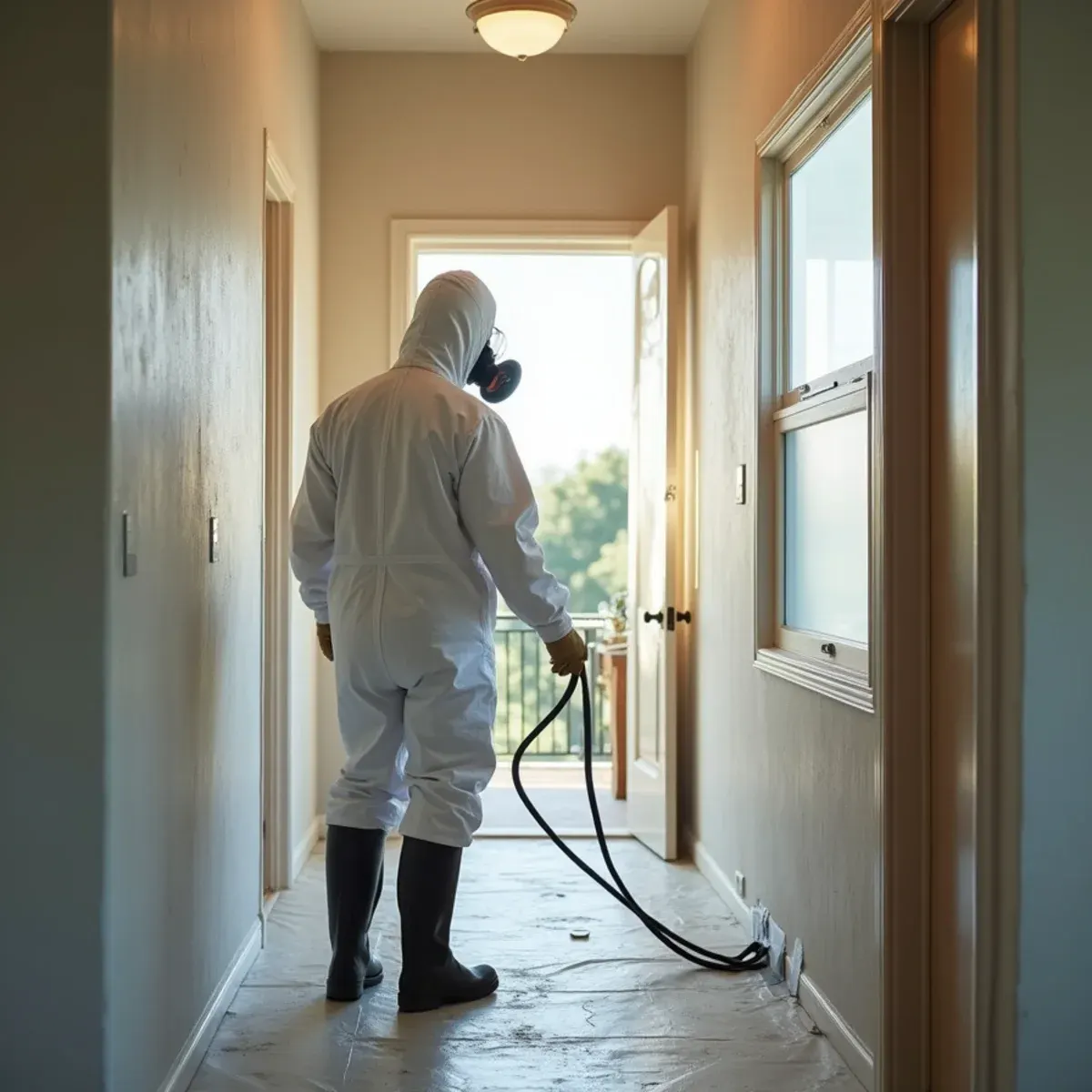
- Full PPE and safe extraction
- Remove contaminated porous materials
- Clean and disinfect all remaining surfaces
- Deodorize at the source
- Dry, verify, and clear
The Tustin Background Worth Knowing
You can usually place your house without paperwork. Foundation vents around the perimeter and a floor that sits a step or two above grade means a raised foundation and a crawl space, which puts you in the Old Town generation. A slab sitting flush at grade with no vents puts you in the tract era. If you have a second-floor laundry, a tankless heater, or a manifold of colored plastic tubing in a closet, you are in the Legacy generation. Each of those buildings has an entirely different weak point, and knowing yours is most of the battle.
There is more on the housing stock, drainage and plumbing history of this city on our water damage restoration in Tustin page.
Tustin at a glance
- Dominant construction era
- 1880–2020
- Foundation type
- mixed on grade
- Supply piping found here
- original pre-war piping in Old Town, under-slab copper, modern PEX in Tustin Legacy
- Drain line materials
- cast iron, clay, ABS
- Terrain and water table
- flat, moderate water table
- Most common local failure
- wildly different failure modes street to street, because the era of the house decides everything
- Highest-value local prevention
- knowing which of the three Tustins your house belongs to before assuming any advice applies
What It Costs in Tustin
We do not quote a number over the phone before seeing the property — anyone who does is guessing. The variables that actually move the price on a sewage cleanup job are affected square footage, volume of porous material removed, contents in the affected area, and they are broken down in full on the sewage backup cleanup page. The assessment and the written estimate are free anywhere in Tustin, day or night, with no obligation.
Sewage Cleanup Questions from Tustin Homeowners
It depends on where the blockage sits, and that's worth establishing early. If it's in your private lateral between the house and the connection point, it's yours. If it's in a shared line or a common-area main, the association's policy is in play and so is theirs. Either way, the cleanup can't wait for that answer. We contain and stabilize first, document the origin carefully, and give both adjusters the same evidence.
It depends on the source. A toilet that overflows with clean bowl water because of a stuck fill valve is Category 1 or 2 and is far less serious. A toilet that backs up from the main line is carrying waste from the whole system, and that is Category 3 — it needs the full protocol.
No. Standard practice for Category 3 water is removal and disposal of carpet and pad that were contacted. Porous materials cannot be reliably disinfected all the way through, and the health risk of leaving them is not worth the savings.
New plumbing removes corrosion from the list, not everything else. What fails in Legacy-era homes is connections and appliances: braided washer hoses, refrigerator ice-maker lines, angle stops, dishwasher fittings, and water heaters that are now well into their service life. Second-floor laundry rooms are the biggest single change from older Tustin housing, because a failure up there drains through two ceilings instead of across a garage slab. Age protects you from one category of failure and none of the others.