

Before you take any advice about your Tustin home, including ours, work out which Tustin it sits in. This city holds three distinct construction generations inside its borders, and they fail in almost unrelated ways. What protects a house on Main Street is irrelevant on Tustin Ranch Road, and a maintenance checklist for a 2012 townhome in Columbus Square would be useless to either one. Most general water damage advice assumes a single kind of house. Tustin punishes that assumption, which is why we ask the year built before we ask almost anything else.
Old Town, around Main Street and El Camino Real, runs from the 1880s through the 1920s: Victorians and Craftsman homes on raised foundations, whatever survives of the original pre-war supply piping, and clay or cast iron below. Leaks there go into the crawl space and stay quiet for weeks. The middle of the city, built from the 1960s into the 1980s, is slab tract where copper runs through concrete and the tell is a warm patch on the floor or a bill that climbed for no reason. Same city, same night, two completely different emergencies.
Then there is Tustin Legacy, built from roughly 2005 onward on the former Marine Corps Air Station, along with Columbus Square and Columbus Grove. Modern PEX, ABS drains, engineered site drainage, and, to a lot of owners' surprise, plenty of water losses. New construction does not fail from corrosion. It fails at connections, at appliances, and at the second-floor laundry rooms an older slab house never had. It also fails sideways, because much of that housing is attached or stacked and one hose serves more than one household's ceiling.
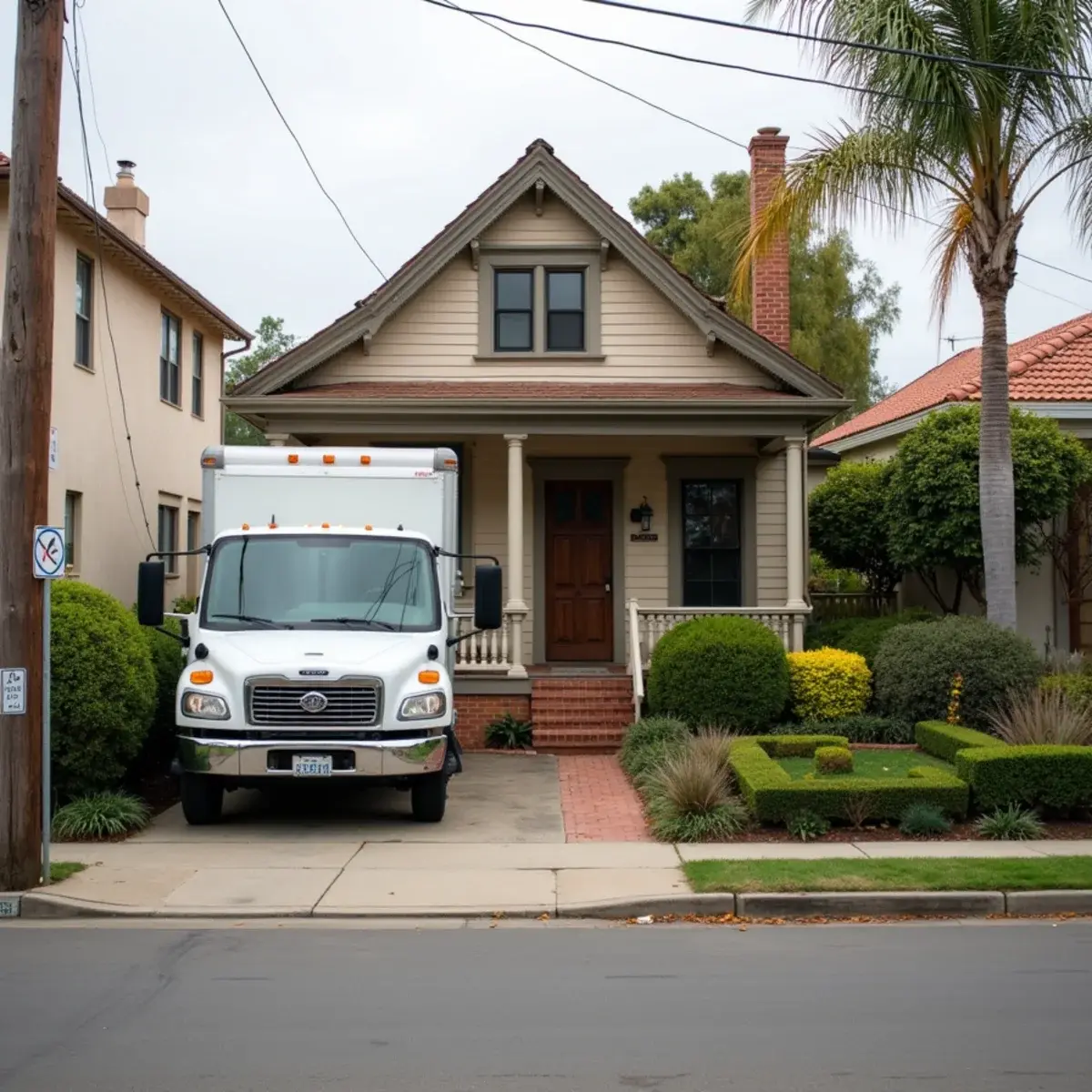
Which Tustin Is Your House In?
You can usually place your house without paperwork. Foundation vents around the perimeter and a floor that sits a step or two above grade means a raised foundation and a crawl space, which puts you in the Old Town generation. A slab sitting flush at grade with no vents puts you in the tract era. If you have a second-floor laundry, a tankless heater, or a manifold of colored plastic tubing in a closet, you are in the Legacy generation. Each of those buildings has an entirely different weak point, and knowing yours is most of the battle.
This matters at two in the morning, but it matters more on a Saturday when you are deciding what to check. The homeowner who spends an afternoon hunting for slab leaks in a raised-foundation house is looking in the wrong place entirely, and the Legacy owner who assumes new plumbing means no risk is the one who leaves for a week without shutting off the washer supply. The failure modes below are what we actually respond to in each part of this city, in rough order of how often we see them.
- Old Town, 1880s to 1920s: crawl-space supply leaks that run for weeks, clay laterals with root intrusion, plaster assemblies needing a week or more of drying rather than three days
- Mid-city tract, 1960s to 1980s: under-slab copper pinholes, water heaters past service life, cast iron drain lines channeling out along the bottom
- Tustin Ranch, 1980s to 1990s: upstairs bathroom leaks that travel down inside a wall, failed angle stops and toilet supply lines, early copper now old enough for pinholes
- Tustin Legacy and Columbus, 2005 onward: appliance connections, second-floor laundry with no pan drain, fitting failures at fixtures, losses that cross into a neighbor's unit
Tustin Legacy Attached Homes and Whose Claim It Is
A lot of Legacy-era housing is attached, stacked, or both. That changes the physics and the paperwork. Water from a second-floor unit finds the path of least resistance, which is rarely straight down into your own rooms. It travels along the top plate, into the shared wall assembly, and into a neighbor's ceiling, and by the time anyone sees a stain there are two damaged homes and one leak. The drying chamber is not your unit. It is whatever contiguous space the water actually reached, and treating it as anything smaller leaves wet cavity behind a repaired wall.
The paperwork wrinkle is ownership. In most attached communities the association carries the structure and the owner carries the interior from a defined point inward, and where that line falls is written in your CC&Rs rather than in any general rule. We will document to whichever standard the adjusters need and work both files at once, but we cannot enter a neighbor's home without their permission, and that access delay is often the single most expensive part of these jobs. If water crossed into another unit, get the association notified in writing the same day and get the neighbor's authorization moving immediately.
The practical steps in the first hour are the same regardless of who ends up paying. Shut the water off at the fixture or the unit valve, photograph everything before a single item is moved, notify the association and your carrier in writing rather than by phone, and do not let anyone open a shared wall before the loss has been documented from both sides. Attached-home claims get argued over the sequence of events more than over the dollar figures, and the owner with a timestamped photo set ends up in a better position than the one relying on memory.
Tustin Ranch Is Just Now Entering the Window
Tustin Ranch homeowners tend to think of their houses as new, and compared with Old Town they are. But a 1988 house is now closer to forty than to thirty, and under-slab copper does not care that the kitchen was remodeled. This is the generation moving into the age range where the older tract cities we serve have been failing for years. We are already taking slab leak calls here that we were not taking a decade ago, and the pattern will keep building through the rest of this decade.
The two-story layouts common through Tustin Ranch add their own signature. Upstairs bathrooms sit above living space, so a failed angle stop or a supply line at a toilet does not stay on the second floor. It runs inside the wall cavity, past insulation, and shows up as a ceiling stain in a room nobody was standing in. Those losses look small on the ceiling and are usually much larger inside the assembly, which is why we open the cavity and take readings rather than trusting the outline of a stain to tell us where the water went.
Neighborhoods and Landmarks We Cover in Tustin
We work throughout Tustin — every neighborhood, every street, residential and commercial. If your address is in the city, we cover it.
Neighborhoods & corridors
- Old Town Tustin
- Tustin Ranch
- Tustin Legacy
- Columbus Square
- Columbus Grove
Landmarks nearby
- Old Town Tustin
- Tustin Legacy
- The District at Tustin Legacy
- Peters Canyon Regional Park
- Tustin Ranch Golf Club
- Tustin Sports Park
Why Tustin Residents Call Us First
Any restoration company can put Tustin on a service-area list. What matters at 2 a.m. is how far the truck has to come and whether the crew has opened a wall in a house like yours before.
About 18 minutes southeast
We dispatch from 6122-6182 Katella Ave in Cypress — not from a regional depot and not from a call centre that sells your job to whoever bids for it. That is the whole reason the 60-minute commitment is one we can put in writing.
Three Tustins, three different problems
Old Town pre-war piping, 1970s Tustin Ranch under-slab copper, and Tustin Legacy PEX. Advice that fits one is wrong for the others.
We establish the era before we cut
On a street where the houses are a century apart, that is not a formality.
- 20+ years restoring Orange County homes
- IICRC Certified Firm
- Licensed, Bonded & Insured
- We bill your insurance company directly
- IICRC S500:2025 compliant on every job
- 100% satisfaction guarantee — in writing, on every job
Tustin Water Damage Questions
New plumbing removes corrosion from the list, not everything else. What fails in Legacy-era homes is connections and appliances: braided washer hoses, refrigerator ice-maker lines, angle stops, dishwasher fittings, and water heaters that are now well into their service life. Second-floor laundry rooms are the biggest single change from older Tustin housing, because a failure up there drains through two ceilings instead of across a garage slab. Age protects you from one category of failure and none of the others.
It depends on your CC&Rs, not on a general rule. Most associations carry the structure while owners carry the interior from a defined point inward, and the source of the leak usually determines whose policy responds first. In practice both carriers get involved. Notify the association in writing the same day, photograph everything before anyone moves it, and get authorization for us to work in both units, because access delay is what turns a two-day dry-out into a full remediation.
Not anymore. Homes built in the late 1980s are now at the age where under-slab copper starts developing pinholes, and we are taking calls in Tustin Ranch that we would not have taken ten years ago. Run the meter test twice a year: shut every fixture, then check that the low-flow indicator on the meter is completely still. Warm spots on the floor and a water heater cycling at odd hours are the other early tells worth watching.
Walk the perimeter and look for foundation vents, usually small screened openings near ground level, and note whether the floor sits a step or more above the yard. Both mean a raised foundation. That matters because leaks in these homes drip into the dirt rather than pooling, so they run undetected far longer than a slab leak. The upside is real access: once you can get under the house, diagnosis and repair are much simpler than working through concrete.