
There are three Tustins, and a fire behaves differently in each one. Old Town, near Main and El Camino Real, is 1880s to 1920s construction on raised foundations with open framing, board sheathing and cavities that carry smoke wherever they lead. The tract belt through the middle of the city is 1960s to 1980s slab, drywall and sprayed ceiling texture from an era when that texture often contained asbestos. Tustin Legacy, built after 2005 on the former Marine Corps Air Station, is a tight modern envelope with fire sprinklers throughout.
That last difference matters more than people expect. A tight house holds odor. Legacy homes and the attached product in Columbus Square and Columbus Grove do not leak air the way an Old Town Victorian does, so smoke that reaches the ductwork or the insulation stays put and keeps announcing itself for months. An Old Town house off-gasses faster but has far more places for residue to hide, under floors and behind layers of remodeling. We scope the house before we quote it, because the address tells us which problem we are solving.
What Tustin Changes About Fire & Smoke Damage
1Pre-1980 ceiling texture needs testing first
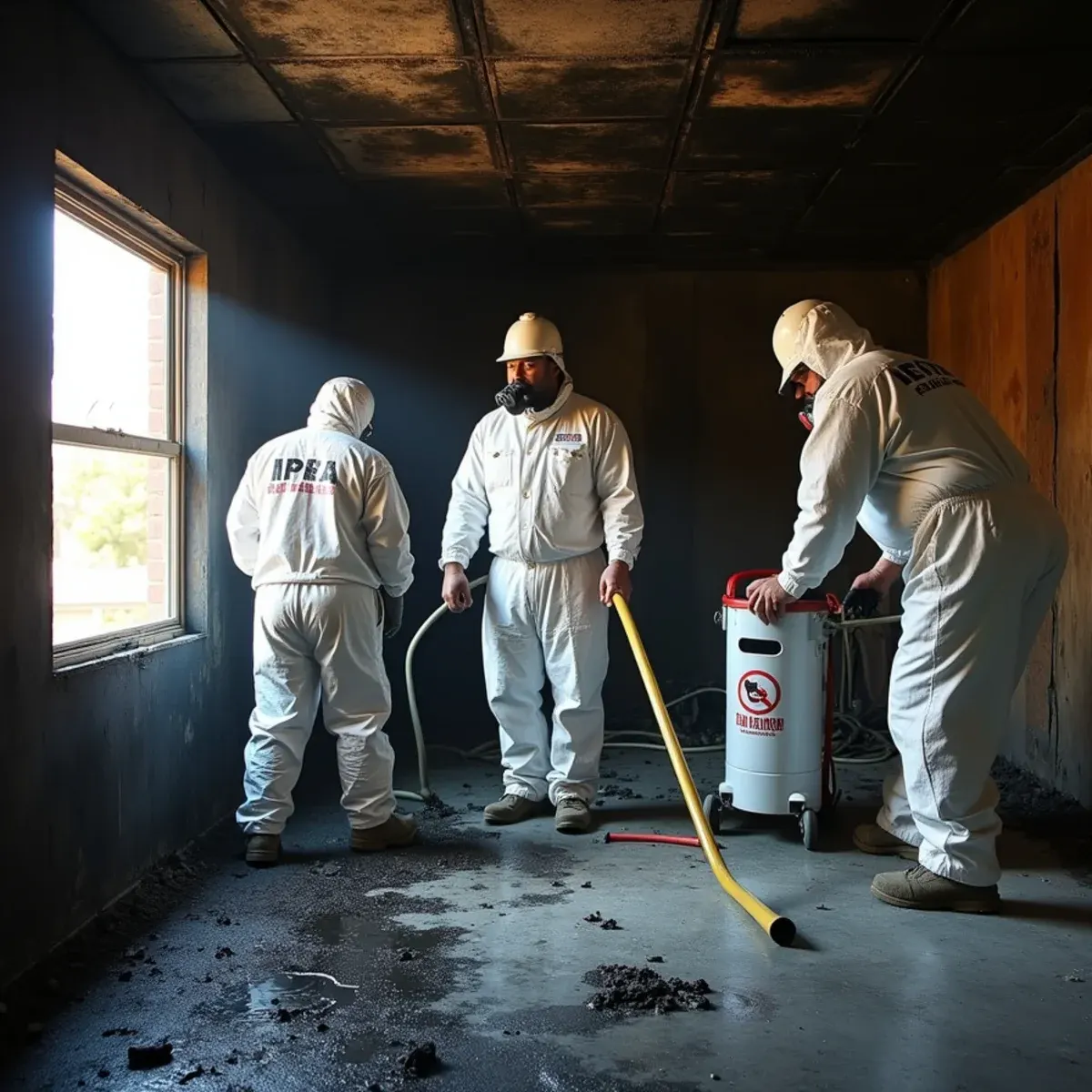
Smoke-filmed acoustic ceiling texture in the 1960s and 1970s tract belt cannot simply be scraped. Material of that era frequently contains asbestos, and sampling comes before removal, not after somebody has already made dust. It adds a short delay at the front of the job. Skipping it turns a fire cleanup into a regulated abatement problem and can stall your claim entirely.
2Sprinklers make small fires into water losses
Residential sprinklers in Tustin Legacy and the attached homes around it do exactly what they should, which is flow until someone shuts the riser. A stovetop fire knocked down in seconds can still put hundreds of gallons through a unit and into the one below. We arrive expecting both losses and treat the water side with the same urgency as the smoke.
3Old Town additions hide residue
Century-old houses near Old Town have been added to repeatedly, and each remodel left furred walls, boxed soffits and dead spaces behind the finished surfaces. Smoke finds those voids and settles. We probe them with a borescope rather than assuming the visible rooms tell the whole story, because a missed cavity is what brings the odor back a month after everyone signed off.
How the Work Runs
The method is the same one we use on every fire & smoke damage job, documented to the IICRC S500:2025 standard. Here it is in short — the full fire & smoke damage restoration process explains each stage in detail.
- Secure the structure
- Water extraction and drying first
- Assess residue type room by room
- Remove non-salvageable material and clean the rest
- Deodorize at the source
- Contents restoration and rebuild
The Tustin Background Worth Knowing
You can usually place your house without paperwork. Foundation vents around the perimeter and a floor that sits a step or two above grade means a raised foundation and a crawl space, which puts you in the Old Town generation. A slab sitting flush at grade with no vents puts you in the tract era. If you have a second-floor laundry, a tankless heater, or a manifold of colored plastic tubing in a closet, you are in the Legacy generation. Each of those buildings has an entirely different weak point, and knowing yours is most of the battle.
There is more on the housing stock, drainage and plumbing history of this city on our water damage restoration in Tustin page.
Tustin at a glance
- Dominant construction era
- 1880–2020
- Foundation type
- mixed on grade
- Supply piping found here
- original pre-war piping in Old Town, under-slab copper, modern PEX in Tustin Legacy
- Drain line materials
- cast iron, clay, ABS
- Terrain and water table
- flat, moderate water table
- Most common local failure
- wildly different failure modes street to street, because the era of the house decides everything
- Highest-value local prevention
- knowing which of the three Tustins your house belongs to before assuming any advice applies
What It Costs in Tustin
We do not quote a number over the phone before seeing the property — anyone who does is guessing. The variables that actually move the price on a fire & smoke damage job are extent of structural burn, how far the smoke traveled, residue type, and they are broken down in full on the fire & smoke damage restoration page. The assessment and the written estimate are free anywhere in Tustin, day or night, with no obligation.
Fire & Smoke Damage Questions from Tustin Homeowners
Attached construction shares framing and often shares attic and mechanical space, so your unit likely has smoke exposure even if nothing burned. We document your interior separately from the fire unit, since your policy and the association's policy cover different parts of the building. Expect us to check the HVAC system, the insulation and any shared chase, and to run containment so cleaning next door does not push more residue your direction.
Fire suppression uses enormous volumes of water in a short time — often thousands of gallons. That water saturates ceilings, insulation, walls, and floors well beyond the burned area, and it has to be extracted and dried like any other water loss, on top of the fire work.
Yes, when the residue is removed completely — including inside wall cavities, ductwork, attic insulation, and behind cabinetry. Odor that returns later always means residue was left somewhere. Masking agents and ozone alone do not solve it.
New plumbing removes corrosion from the list, not everything else. What fails in Legacy-era homes is connections and appliances: braided washer hoses, refrigerator ice-maker lines, angle stops, dishwasher fittings, and water heaters that are now well into their service life. Second-floor laundry rooms are the biggest single change from older Tustin housing, because a failure up there drains through two ceilings instead of across a garage slab. Age protects you from one category of failure and none of the others.