
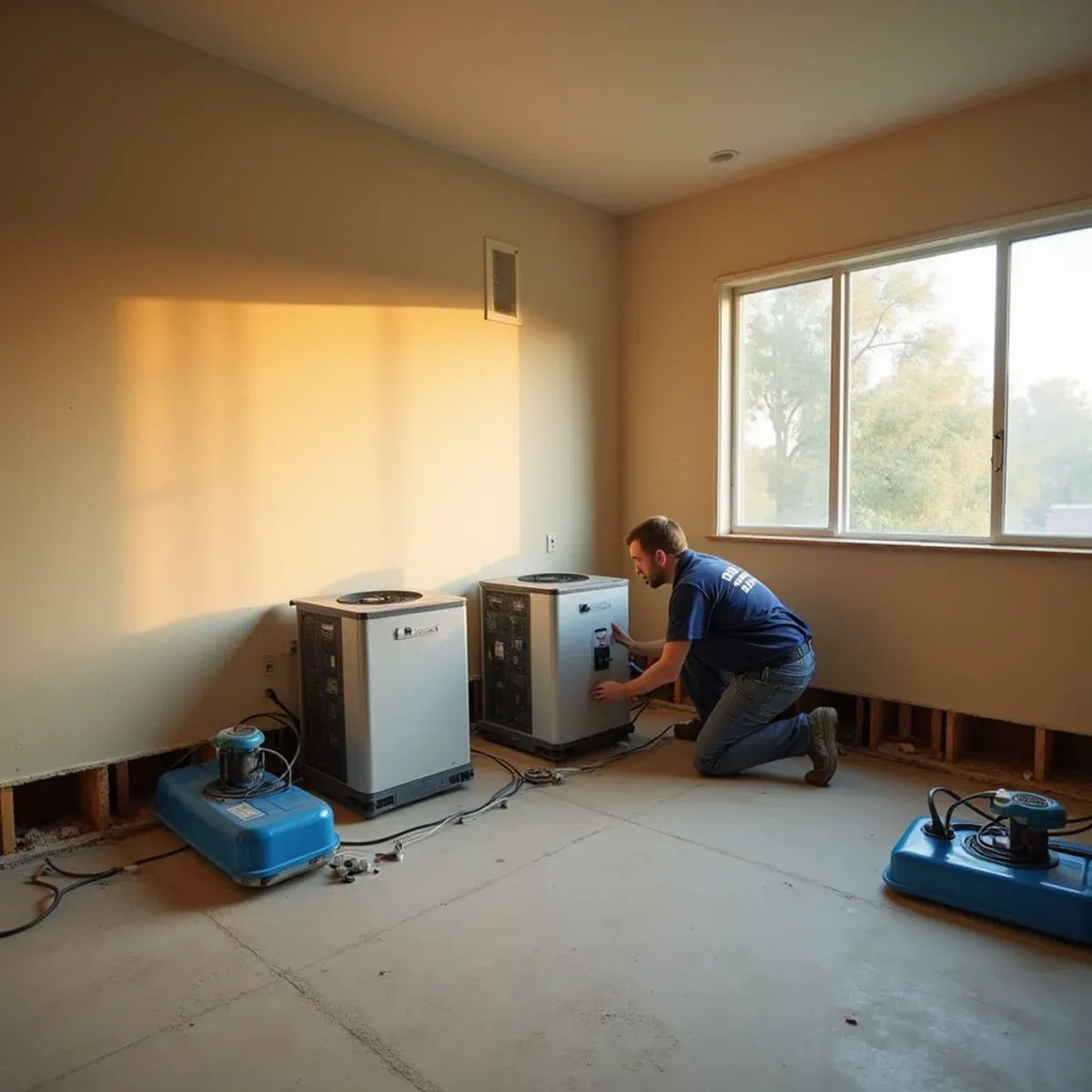
Before we load the truck for a Tustin call, we ask what year the house was built, because the answer changes the equipment list. An 1890s Old Town house on a raised foundation means crawl-space work, poly containment and low-profile air movers under the joists. A post-2005 Tustin Legacy home means a tight, well-insulated envelope that holds a chamber beautifully and dries fast. A 1970s slab house means we're tracing where hot water traveled under the flooring. Same city, three completely different trucks.
That middle generation is the bulk of our work here: 1960s to 1980s slab tract with under-slab copper old enough to be failing. Those jobs live or die on getting airflow into the flooring assembly early, before the base plates and wall cavities take on the load. The stacked flats and townhomes at Columbus Square and Columbus Grove bring a fourth situation, where an upper-floor supply failure becomes two or three ceilings and drying has to follow the water down through the assembly with containment in each affected unit.
What Tustin Changes About Structural Drying
1Old Town crawl spaces dry from below
On a raised-foundation house near Main Street, the wet materials are joists, subfloor and soil, not the room you're standing in. We cover the dirt with a vapor retarder, work low-profile air movers along the joist bays and duct the dehumidifier's discharge outside. Readings come off the framing under the floor, which is the only place they mean anything on a house like this.
2Legacy's tight envelope is an advantage
Post-2005 construction at Tustin Legacy is insulated and reasonably airtight, which makes a sealed drying chamber easy to establish and easy to hold. Temperature stays where we set it, the LGR isn't fighting infiltration, and comparable losses often finish a day or two sooner than in older stock. Modern PEX also tends to fail at fittings, which keeps the wet area localized.
3Stacked units mean drying more than one home
In the flats and townhomes at Columbus Square and Columbus Grove, an upper-floor failure becomes your neighbor's ceiling. We ask for access to the units below and beside on day one, meter their walls, and set containment so each chamber actually holds. Skipping that step is how a job that looked finished reopens two weeks later with a stain on somebody else's drywall.
How the Work Runs
The method is the same one we use on every structural drying job, documented to the IICRC S500:2025 standard. Here it is in short — the full structural drying & dehumidification process explains each stage in detail.
- Establish the dry standard
- Calculate the load and build the chamber
- Place air movers for surface evaporation
- Run LGR dehumidification to capture the moisture
- Monitor and adjust daily
- Verify, document, and demobilize
The Tustin Background Worth Knowing
You can usually place your house without paperwork. Foundation vents around the perimeter and a floor that sits a step or two above grade means a raised foundation and a crawl space, which puts you in the Old Town generation. A slab sitting flush at grade with no vents puts you in the tract era. If you have a second-floor laundry, a tankless heater, or a manifold of colored plastic tubing in a closet, you are in the Legacy generation. Each of those buildings has an entirely different weak point, and knowing yours is most of the battle.
There is more on the housing stock, drainage and plumbing history of this city on our water damage restoration in Tustin page.
Tustin at a glance
- Dominant construction era
- 1880–2020
- Foundation type
- mixed on grade
- Supply piping found here
- original pre-war piping in Old Town, under-slab copper, modern PEX in Tustin Legacy
- Drain line materials
- cast iron, clay, ABS
- Terrain and water table
- flat, moderate water table
- Most common local failure
- wildly different failure modes street to street, because the era of the house decides everything
- Highest-value local prevention
- knowing which of the three Tustins your house belongs to before assuming any advice applies
What It Costs in Tustin
We do not quote a number over the phone before seeing the property — anyone who does is guessing. The variables that actually move the price on a structural drying job are size of the drying chamber, class of water intrusion, material types involved, and they are broken down in full on the structural drying & dehumidification page. The assessment and the written estimate are free anywhere in Tustin, day or night, with no obligation.
Structural Drying Questions from Tustin Homeowners
Different houses, not different effort. An Old Town raised-foundation home means drying joists, subfloor and crawl-space soil, and those old assemblies release water slowly. Your Tustin Ranch slab house has shallower assemblies and a tighter envelope, so a sealed chamber holds and grain depth drops faster. Both jobs ended in the same place, with material readings matching unaffected material in the same house. They just took very different roads to get there.
Three to five days covers most residential losses. Saturated hardwood, plaster, or a concrete slab can run seven or more. We will give you an estimated window after the first readings and update you daily — and equipment comes out when the numbers say so, not on a fixed schedule.
We would rather you did not. Drying is a continuous process, and every hour off extends the total run — which usually costs more than the sleep is worth. If noise is genuinely unmanageable we can often reconfigure the chamber or reposition units to reduce it. Talk to us instead of unplugging them.
New plumbing removes corrosion from the list, not everything else. What fails in Legacy-era homes is connections and appliances: braided washer hoses, refrigerator ice-maker lines, angle stops, dishwasher fittings, and water heaters that are now well into their service life. Second-floor laundry rooms are the biggest single change from older Tustin housing, because a failure up there drains through two ceilings instead of across a garage slab. Age protects you from one category of failure and none of the others.