
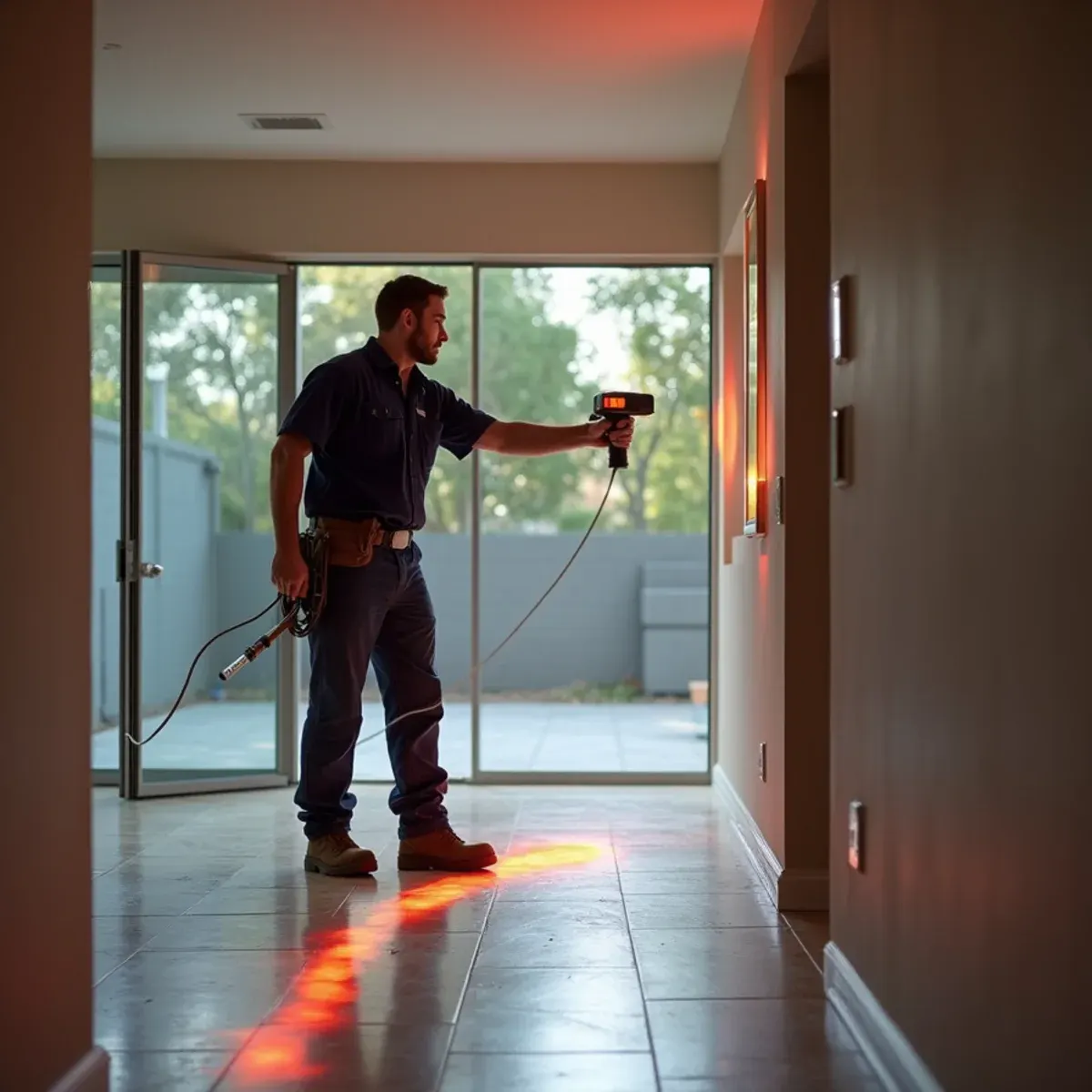
Tustin is three cities stacked into one pair of ZIP codes, and slab leaks only exist in two of them. Old Town, around Main and El Camino Real, is 1880s to 1920s housing on raised foundations — original piping, but nothing buried in concrete. The 1960s through 1980s tract that fills the middle of the city is where under-slab copper lives, and that copper is now old enough to pinhole on the hot side. Tustin Ranch carried the same construction into the late 1980s.
Then there's Tustin Legacy and Columbus Square, built after 2005 on the old Marine Corps Air Station with PEX and modern drainage. Those homes do get slab leaks, usually at a fitting rather than along a run, and they're harder to hear because PEX doesn't carry sound the way copper does. The concrete is also newer and denser, which matters when flooring goes back down. We set in-situ RH probes in the slab rather than trusting a surface meter, which is what IICRC S500:2025 points toward for concrete that has to take finish flooring.
What Tustin Changes About Slab Leak Damage
1Tustin Ranch copper is the main population
The 1970s and 1980s slab tract through the middle of the city, including the earlier Tustin Ranch phases, is where we find most Tustin slab leaks. Hot-side lines fail first, typically as pinholes under a hallway or near a bathroom group. These plans repeat, so once we've worked a few houses in a tract we have a good idea where to listen first.
2PEX leaks in Legacy and Columbus Square
Post-2005 homes on the former air station use PEX, and PEX is quieter than copper. Acoustic listening picks up much less, so we lean harder on the meter test, thermal imaging and pressure isolation by zone. Failures here usually happen at a fitting or a bend rather than mid-run, which narrows the search considerably once we know the manifold layout.
3Old Town access from below, not above
The 1880s to 1920s houses around Old Town sit on raised foundations. Work there happens in a crawl space that's often tight, poorly vented and floored with bare soil that holds moisture long after the pipe is fixed. Drying the ground and the framing matters as much as the repair itself, and it takes longer than most homeowners expect.
How the Work Runs
The method is the same one we use on every slab leak damage job, documented to the IICRC S500:2025 standard. Here it is in short — the full slab leak water damage repair process explains each stage in detail.
- Confirm it is actually a slab leak
- Electronic leak location
- Choose the repair approach with you
- Dry the slab and the affected assemblies
- Address the flooring and wall base
- Restore the floor and finish
The Tustin Background Worth Knowing
You can usually place your house without paperwork. Foundation vents around the perimeter and a floor that sits a step or two above grade means a raised foundation and a crawl space, which puts you in the Old Town generation. A slab sitting flush at grade with no vents puts you in the tract era. If you have a second-floor laundry, a tankless heater, or a manifold of colored plastic tubing in a closet, you are in the Legacy generation. Each of those buildings has an entirely different weak point, and knowing yours is most of the battle.
There is more on the housing stock, drainage and plumbing history of this city on our water damage restoration in Tustin page.
Tustin at a glance
- Dominant construction era
- 1880–2020
- Foundation type
- mixed on grade
- Supply piping found here
- original pre-war piping in Old Town, under-slab copper, modern PEX in Tustin Legacy
- Drain line materials
- cast iron, clay, ABS
- Terrain and water table
- flat, moderate water table
- Most common local failure
- wildly different failure modes street to street, because the era of the house decides everything
- Highest-value local prevention
- knowing which of the three Tustins your house belongs to before assuming any advice applies
What It Costs in Tustin
We do not quote a number over the phone before seeing the property — anyone who does is guessing. The variables that actually move the price on a slab leak damage job are how long the leak ran undetected, flooring type over the leak, repair method chosen, and they are broken down in full on the slab leak water damage repair page. The assessment and the written estimate are free anywhere in Tustin, day or night, with no obligation.
Slab Leak Damage Questions from Tustin Homeowners
Less than an older neighbor, but not zero. PEX under a Tustin Legacy slab fails at fittings more than along runs, usually from installation stress or a bad crimp rather than age. What's different is the concrete: newer, denser slabs release moisture slowly, so if a leak has been running, expect the drying phase to take longer than the repair did. We set in-situ probes before anyone reinstalls flooring.
The meter test is the first step: shut off every fixture and watch the low-flow indicator. If it moves and nothing is wet above the floor, suspect the slab. Warm spots on the floor, running-water sounds from below, and flooring that lifts or cups without an obvious cause all point the same direction. We confirm it with thermal imaging and moisture mapping at no charge.
Not always. Depending on where the leak is and the condition of the system, rerouting the line overhead through the attic and walls avoids opening the concrete entirely. When a spot repair is the better option, precise electronic location keeps the opening small — typically a couple of feet, not a trench across the room.
New plumbing removes corrosion from the list, not everything else. What fails in Legacy-era homes is connections and appliances: braided washer hoses, refrigerator ice-maker lines, angle stops, dishwasher fittings, and water heaters that are now well into their service life. Second-floor laundry rooms are the biggest single change from older Tustin housing, because a failure up there drains through two ceilings instead of across a garage slab. Age protects you from one category of failure and none of the others.