
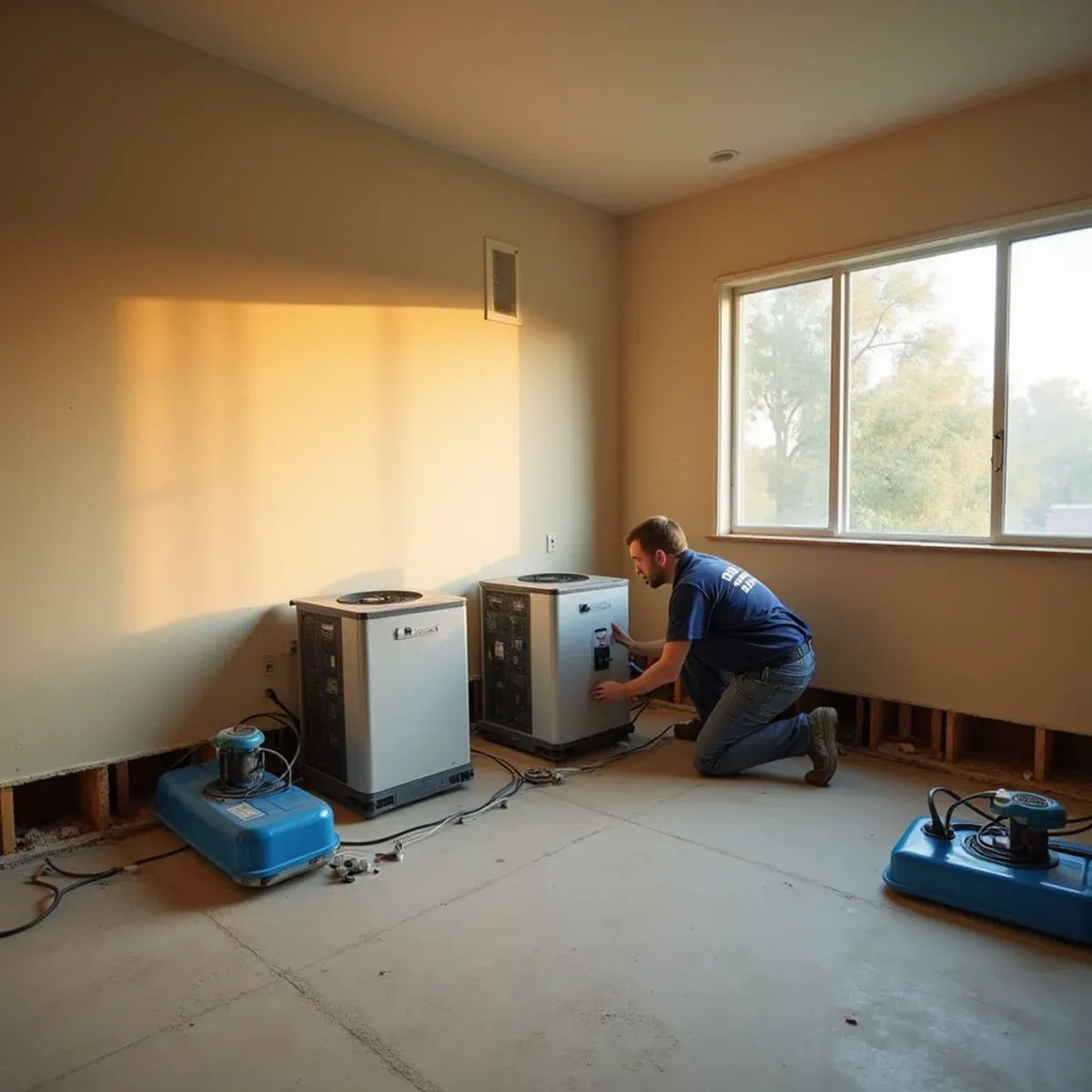
A supply line under a raised-foundation house in Old Towne can drip into the dirt for weeks before anyone upstairs notices. By the time the hardwood cups, the subfloor, the joists and the soil beneath them are all holding water, and the drying problem is under the house rather than in the room. We set the dry standard from a joist bay in an unaffected part of the crawl space, then build the chamber down there: vapor retarder over the soil, air movers along the joist line, and an LGR ducted so it discharges outside instead of into your living room.
Above the crawl space the materials are lath and plaster, old-growth fir subfloor and single-pane windows, assemblies that release water slowly and punish anyone in a hurry. Overdrying crazes plaster; underdrying leaves the joists wet. We meter daily and adjust rather than running everything wide open for three days. The postwar slab tract out toward El Modena and Santiago Hills is a different job entirely, with shallower assemblies and faster schedules, while the equestrian lots in Orange Park Acres add long irrigation runs that muddy any leak investigation.
What Orange Changes About Structural Drying
1The drying chamber goes under the house
Under a raised Old Towne foundation the wet materials are joists, subfloor and the soil itself. We lay a vapor retarder over the dirt, set low-profile air movers along the joist bays and duct the dehumidifier's discharge outside rather than into the rooms above. Readings come off the framing and the underside of the subfloor, not from the finished floor you're standing on.
2Original plaster sets the drying pace
Lath and plaster gives up water slowly and cracks if you push it. On Old Towne interiors we run gentler airflow over more days instead of forcing a three-day schedule, and we take penetrating readings through the base rather than the wall face. S500:2025 sets the target from unaffected plaster in the same house, so an 1890s wall gets judged against itself.
3Old services cap the equipment we run
Plenty of houses around the Plaza and Chapman still have small electrical services with a handful of circuits feeding the whole first floor. Air movers and an LGR draw real current, and tripping a breaker every hour ruins a drying schedule. We count amps before anything gets plugged in, spread the load across circuits, and bring our own distribution when the house can't carry a full chamber.
How the Work Runs
The method is the same one we use on every structural drying job, documented to the IICRC S500:2025 standard. Here it is in short — the full structural drying & dehumidification process explains each stage in detail.
- Establish the dry standard
- Calculate the load and build the chamber
- Place air movers for surface evaporation
- Run LGR dehumidification to capture the moisture
- Monitor and adjust daily
- Verify, document, and demobilize
The Orange Background Worth Knowing
A slab leak announces itself eventually because concrete has nowhere to put the water. A crawl-space leak has somewhere to put it. Dirt absorbs a slow drip almost indefinitely, so the loss never produces the one thing homeowners watch for, which is water on a floor. Meanwhile the humidity under the house climbs, the fiberglass insulation between the joists soaks up moisture and sags, the subfloor picks up that moisture from below, and mold begins on the joists where it is invisible and undisturbed. Everything about this failure is built to stay quiet.
There is more on the housing stock, drainage and plumbing history of this city on our water damage restoration in Orange page.
Orange at a glance
- Dominant construction era
- 1888–1975
- Foundation type
- mixed on grade
- Supply piping found here
- original turn-of-century piping, galvanized steel, under-slab copper
- Drain line materials
- cast iron, clay
- Terrain and water table
- flat, moderate water table
- Most common local failure
- crawl-space leaks under raised-foundation historic homes, running for weeks because water drips into the dirt instead of pooling on a floor
- Highest-value local prevention
- an annual crawl-space inspection, which almost nobody does and which catches nearly everything early
What It Costs in Orange
We do not quote a number over the phone before seeing the property — anyone who does is guessing. The variables that actually move the price on a structural drying job are size of the drying chamber, class of water intrusion, material types involved, and they are broken down in full on the structural drying & dehumidification page. The assessment and the written estimate are free anywhere in Orange, day or night, with no obligation.
Structural Drying Questions from Orange Homeowners
It can, if it's done carelessly. Plaster and lath give up water slowly, and pushing a room with maximum airflow and very low humidity can shrink and craze old finishes. We run a gentler chamber over more days, take penetrating readings through the base instead of the wall face, and set the target from unaffected plaster in your own house rather than a generic number. The daily log shows exactly how we got there.
Three to five days covers most residential losses. Saturated hardwood, plaster, or a concrete slab can run seven or more. We will give you an estimated window after the first readings and update you daily — and equipment comes out when the numbers say so, not on a fixed schedule.
We would rather you did not. Drying is a continuous process, and every hour off extends the total run — which usually costs more than the sleep is worth. If noise is genuinely unmanageable we can often reconfigure the chamber or reposition units to reduce it. Talk to us instead of unplugging them.
Pick a dry day, open the hatch, and use a good flashlight. You are looking at the soil directly under the bathrooms, kitchen, and laundry for dark damp patches, at the insulation for sagging or fallen batts, and at the piers and foundation vents for rust or white staining. Trust your nose as much as your eyes. If the access is too tight or you would rather not go under, we will do the inspection and photograph what is down there.