
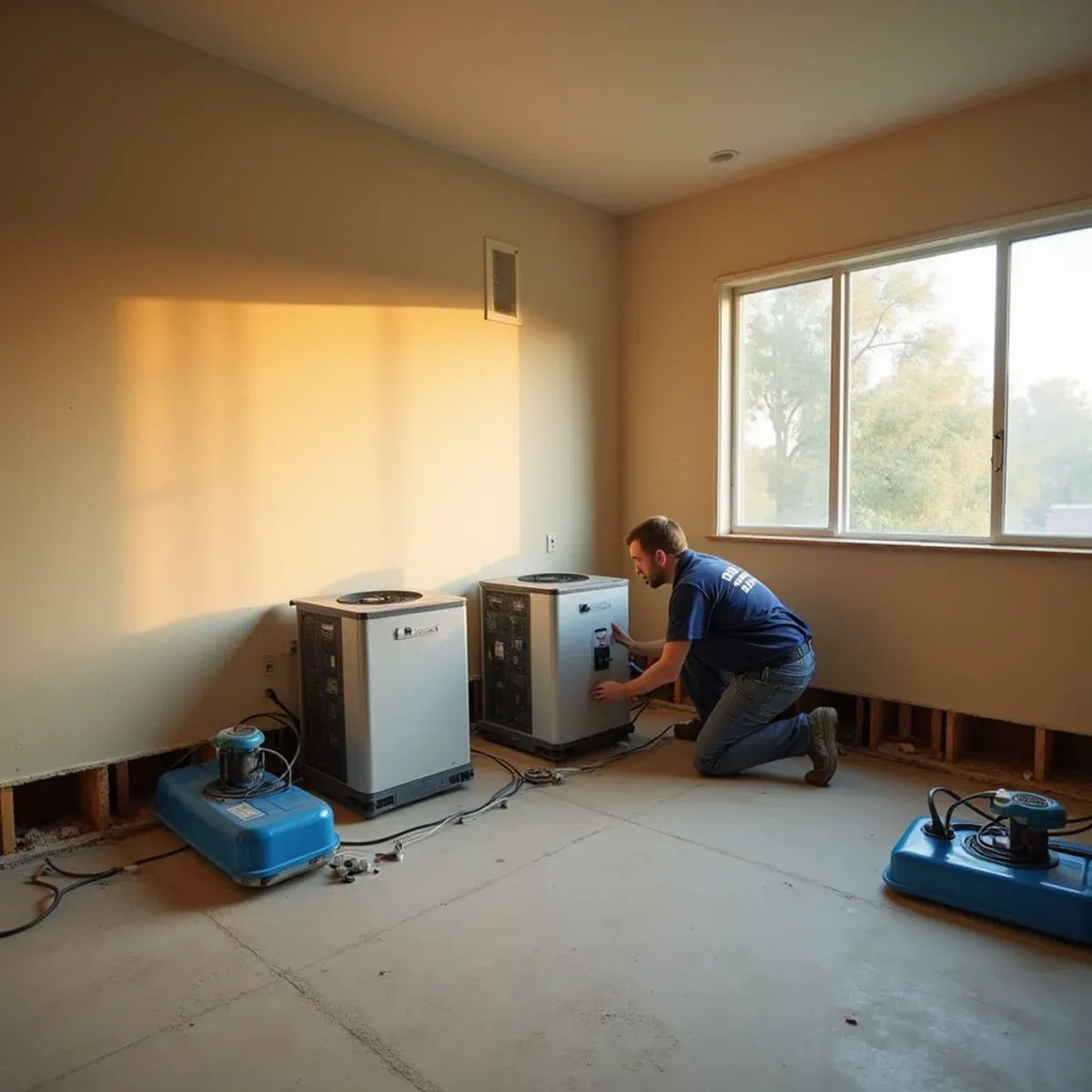
Villa Park is about 5,800 people on half-acre lots, zoned almost entirely single-family, and the houses are large custom plans rather than repeated tract elevations. That has a specific consequence for drying. The supply runs under those slabs are long, and a failure can sit thirty or forty feet from the nearest fixture. By the time it surfaces, the wet zone crosses a hallway and two rooms, and the chamber we need to seal is considerably larger than the space where the flooring first cupped.
The second consequence is electrical. A full chamber in a house this size can call for more air movers and more dehumidification than a residential panel will carry alongside the refrigerator and the air conditioning. We calculate the load first and bring distribution or a generator rather than nuisance-tripping breakers overnight. And the heavy landscape irrigation these lots carry, along Center Drive, Wanda Road and Santiago Boulevard, makes a meter test meaningless until the irrigation side has been isolated and the test rerun.
What Villa Park Changes About Structural Drying
1Long slab runs make wide wet zones
In these custom plans the supply run under the slab can travel thirty or forty feet between fixtures, so the leak and the visible damage often sit in different rooms. Locating it takes longer, and the chamber that follows is bigger than most people expect, usually a hallway plus two adjoining rooms rather than the single space where the floor started to cup.
2Custom millwork earns the extra days
Paneling, built-ins and solid-wood cabinetry in these houses were made for the house. Drying in place behind and beneath them means smaller access points, longer schedules and more monitoring visits than demolition would take. On a Villa Park loss that trade almost always favors drying, and the daily log is what justifies the extra days to an adjuster reviewing the file.
3Irrigation has to come out of the picture
Half-acre lots carry serious landscape irrigation, and a zone tied into the domestic side makes any meter test worthless. Before we treat a reading as evidence of a supply leak, we isolate the landscape and re-test. It's a fifteen-minute step that has kept Villa Park homeowners from opening a slab that turned out never to have been leaking at all.
How the Work Runs
The method is the same one we use on every structural drying job, documented to the IICRC S500:2025 standard. Here it is in short — the full structural drying & dehumidification process explains each stage in detail.
- Establish the dry standard
- Calculate the load and build the chamber
- Place air movers for surface evaporation
- Run LGR dehumidification to capture the moisture
- Monitor and adjust daily
- Verify, document, and demobilize
The Villa Park Background Worth Knowing
In a tract, the plumbing sits where it sat in the last four houses we worked on. In Villa Park it is wherever the plan put it in 1974, and there is rarely a drawing left to consult. That is why locating a leak here can take longer than a homeowner expects. Water from a pinhole travels the path of least resistance under the slab and surfaces wherever the soil and the concrete let it, which on a plan this size can be an entire room away from the break. Guessing at the wet spot is how people end up cutting the wrong floor.
There is more on the housing stock, drainage and plumbing history of this city on our water damage restoration in Villa Park page.
Villa Park at a glance
- Dominant construction era
- 1962–1985
- Foundation type
- slab on grade
- Supply piping found here
- under-slab copper
- Drain line materials
- cast iron, ABS
- Terrain and water table
- rolling, moderate water table
- Most common local failure
- long under-slab runs in large custom floor plans, where a leak can sit far from any fixture and take longer to locate
- Highest-value local prevention
- separating irrigation from the domestic meter so a leak test actually means something
What It Costs in Villa Park
We do not quote a number over the phone before seeing the property — anyone who does is guessing. The variables that actually move the price on a structural drying job are size of the drying chamber, class of water intrusion, material types involved, and they are broken down in full on the structural drying & dehumidification page. The assessment and the written estimate are free anywhere in Villa Park, day or night, with no obligation.
Structural Drying Questions from Villa Park Homeowners
Usually, yes. On these custom plans the cabinetry was built for the house, so we work through small access points, toe kicks, cabinet backs and holes hidden behind removable base, and push conditioned air into the cavities while the dehumidifier handles the room. It takes more monitoring visits and a longer schedule than demolition would. When readings show something behind the run isn't moving, we'll say so rather than leave a wet cavity behind good millwork.
Three to five days covers most residential losses. Saturated hardwood, plaster, or a concrete slab can run seven or more. We will give you an estimated window after the first readings and update you daily — and equipment comes out when the numbers say so, not on a fixed schedule.
We would rather you did not. Drying is a continuous process, and every hour off extends the total run — which usually costs more than the sleep is worth. If noise is genuinely unmanageable we can often reconfigure the chamber or reposition units to reduce it. Talk to us instead of unplugging them.
Start by taking irrigation out of the equation, because on a half-acre lot it is the largest variable you have. Shut the controller off for a full day, then read the meter twice with nothing running in the house. If the leak indicator is still moving, the loss is on the domestic side and worth locating. If it stops, you have a landscape valve or lateral line problem, which is a different and much cheaper trade.