
The most useful thing we can tell a Villa Park homeowner is that low flood risk is not no flood risk, and low risk is exactly why a flood here goes badly. Nobody has sandbags. Almost nobody carries an NFIP policy. The half-acre lots that make this city what it is also mean extensive private landscape drainage — area drains, catch basins, long runs out to the street — maintained by whoever owned the house before you, and often not maintained at all. A single blocked basin on a lot this size collects a remarkable amount of water.
Orange County's smallest city, incorporated in 1962 and zoned almost entirely for large custom single-family homes, has no industrial ground and barely any commercial. What it does have is rolling terrain, heavy irrigation and Santiago Creek along the edge. The floods we see here come from a failed irrigation main running for hours across saturated yard, from a plugged area drain backing up into a sunken entry, or from creekside ground giving up during a long wet stretch. The water is still ground water, and it is still Category 3.
What Villa Park Changes About Flood Cleanup
1Irrigation volume rivals a storm event
Half-acre lots carry irrigation systems sized like small municipal ones. A broken lateral or a stuck valve overnight puts hundreds of gallons into landscaped ground right against a slab, and it arrives at the house as soil-borne water carrying fertilizer, pesticide and organic matter. It looks clean. It is not. We treat it as Category 3 and scope it that way, which occasionally surprises owners expecting a quick dry-out.
2Long floor plans hide the far edge
Custom houses here run long and wide, with rambling single-story plans and interior rooms a good distance from any exterior wall. Water entering at a side yard can travel thirty or forty feet under flooring before anything looks wrong at the other end. Our moisture mapping covers the full footprint on these homes rather than the affected room, and it routinely finds wet subfloor and toe kicks two rooms from the entry point.
3No flood coverage on most Villa Park homes
Because mapped flood risk here is low, lenders rarely require flood insurance and most owners never buy it. When ground water gets in, the standard homeowners policy excludes it. Where a plumbing failure or an irrigation main on your side of the meter caused the loss, coverage may well apply. We document cause carefully instead of assuming, because on these properties that distinction is significant money.
How the Work Runs
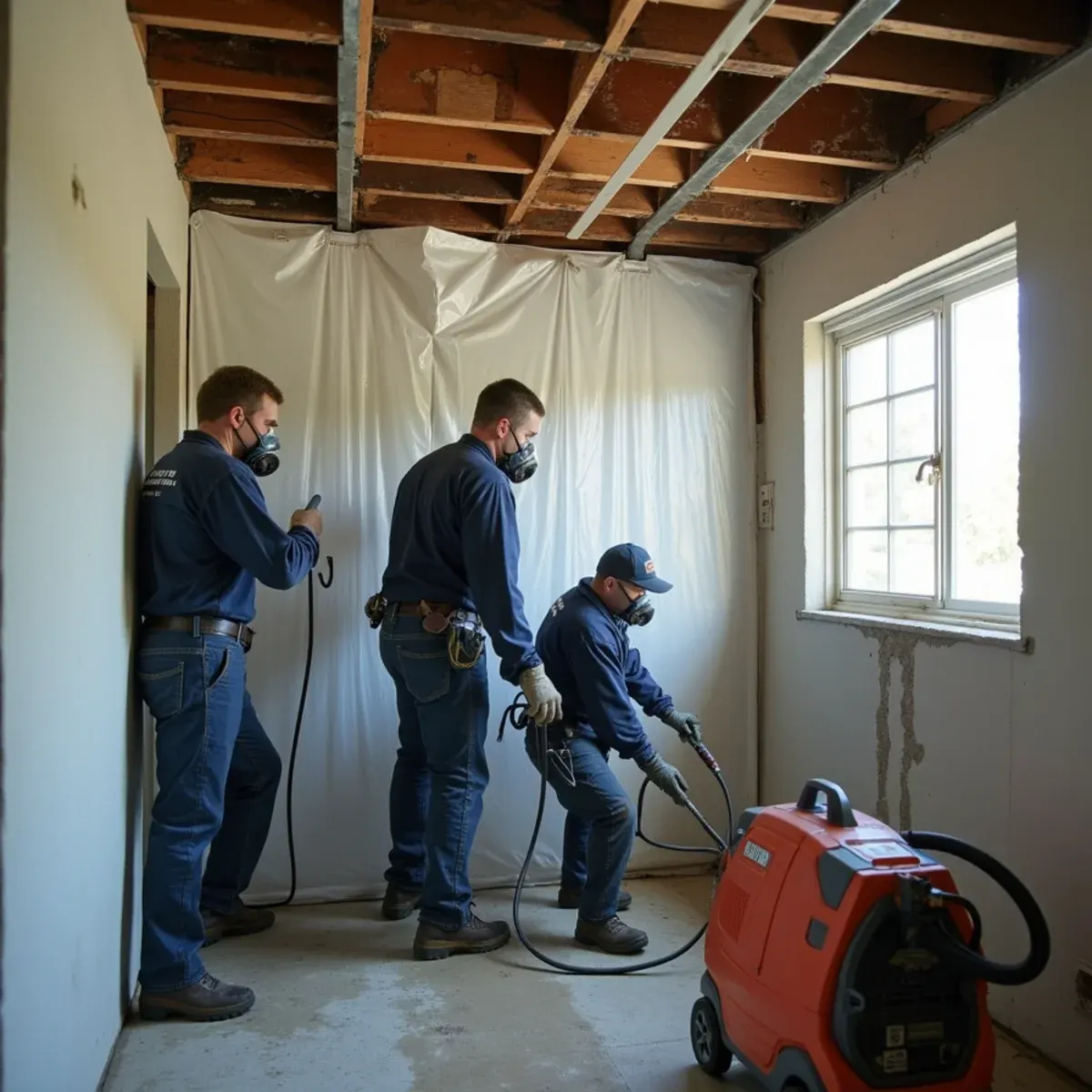
The method is the same one we use on every flood cleanup job, documented to the IICRC S500:2025 standard. Here it is in short — the full flood damage cleanup process explains each stage in detail.
- Safety assessment and utility check
- Containment and negative air
- Documentation and contents triage
- Extraction and controlled demolition
- Cleaning and disinfection
- Structural drying and clearance
The Villa Park Background Worth Knowing
In a tract, the plumbing sits where it sat in the last four houses we worked on. In Villa Park it is wherever the plan put it in 1974, and there is rarely a drawing left to consult. That is why locating a leak here can take longer than a homeowner expects. Water from a pinhole travels the path of least resistance under the slab and surfaces wherever the soil and the concrete let it, which on a plan this size can be an entire room away from the break. Guessing at the wet spot is how people end up cutting the wrong floor.
There is more on the housing stock, drainage and plumbing history of this city on our water damage restoration in Villa Park page.
Villa Park at a glance
- Dominant construction era
- 1962–1985
- Foundation type
- slab on grade
- Supply piping found here
- under-slab copper
- Drain line materials
- cast iron, ABS
- Terrain and water table
- rolling, moderate water table
- Most common local failure
- long under-slab runs in large custom floor plans, where a leak can sit far from any fixture and take longer to locate
- Highest-value local prevention
- separating irrigation from the domestic meter so a leak test actually means something
What It Costs in Villa Park
We do not quote a number over the phone before seeing the property — anyone who does is guessing. The variables that actually move the price on a flood cleanup job are how high the water reached, how long it sat before extraction, contents volume in the flooded area, and they are broken down in full on the flood damage cleanup page. The assessment and the written estimate are free anywhere in Villa Park, day or night, with no obligation.
Flood Cleanup Questions from Villa Park Homeowners
Structurally, no — and that distinction may help you. Water from your own irrigation line is a plumbing failure, which many policies treat very differently from ground flooding. Practically, though, it behaved like a flood: it soaked through landscape soil before entering the house, so it carries the same bacterial and chemical load and gets handled under Category 3 protocols. We contain, remove porous material, disinfect, then dry. The cleanup is identical. The coverage conversation is not.
Yes. Water that crossed soil, pavement, or a storm drain is Category 3 by IICRC classification regardless of appearance — it carries bacteria, fuel and oil residue, lawn chemicals, and whatever else was on the ground. Do not walk through it in open shoes, and keep children and pets out of the area entirely.
If the water came from outside across the ground, almost certainly not — that requires separate flood insurance. If it came from a failed water heater, a burst pipe, or a supply line inside the garage, it is usually covered. We document the source carefully because that distinction determines everything.
Start by taking irrigation out of the equation, because on a half-acre lot it is the largest variable you have. Shut the controller off for a full day, then read the meter twice with nothing running in the house. If the leak indicator is still moving, the loss is on the domestic side and worth locating. If it stops, you have a landscape valve or lateral line problem, which is a different and much cheaper trade.