
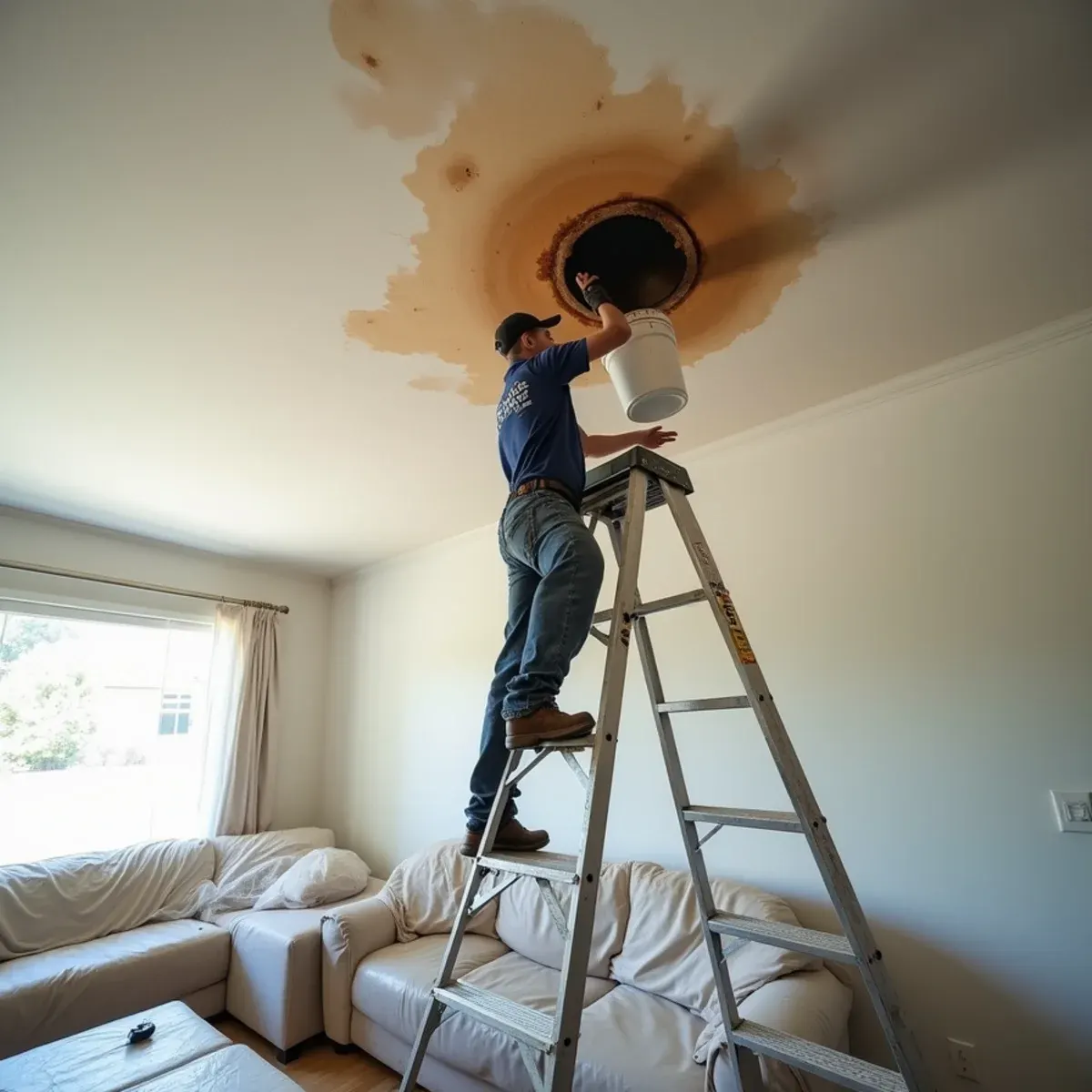
The first thing we ask on a Tustin ceiling call is the year the house was built, because the answer points at three different failure modes. Old Town, 1880s through the 1920s, raised foundations and rafter attics under roofs that have been covered and recovered more than once. Tustin Ranch, mostly 1980s and 1990s, concrete tile sitting over felt underlayment that reaches the end of its life long before the tile does. Then Tustin Legacy and Columbus Square, built after 2005 on the old Marine Corps Air Station, with air handlers up in the attic.
That last group produces stains homeowners rarely expect. A condensate pan rusts through or its drain line plugs, the overflow switch fails or was never wired in, and a clean brown ring appears on a second-floor ceiling with no rain anywhere in the forecast. The same ring in Tustin Ranch almost always means underlayment rather than cracked tile. In Old Town it usually means a valley or a chimney flashing that predates the last two roofs. One symptom, three answers, and the wrong assumption wastes a week.
What Tustin Changes About Ceiling & Roof Leaks
1Tile outlives the felt beneath it
The concrete tile on most Tustin Ranch roofs is fine at thirty years. The underlayment carrying the actual waterproofing is not. Water slips past the tile field, runs down brittle felt to a nail hole or a short lap, and enters over a bedroom. Nothing looks wrong from the curb, which is why homeowners here often replace ceilings twice before anyone lifts a tile.
2Attic air handlers in Tustin Legacy
Post-2005 construction here commonly puts the air handler in the attic above the second floor. A plugged condensate line or a failed float switch drips onto the back of the ceiling for days. Stains from this are round, sharp-edged and appear in warm weather. We check the pan, the switch and the primary line before anyone climbs on the roof.
3Old Town roofs sit on older roofs
The 1880s-to-1920s houses around Old Town have been reroofed repeatedly, and each layer buries the last set of flashing details. Deep porch roofs tying into two-story walls are the most common entry we find, followed by chimney counterflashing. The attics are rafter-framed and cramped, so we plan access points before cutting, and we keep openings inside closets where we can.
How the Work Runs
The method is the same one we use on every ceiling & roof leaks job, documented to the IICRC S500:2025 standard. Here it is in short — the full ceiling & roof leak water damage process explains each stage in detail.
- Emergency tarping or temporary dry-in
- Controlled relief of trapped water
- Trace the intrusion to its real source
- Remove wet insulation and compromised drywall
- Dry the attic and the ceiling assembly
- Restore the ceiling completely
The Tustin Background Worth Knowing
You can usually place your house without paperwork. Foundation vents around the perimeter and a floor that sits a step or two above grade means a raised foundation and a crawl space, which puts you in the Old Town generation. A slab sitting flush at grade with no vents puts you in the tract era. If you have a second-floor laundry, a tankless heater, or a manifold of colored plastic tubing in a closet, you are in the Legacy generation. Each of those buildings has an entirely different weak point, and knowing yours is most of the battle.
There is more on the housing stock, drainage and plumbing history of this city on our water damage restoration in Tustin page.
Tustin at a glance
- Dominant construction era
- 1880–2020
- Foundation type
- mixed on grade
- Supply piping found here
- original pre-war piping in Old Town, under-slab copper, modern PEX in Tustin Legacy
- Drain line materials
- cast iron, clay, ABS
- Terrain and water table
- flat, moderate water table
- Most common local failure
- wildly different failure modes street to street, because the era of the house decides everything
- Highest-value local prevention
- knowing which of the three Tustins your house belongs to before assuming any advice applies
What It Costs in Tustin
We do not quote a number over the phone before seeing the property — anyone who does is guessing. The variables that actually move the price on a ceiling & roof leaks job are how long the leak has been active, ceiling texture and finish, attic access and insulation type, and they are broken down in full on the ceiling & roof leak water damage page. The assessment and the written estimate are free anywhere in Tustin, day or night, with no obligation.
Ceiling & Roof Leaks Questions from Tustin Homeowners
In post-2005 Tustin Legacy and Columbus Square homes, a dry-weather ceiling stain is usually the attic air handler. The condensate pan or its drain line backs up, and the water lands on the back of the drywall. It is clean water at first, but by the time it shows through it has passed through dust and insulation, so we treat it by category under S500:2025 rather than by how it looks. We dry the cavity and have the HVAC side corrected before repainting.
Clear the room and keep everyone out from underneath it, including pets. Move furniture if you can do it from the side. Put a bucket down if you can place it safely without standing under the bulge. Then call us — we relieve it deliberately, which is safer and preserves much more of the ceiling than letting it fail on its own.
We tarp immediately to stop the intrusion and coordinate the roofing repair with a licensed roofer, then handle all the interior restoration ourselves. You get one point of contact and one schedule instead of managing two trades during a storm week.
New plumbing removes corrosion from the list, not everything else. What fails in Legacy-era homes is connections and appliances: braided washer hoses, refrigerator ice-maker lines, angle stops, dishwasher fittings, and water heaters that are now well into their service life. Second-floor laundry rooms are the biggest single change from older Tustin housing, because a failure up there drains through two ceilings instead of across a garage slab. Age protects you from one category of failure and none of the others.