
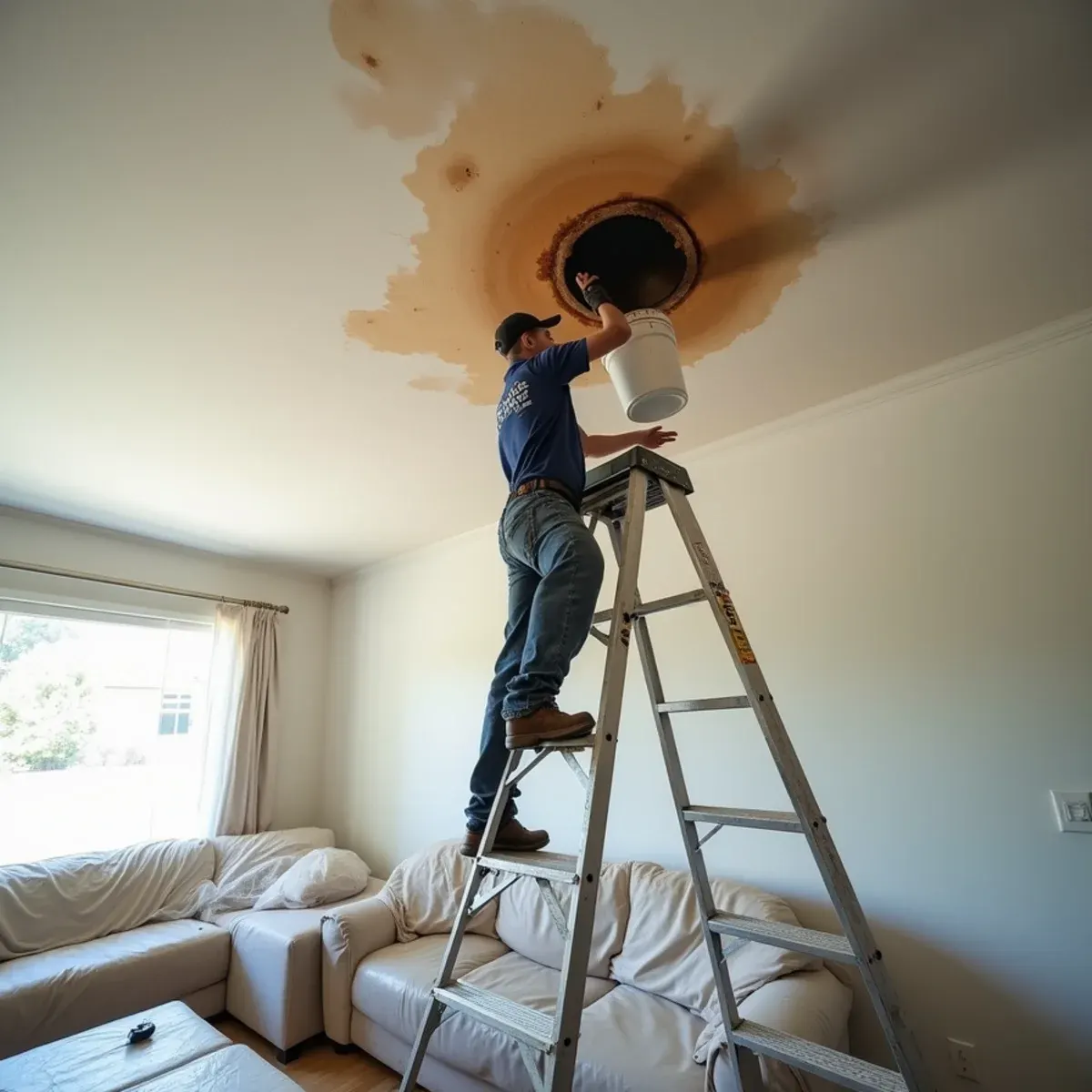
Before we go looking for a hole, we want to know how many roofs are on your house. In Bellflower the answer is frequently two and sometimes three. These small houses went up fast on small lots through the 1940s and 1950s, and for forty years the cheapest reroof was another layer of composition laid over the last one. Stacked layers change the problem. Water gets between them, travels sideways along the laps, and comes through the sheathing somewhere well away from the actual defect, which is why the wet spot on your ceiling is not a reliable pointer.
Under all of it is shallow framing: low-pitch gables, one-by sheathing, and attics with maybe two feet of headroom at the ridge. There is not much room to work and not much room for air to move. The multi-family stock along Bellflower Boulevard and through the Somerset and Mayfair areas adds a separate problem. Attic space often runs continuously above several units with no firm separation, so water entering above one apartment shows up on a ceiling two doors down, and the resident who reports it is not the one with the leak.
What Bellflower Changes About Ceiling & Roof Leaks
1Stacked shingle layers move water sideways
Multiple roof layers hold water between courses and carry it laterally before it reaches the sheathing. It also means a roofer probing from above has more material to get through, and it adds real weight to a 1950s roof structure. When we find three layers over a Bellflower house, we say so in the report, because it affects both the leak diagnosis and what a proper repair actually requires.
2Shared attic space over apartment units
In the older fourplexes and small apartment buildings along the boulevard, attic cavities frequently run past the unit walls. Water that entered above unit C ends up on the ceiling of unit A. We inspect the full run rather than the reported unit, coordinate access with the manager, and document which units are affected, because otherwise half the wet material never gets dried.
3Two feet of headroom at the ridge
Postwar Bellflower attics are shallow, unfloored, and framed with joists sized for a ceiling rather than for people. That limits equipment placement, limits how far we can trace a leak from inside, and creates a genuine risk of a foot through your ceiling if someone untrained goes up there. We work off boards, place equipment at the hatch, and dry the cavity rather than trying to occupy it.
How the Work Runs
The method is the same one we use on every ceiling & roof leaks job, documented to the IICRC S500:2025 standard. Here it is in short — the full ceiling & roof leak water damage process explains each stage in detail.
- Emergency tarping or temporary dry-in
- Controlled relief of trapped water
- Trace the intrusion to its real source
- Remove wet insulation and compromised drywall
- Dry the attic and the ceiling assembly
- Restore the ceiling completely
The Bellflower Background Worth Knowing
Galvanized steel was the standard supply pipe when Bellflower was being built, and it fails from the inside out. The zinc lining wears through, the steel underneath corrodes, and scale builds on the interior wall until the pipe is a fraction of its original diameter. Narrower pipe means faster, more turbulent water, which chews at elbows and threaded fittings until one of them lets go. Hot lines corrode faster than cold, which is why hot water pressure is usually the first thing to drop. Eighty years is well past any service life anyone intended when this was installed.
There is more on the housing stock, drainage and plumbing history of this city on our water damage restoration in Bellflower page.
Bellflower at a glance
- Dominant construction era
- 1940–1960
- Foundation type
- slab on grade
- Supply piping found here
- original galvanized steel, early copper
- Drain line materials
- cast iron
- Terrain and water table
- flat, moderate water table
- Most common local failure
- original galvanized supply lines and cast-iron laterals failing together in the same decade
- Highest-value local prevention
- scoping the sewer lateral, which on a house this age has usually never been looked at
What It Costs in Bellflower
We do not quote a number over the phone before seeing the property — anyone who does is guessing. The variables that actually move the price on a ceiling & roof leaks job are how long the leak has been active, ceiling texture and finish, attic access and insulation type, and they are broken down in full on the ceiling & roof leak water damage page. The assessment and the written estimate are free anywhere in Bellflower, day or night, with no obligation.
Ceiling & Roof Leaks Questions from Bellflower Homeowners
On a roof with two or three stacked shingle layers, it is normal. Water enters at the defect, runs between the layers along the shingle laps, and only reaches the sheathing where a nail hole or a seam lets it through. From there it follows a rafter to the low point. On a low-pitch Bellflower roof that can be fifteen or twenty feet of travel. The stain marks where gravity finally won, not where the roof failed.
Clear the room and keep everyone out from underneath it, including pets. Move furniture if you can do it from the side. Put a bucket down if you can place it safely without standing under the bulge. Then call us — we relieve it deliberately, which is safer and preserves much more of the ceiling than letting it fail on its own.
We tarp immediately to stop the intrusion and coordinate the roofing repair with a licensed roofer, then handle all the interior restoration ourselves. You get one point of contact and one schedule instead of managing two trades during a storm week.
It is the most common gap we see here. A cast iron lateral that age has corroded along the bottom, the joints have shifted, and the parkway trees on most Bellflower streets have had seventy years to find them. A camera inspection costs a small fraction of a sewage remediation, and on a line that has never been scoped it usually finds something worth knowing about before it finds you at two in the morning.